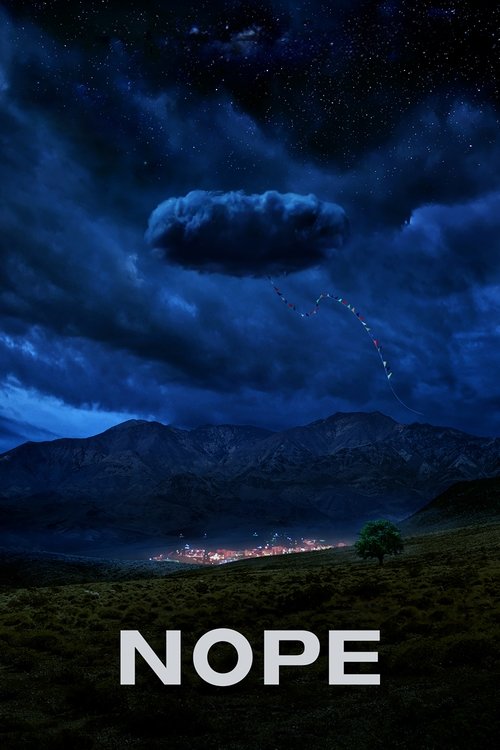
Nope is not an alien-invasion film. The thing in the sky is a god with territory that eats everyone who looks at it. Every death is a death by eye contact, and the only spectacle worth having is the one that cannot be sold.
Nope is a teaching about the predatory nature of the gaze, dressed as a summer creature feature. The thing OJ and Emerald hunt is not an alien spaceship. It is an animal, a territorial sky-god that has lived above Agua Dulce long enough to be mistaken for a cloud, and it strikes only the eyes that lock onto it. Every death in the film is a death by looking. Every survival is an act of refusing to look. Underneath the monster movie sits an old shamanic law about how you meet the numinous without being devoured, and underneath that sits a Gnostic indictment of an entire civilization that has forgotten the difference between witnessing and consuming. The Haywoods know the law because they have always lived with animals. The world that buys tickets does not.
The Surface
OJ and Emerald Haywood run a failing Hollywood horse ranch in the high desert of California, inherited from a father killed by a nickel that fell out of the sky. Strange things start happening above the property. The power cuts out. Horses vanish. A shape moves behind a single cloud that never drifts. They realize a predatory flying creature is hunting their land, and they decide to capture it on camera for what Emerald calls the Oprah shot, the impossible image that would make them rich and remembered.
Critics read Nope as Jordan Peele's essay on spectacle, exploitation, and Hollywood's hunger for the unfilmable image. They are right, as far as it goes. The film names its subject in a Bible verse on a black title card, Nahum 3:6, about a God who casts filth at those who make a spectacle. Reviewers caught the meta-commentary, the Gordy subplot about a chimp that snapped on a sitcom set, the way Peele weaponizes the audience's own desire to see.
What most reviews stop short of is the shape of the law itself. Nope is not only about spectacle as a theme. It is built as an initiation, and it punishes its characters by an exact rule that the surface reading never quite states out loud.
The Creature Is Not a Ship. It Is a God With Territory
The single most important reveal in the film is that there is no ship. The thing OJ realizes mid-film, watching it bank and flatten and ripple, is that the object is the alien. It is a living organism, an apex predator that occupies a patch of sky the way a shark occupies a reef. Peele has said it is animal, not machine, and the film stakes everything on that distinction.
This changes the category of the story. A spaceship is a visitor. An animal that owns territory is a local god. Every traditional culture that lived close to large predators understood that the land has a master, a being you do not provoke, whose domain you cross with averted eyes and offerings. The creature, which OJ eventually names Jean Jacket after a horse, behaves exactly like such a master. It does not invade. It does not communicate. It feeds, and it defends its airspace, and it has its own weather.
The horse ranch is the key. The Haywoods are the last people in this world who still work daily with an animal that can kill them. **OJ survives because he reads the sky the way he reads a spooked horse, and everyone who dies treats the sky like a screen.** When OJ tells the film crew, on his first job, that you never look a horse in the eyes without it knowing you, he is stating the entire survival rule of the movie forty minutes before anyone needs it.
The numinous, in shamanic understanding, is not safe and is not kind. It is power without morality, and the human task is relationship, not conquest. OJ never tries to tame Jean Jacket. He learns its boundaries, marks its territory, and finally bargains with it on its own terms. He treats a god like a god.
Every Death Is a Death by Eye Contact
Watch who Jean Jacket takes and you find the rule with no exceptions. It eats what looks up.
The crowd at Jupe's Star Lasso Experience is seated in a grandstand and instructed to look skyward for a show. They are swallowed whole, hundreds of upturned faces drawn into the mouth. The TMZ rider on the motorcycle crashes, and his last act is to lift his cracked helmet visor toward the thing to film it, and it takes him. Angel survives by tangling in barbed wire and ground cover, pinned low, eyes down. The Haywoods survive sequence after sequence by not meeting it, by hanging streamers and inflatable tube men to track its movement without facing it, by riding with their gaze fixed on the ground.
This is the oldest taboo around the sacred, encoded in a hundred mythologies. You do not look directly at the god. Lot's wife turns to look and becomes salt. Semele demands to see Zeus undisguised and burns. The Gorgon kills through the meeting of eyes, and Perseus survives only by looking at the reflection, the indirect image, the screen. Jean Jacket is a Gorgon in the clouds, and Nope is the Perseus problem restated for the age of the camera. How do you witness a power that destroys whatever witnesses it directly?
Emerald's answer in the final act is pure shamanic cunning. She does not film the creature with a lens that requires her to face it. She triggers a giant inflatable sky-dancer to provoke its territorial display, then captures the killing image in the analog plate of a well camera, a coin-operated tourist machine, looking down a chute, never with her eye on the thing itself. She gets the shot by refusing the gaze. The Gorgon dies in the mirror.
Gordy's Eye Is the Whole Film in One Cut
The film's most haunted sequence has nothing to do with the sky. Jupe, the former child star, survived a 1998 sitcom massacre when the chimpanzee playing Gordy snapped under the flash of celebrating cameras and mauled the cast on live tape. The film returns to this again and again, and it is the secret center of the whole structure.
Look at what saved young Jupe. He was hidden under a table, and through the tablecloth gap he and the bloodied chimp locked eyes, and Gordy, reaching out, was about to fist-bump him when a balloon popped and he was shot. Jupe builds his entire adult mythology on a misreading of that moment. He believes he and Gordy shared a sacred bond, that the animal spared him out of love, that he is the chosen survivor who can commune with the beast. He builds a shrine, monetizes the trauma, and finally tries to feed Jean Jacket the way he imagines he once communed with Gordy.
The truth Jupe cannot face is that Gordy never saw him as a person. The fist bump was an animal's gesture toward another animal under stress, and it meant nothing about love or chosenness. Jupe survived by accident and by the tablecloth, the screen, the thing between him and the eyes. He learned the wrong lesson. He decided the beast loved him, and that decision kills him and his entire audience decades later.
This is the initiatory failure the whole film is built around. **An initiation is the survival of an encounter with overwhelming power, and its only valid lesson is humility before what cannot be controlled.** Jupe survives the encounter and extracts the opposite lesson, that he is special, that the power is his to wield and sell. He becomes the false initiate, the man who walked into the cave and came out claiming the dragon as a pet. The shoe standing impossibly on its heel in his memory of the massacre is the detail his mind fixates on instead of the horror, the trivial spectacle that lets him avoid the actual teaching. He spends his life staring at the shoe and never at what it stood beside.
OJ is the true initiate of the same lesson. He watched his father die from the sky and asked what it meant rather than what it could earn. By the end he can ride into the creature's territory, read its hunger, lead it where he needs it, and look away at the exact instant survival demands. He passed the initiation Jupe failed.
The Spectacle That Cannot Be Sold Is the Only Spectacle Worth Having
Nope is structured as a Gnostic parable about a fallen world that mistakes consumption for vision. In Gnostic terms the cosmos is run by powers that feed on the souls trapped inside it, the archons, blind and hungry, who keep humanity asleep by keeping it watching. Jean Jacket is an archon in the literal sky, a devouring eye in the heavens that the world keeps trying to put on screen.
The film is dense with images of looking-as-feeding. The Gordy set, the talk-show couch, the theme park grandstand, the TMZ camera, the Saturday Night Live origin of the family's lost legacy. Everywhere people gather to consume an image, the image consumes them. Peele extends this even to the audience in the theater, who came, like Jupe's crowd, to look up and be thrilled, and who are implicated in the same hunger that the creature exploits.
The Bible verse on the opening card, Nahum 3:6, reads in full as a curse on a city that whored itself out as a spectacle, that God will pelt with filth and make a gazingstock. A gazingstock is a thing set up to be stared at. The creature, fittingly, kills by raining the indigestible remains of what it ate, blood and metal and keys, down on the ranch and the house. It pelts the world with filth. It makes spectacles of everyone who tried to make a spectacle of it.
Gnostic liberation comes through gnosis, a direct knowing that the system runs on your captured attention and that freedom is the withdrawal of consent to be fed upon. The Haywoods enact exactly this. **They stop trying to sell the image and start trying to survive it, and the moment their motive shifts from capture to relationship is the moment they become able to win.** OJ's final ride is not a hunt for footage. It is a horseman drawing a predator out of his family's sky. The single photograph Emerald gets at the end matters not as a payday but as proof, a witnessing that does not feed the thing it witnesses. The fallen world's question is how do we monetize the wonder. The Haywoods answer the older question, how do we live in right relationship with a power larger than us, and that answer is the only thing the archon cannot eat.
The Haywood Inheritance: Witnesses Since the First Frame
Emerald's pitch on the film set is the film's thesis in disguise. The first piece of motion-picture footage ever made, the galloping horse in Eadweard Muybridge's experiment, was ridden by a Black jockey whose name history erased. The Haywoods claim descent from that rider. They were present at the literal birth of the moving image, and they were uncredited, consumed by the medium, turned into a study of motion while the men who profited got the names.
This reframes everything. The Haywoods are not random victims of a sky monster. They are the people who have been on the wrong end of the spectacle since the spectacle began, the witnesses whose witnessing was stolen and sold. Their fight with Jean Jacket is the same fight their ancestor was already inside, the fight over who gets to look and who gets eaten, who is the subject and who is the consumed image.
When Emerald finally captures the creature in the well-camera plate, she does what her family was denied at the beginning. She gets the shot, on her own terms, with her name on it, of a thing the whole industry of looking could not capture. The unnamed jockey at the dawn of cinema is finally answered by a Haywood who frames the unframeable and walks away alive. The cycle that began with consumption ends with witnessing.
That is the difference the film draws its whole moral line along, the line between looking that feeds and looking that frees. Jupe consumed and was consumed. The crowd consumed and was consumed. The Haywoods learned to witness, and witnessing, done in right relationship, survives.
Questions this film answers
What is the deeper meaning of Nope?
Nope is a teaching about the predatory nature of the gaze, dressed as a summer creature feature. The thing OJ and Emerald hunt is not an alien spaceship. It is an animal, a territorial sky-god that has lived above Agua Dulce long enough to be mistaken for a cloud, and it strikes only the eyes that lock onto it. Every death in the film is a death by looking. Every survival is an act of refusing to look. Underneath the monster movie sits an old shamanic law about how you meet the numinous without being devoured, and underneath that sits a Gnostic indictment of an entire civilization that has forgotten the difference between witnessing and consuming. The Haywoods know the law because they have always lived with animals. The world that buys tickets does not.
What is the hidden symbolism in Nope?
OJ and Emerald Haywood run a failing Hollywood horse ranch in the high desert of California, inherited from a father killed by a nickel that fell out of the sky. Strange things start happening above the property. The power cuts out. Horses vanish. A shape moves behind a single cloud that never drifts. They realize a predatory flying creature is hunting their land, and they decide to capture it on camera for what Emerald calls the Oprah shot, the impossible image that would make them rich and remembered.
What esoteric traditions appear in Nope?
Nope draws from Shamanism, Gnosticism, Initiation traditions. Nope is not an alien-invasion film. The thing in the sky is a god with territory that eats everyone who looks at it. Every death is a death by eye contact, and the only spectacle worth having is the one that cannot be sold.
Is Nope worth watching for spiritual seekers?
Nope (2022) directed by Jordan Peele is essential viewing for those interested in Shamanism, Gnosticism, Spectacle. The God With Territory in the Sky. It rewards multiple viewings and contemplation.
Rewatch With New Eyes
Now that you've seen the architecture, experience it again. The same film becomes a different film when you know what to watch for.
This time, watch for:
- Follow the descent: what dies, what guides, what returns transformed
- Watch for the false world vs. the real — who is asleep, who awakens
- Mark the threshold: the old self dies, the ordeal transforms, the new self returns
Links may include affiliate partnerships that support Media Revelations