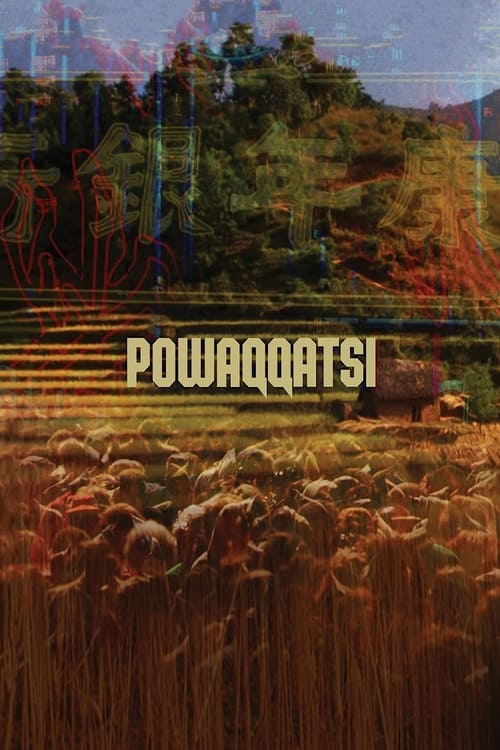
Powaqqatsi
Powaqqatsi Films a Sorcerer Feeding on the Life Force of the Whole Global South
Directed by Godfrey Reggio
The title is a Hopi word for an entity that consumes the life of others to fuel its own. Reggio spends ninety minutes showing you it is not a metaphor.
Powaqqatsi opens on the Serra Pelada gold mines of Brazil, where thousands of men climb ladders out of a vast pit carrying sacks of earth on their backs, an anthill of human labor, one man covered in mud and blood carried up limp by the others while the line never stops. From there Godfrey Reggio moves across the developing world: potters, fishermen, weavers, women carrying water and grain on their heads with unhurried grace, whole cultures moving to the rhythm of the body and the season. Then the machines arrive, the traffic and the smog and the television screens, and Philip Glass's score curdles from human voices into industrial pulse. The surface reading is a lyrical documentary about modernization in the Southern Hemisphere. The Hopi title states the real thesis without ambiguity. Powaqqatsi means a way of life that consumes the life forces of other beings in order to further its own. Reggio is filming a possession.
Shamanic Reading: The Powaqa and the Theft of Vital Force
In Hopi cosmology the powaqa is a sorcerer, an entity that survives by draining the vitality of others. Across shamanic traditions worldwide the same figure recurs: the being that cannot generate its own life and so must siphon it, leaving its hosts hollowed. Reggio is not using this as poetry. He structures the entire film as the anatomy of such a feeding.
The first half brims with intact vital force. Watch the faces in the markets, the coordination of hands at the loom, the woman balancing an impossible load and still moving like a dancer. These cultures are shown as full, self-generating, alive from their own root. The second half shows the drain. The same human energy is redirected into the machinery of industrial modernity, the bodies now serving the pit, the assembly line, the highway. The powaqa is Western technological civilization itself, and its meal is the accumulated life force of every traditional culture it touches. The film is a shaman's diagnosis of a planetary parasitism, delivered in images because the disease is too large for argument.
Gnostic Reading: The Archons and the World-Machine
Gnostic cosmology describes the archons, the ruling powers of the material order, who administer a vast mechanism designed to keep the divine spark harnessed and asleep. The archontic system does not hate its subjects. It processes them. It converts living souls into fuel for a machine whose only purpose is its own perpetuation.
Reggio's second movement is a portrait of the archontic world coming online. The traffic, the glass towers, the flickering advertisements, the endless mechanical repetition, all of it filmed with a cold sublimity that makes the machine both beautiful and monstrous. Against this he keeps cutting back to the human face, held in slow motion, luminous, the trapped spark still shining through. The film's grief is the Gnostic grief exactly: a living light being fed into a grinding apparatus that mistakes consumption for progress. The archons are not devils with horns. They are the highway and the factory and the screen, and Reggio filmed them in the act of eating the world.
Other wordless films that read civilization as a cosmic condition: Koyaanisqatsi (the first movement: life out of balance), Baraka (the sacred and the mechanized side by side), Samsara (the wheel of production and consumption filmed whole).
Questions this film answers
What is the deeper meaning of Powaqqatsi?
Powaqqatsi opens on the Serra Pelada gold mines of Brazil, where thousands of men climb ladders out of a vast pit carrying sacks of earth on their backs, an anthill of human labor, one man covered in mud and blood carried up limp by the others while the line never stops. From there Godfrey Reggio moves across the developing world: potters, fishermen, weavers, women carrying water and grain on their heads with unhurried grace, whole cultures moving to the rhythm of the body and the season. Then the machines arrive, the traffic and the smog and the television screens, and Philip Glass's score curdles from human voices into industrial pulse. The surface reading is a lyrical documentary about modernization in the Southern Hemisphere. The Hopi title states the real thesis without ambiguity. Powaqqatsi means a way of life that consumes the life forces of other beings in order to further its own. Reggio is filming a possession.
What is the hidden symbolism in Powaqqatsi?
In Hopi cosmology the powaqa is a sorcerer, an entity that survives by draining the vitality of others. Across shamanic traditions worldwide the same figure recurs: the being that cannot generate its own life and so must siphon it, leaving its hosts hollowed. Reggio is not using this as poetry. He structures the entire film as the anatomy of such a feeding.
What esoteric traditions appear in Powaqqatsi?
Powaqqatsi draws from Shamanism, Gnosticism traditions. The title is a Hopi word for an entity that consumes the life of others to fuel its own. Reggio spends ninety minutes showing you it is not a metaphor.
Is Powaqqatsi worth watching for spiritual seekers?
Powaqqatsi (1988) directed by Godfrey Reggio is essential viewing for those interested in Shamanism, Gnosticism. Powaqqatsi Films a Sorcerer Feeding on the Life Force of the Whole Global South. It rewards multiple viewings and contemplation.
Rewatch With New Eyes
Now that you've seen the architecture, experience it again. The same film becomes a different film when you know what to watch for.
This time, watch for:
- Follow the descent: what dies, what guides, what returns transformed
- Watch for the false world vs. the real — who is asleep, who awakens
Links may include affiliate partnerships that support Media Revelations