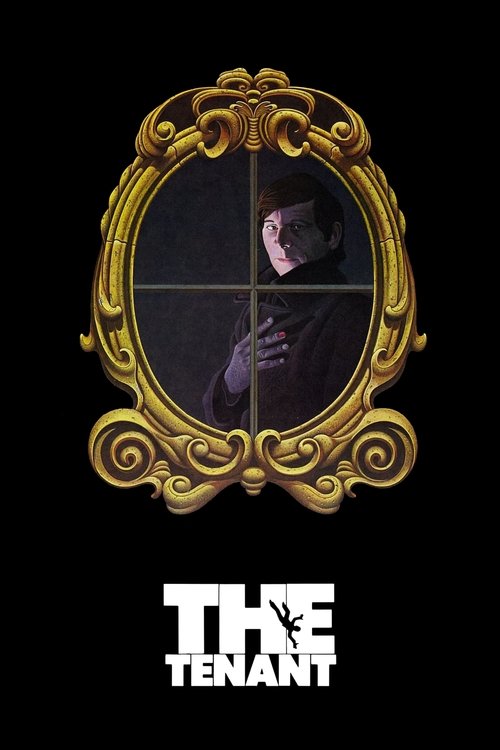
The Tenant
The Tenant Is About How a Building Can Tell You Who to Become
Directed by Roman Polanski
Trelkovsky moves into a dead woman's apartment. Polanski's real question is whether the apartment moves into him.
Trelkovsky is meek, apologetic, foreign in a city that treats him as a category rather than a man. He rents a flat whose previous tenant, Simone Choule, threw herself from the window and has not yet died. The neighbors expect him to be her. They serve him her brand of cigarettes, her coffee, complain when he does not keep her hours. He resists, then adjusts, then begins to find her dress, her lipstick, her tooth left behind in a hole in the wall. By the end he is wearing her clothes and preparing to leap from the same window, twice, because the first fall does not finish the job. The horror is not that ghosts are real. The horror is that a self is porous, that identity is a role others cast you in, and that a man with no firm center will accept the part written for him even when the part ends in the courtyard.
Jungian Reading: Ego Overwhelmed by the Collective
Jung warned that a weak ego can be flooded, that the boundary between the individual and the surrounding psyche is thinner than we pretend. Trelkovsky has almost no ego to defend. He cannot even claim his own name without stammering an apology. So the collective, embodied by the concierge and the landlord and the paranoid tenants, pours in and fills the vacancy. They do not need to force him. They only need to keep insisting, and his hollow center accepts the imprint.
The film externalizes this beautifully. He looks across the courtyard at the communal toilet and sees figures standing motionless for hours, watching. Later he sees himself standing there, watching his own window. The observer and the observed have merged. This is what possession by the collective looks like from inside: you become the eyes that judge you. Simone was not haunting the apartment. The apartment was a machine for producing Simones, and Trelkovsky, lacking any self to resist it, was simply the next output.
Gnostic Reading: The Archons Wear Neighbors' Faces
In Gnostic cosmology the archons are the rulers of the lower world, the authorities who administer the prison of matter and keep souls asleep and obedient. They do not appear as monsters. They appear as officials, landlords, keepers of rules. The tenants of Trelkovsky's building are archons in slippers. Their weapon is petty regulation: a complaint about noise, a petition to remove a difficult neighbor, the relentless enforcement of who belongs and who must be expelled.
Trelkovsky's descent is a soul realizing, too late, that the world it inhabits is a rigged system designed to erase it. His paranoia, which the film keeps almost plausible, is the beginning of gnosis: the suspicion that the whole apparatus is arranged against him, that the friendly faces are functionaries of his undoing. The tragedy is that gnosis without strength does not liberate. It only reveals the walls of the cell more clearly. He sees the conspiracy and cannot escape it, so he completes it, performing the suicide the system required as the price of the room. The archons win by making the prisoner carry out his own sentence.
Questions this film answers
What is the deeper meaning of The Tenant?
Trelkovsky is meek, apologetic, foreign in a city that treats him as a category rather than a man. He rents a flat whose previous tenant, Simone Choule, threw herself from the window and has not yet died. The neighbors expect him to be her. They serve him her brand of cigarettes, her coffee, complain when he does not keep her hours. He resists, then adjusts, then begins to find her dress, her lipstick, her tooth left behind in a hole in the wall. By the end he is wearing her clothes and preparing to leap from the same window, twice, because the first fall does not finish the job. The horror is not that ghosts are real. The horror is that a self is porous, that identity is a role others cast you in, and that a man with no firm center will accept the part written for him even when the part ends in the courtyard.
What is the hidden symbolism in The Tenant?
Jung warned that a weak ego can be flooded, that the boundary between the individual and the surrounding psyche is thinner than we pretend. Trelkovsky has almost no ego to defend. He cannot even claim his own name without stammering an apology. So the collective, embodied by the concierge and the landlord and the paranoid tenants, pours in and fills the vacancy. They do not need to force him. They only need to keep insisting, and his hollow center accepts the imprint.
What esoteric traditions appear in The Tenant?
The Tenant draws from Jungian, Gnosticism traditions. Trelkovsky moves into a dead woman's apartment. Polanski's real question is whether the apartment moves into him.
Is The Tenant worth watching for spiritual seekers?
The Tenant (1976) directed by Roman Polanski is essential viewing for those interested in Jungian, Gnosticism. The Tenant Is About How a Building Can Tell You Who to Become. It rewards multiple viewings and contemplation.
Rewatch With New Eyes
Now that you've seen the architecture, experience it again. The same film becomes a different film when you know what to watch for.
This time, watch for:
- Meet the shadow: what is rejected, projected, and finally integrated
- Watch for the false world vs. the real — who is asleep, who awakens
Links may include affiliate partnerships that support Media Revelations
The Descent Continues
Where this thread leads next.
Repulsion 1965
Repulsion Is What a Room Becomes When the Self Inside It Stops Holding Its Walls
Read the revelation →