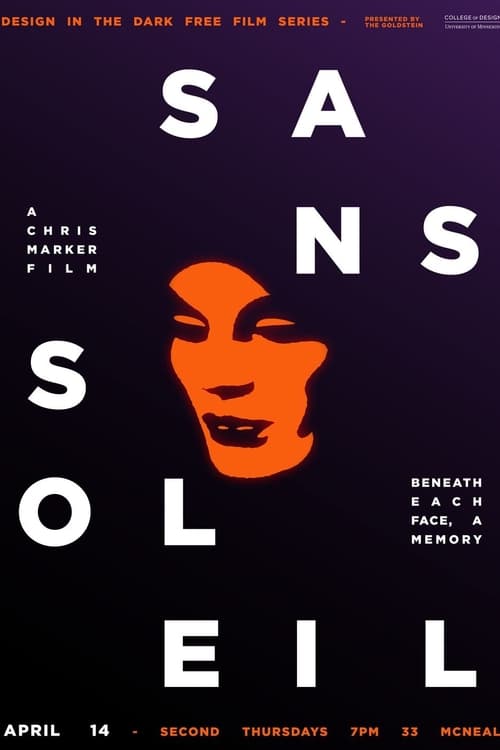
Sans Soleil
Sans Soleil Is a Film About the One Thing Memory Can Never Actually Hold
Directed by Chris Marker
Chris Marker sends images back from Japan, Africa, Iceland, San Francisco. A woman reads letters that never quite settle on what they saw.
A woman's voice reads letters from a cameraman named Sandor Krasna, who does not exist. He sends footage from Tokyo, from Guinea-Bissau, from the volcanic ash of an Icelandic town later buried alive, from the exact San Francisco streets Hitchcock filmed in Vertigo. Marker built Sans Soleil out of found and shot fragments and then narrated them with a fictional correspondent, so that every image arrives already at two removes: seen by an invented man, described by a woman who only received his description. The film is usually called an essay on memory and travel. It is more exact than that. It is a sustained demonstration that memory does not store the past, it manufactures a substitute and quietly swaps it in. Marker's narrator says she will have spent her life trying to understand the function of remembering, which is not the opposite of forgetting but its lining. The film keeps trying to hold a moment and keeps watching the moment become an image of itself, which is a different thing that has replaced it.
Buddhist Reading: Impermanence Filmed Frame by Frame
The Buddhist teaching of anicca holds that every phenomenon is arising and passing without pause, that there is no stable thing to grasp anywhere, and that suffering comes from clutching at what is already leaving. Sans Soleil films this doctrine as method. Marker is drawn again and again to Japanese ceremonies for impermanent things: a Buddhist service held for broken dolls, in which the dolls are given a proper funeral before being burned, because even a manufactured object passing out of existence deserves acknowledgment of its passing.
He lingers on Tokyo commuters asleep on trains, dreaming, and cuts their sleeping faces against footage of the fantastical, as if waking life and dream are the same flickering current of images with no solid ground beneath either. The Icelandic town appears early, filmed alive and ordinary, and returns at the end buried under volcanic ash, the same street now erased, proving anicca on a geological scale within a single film. Marker does not mourn this. He observes it the way the dharma asks you to observe the breath: as the plain fact of everything, which becomes bearable only when you stop demanding that anything stay.
Gnostic Reading: The Zone Where Images Confess They Are Images
There is a Gnostic instinct in Marker's refusal to let any image pass as simple truth. A character called Hayao Yamaneko feeds the footage into a video synthesizer that abstracts it into shimmering electronic color, and the narrator calls this altered realm the Zone, after Tarkovsky's Stalker. In the Zone, an image can no longer lie about being reality, because it has been visibly transfigured into pure signal. This is the Gnostic move exactly: only when the false surface is disrupted does its true nature as fabrication become visible.
The Vertigo pilgrimage sharpens it. The narrator retraces every San Francisco location where Scottie remade a living woman into the image of a dead one, and recognizes in Hitchcock's plot the fundamental sickness of the whole apparatus: the attempt to resurrect the past through images, which produces not the beloved but a counterfeit that destroys her. Marker sees that we are all Scottie, forever loving the picture and mistaking it for the person. Sans Soleil is the rare film honest enough to indict its own medium as the mechanism of the illusion it is made of.
Questions this film answers
What is the deeper meaning of Sans Soleil?
A woman's voice reads letters from a cameraman named Sandor Krasna, who does not exist. He sends footage from Tokyo, from Guinea-Bissau, from the volcanic ash of an Icelandic town later buried alive, from the exact San Francisco streets Hitchcock filmed in Vertigo. Marker built Sans Soleil out of found and shot fragments and then narrated them with a fictional correspondent, so that every image arrives already at two removes: seen by an invented man, described by a woman who only received his description. The film is usually called an essay on memory and travel. It is more exact than that. It is a sustained demonstration that memory does not store the past, it manufactures a substitute and quietly swaps it in. Marker's narrator says she will have spent her life trying to understand the function of remembering, which is not the opposite of forgetting but its lining. The film keeps trying to hold a moment and keeps watching the moment become an image of itself, which is a different thing that has replaced it.
What is the hidden symbolism in Sans Soleil?
The Buddhist teaching of anicca holds that every phenomenon is arising and passing without pause, that there is no stable thing to grasp anywhere, and that suffering comes from clutching at what is already leaving. Sans Soleil films this doctrine as method. Marker is drawn again and again to Japanese ceremonies for impermanent things: a Buddhist service held for broken dolls, in which the dolls are given a proper funeral before being burned, because even a manufactured object passing out of existence deserves acknowledgment of its passing.
What esoteric traditions appear in Sans Soleil?
Sans Soleil draws from Buddhism, Gnosticism traditions. Chris Marker sends images back from Japan, Africa, Iceland, San Francisco. A woman reads letters that never quite settle on what they saw.
Is Sans Soleil worth watching for spiritual seekers?
Sans Soleil (1983) directed by Chris Marker is essential viewing for those interested in Buddhism, Gnosticism. Sans Soleil Is a Film About the One Thing Memory Can Never Actually Hold. It rewards multiple viewings and contemplation.
Rewatch With New Eyes
Now that you've seen the architecture, experience it again. The same film becomes a different film when you know what to watch for.
This time, watch for:
- See impermanence: what clings, what releases, what remains
- Watch for the false world vs. the real — who is asleep, who awakens
Links may include affiliate partnerships that support Media Revelations
The Descent Continues
Where this thread leads next.

La Jetée 1962
La Jetée Is a Buddhist Teaching on Attachment (The Prisoner Chooses His Chain)
Read the revelation →