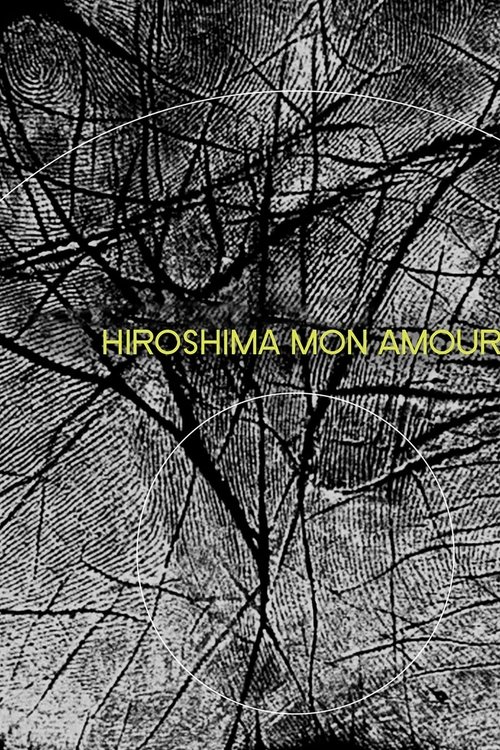
Hiroshima Mon Amour
Hiroshima Mon Amour Says Memory and Forgetting Are the Same Act
Directed by Alain Resnais
A French actress and a Japanese architect spend a night together in a city built on ash. She keeps insisting she saw everything. He keeps telling her she saw nothing.
The film opens on two bodies intertwined, dusted with what could be ash, sweat, or radioactive fallout, indistinguishable. Over this image she says, "I saw everything in Hiroshima," and he corrects her, flatly, four times: "You saw nothing in Hiroshima." This is the argument the entire film conducts. She has come to make a film about peace. She believes her grief, her museum visits, her documentary footage of scarred survivors constitute knowledge of the catastrophe. He knows they do not. But the film does not side with him against her. It reveals something stranger: that her private catastrophe, a dead German lover in wartime Nevers, and the annihilation of a city are held together in the same nervous system, and that the mechanism which lets her love again is the same mechanism erasing the man she is loving now. Resnais made a film in which remembering a person and losing them are not sequential. They happen in the same gesture.
Buddhist Reading: Impermanence Is Not a Consolation, It Is the Wound
The Buddhist teaching on impermanence is usually delivered as comfort: nothing lasts, so release your grip. Hiroshima Mon Amour delivers the same truth as a form of horror. The actress remembers her German soldier, shot dead at the Liberation, his body cooling under her for an entire day while she went mad in a cellar. Now, years later, she can barely reach the memory. "I begin to see you less clearly," she tells the Japanese man in the same breath she uses to recall the dead one. The two men are dissolving into each other because both are dissolving, period.
The film's cruelest insight is that healing and forgetting cannot be separated. She wept for the German until she could bear it, and bearing it meant losing him. This is the meaning of the museum sequence, the endless reconstructed hair and melted stone displayed so that Hiroshima will be "remembered forever." The film knows this is impossible. Everything the museum preserves is proof that the thing itself is gone. The city rebuilt itself in fourteen years, neon and bicycles over the crater. Impermanence does not console the grieving here. It is what steals the beloved a second time, from the inside.
Jungian Reading: Nevers as the Shadow City Beneath Hiroshima
Jung held that the personal unconscious and the collective catastrophe speak the same symbolic language, and that we approach the unbearable large wound only through the private one we can hold. The actress cannot feel Hiroshima. It is too vast. But she can feel Nevers, her hometown, where she was shaved and shamed and locked away for loving the enemy. Resnais cuts between the two cities until they rhyme: a hand, a river, a body on a floor.
Nevers is her shadow, the disowned self she has never told anyone, buried so deep that speaking it to a stranger in a foreign city feels like the first confession of her life. Only by descending into her own small hell does the enormous one become real to her. In the last scene she names them: "Hiroshima. That is your name." "Nevers. In France." They have become each other's cities, each the buried underside of the other, and neither can be entered without the other opening too.
Questions this film answers
What is the deeper meaning of Hiroshima Mon Amour?
The film opens on two bodies intertwined, dusted with what could be ash, sweat, or radioactive fallout, indistinguishable. Over this image she says, "I saw everything in Hiroshima," and he corrects her, flatly, four times: "You saw nothing in Hiroshima." This is the argument the entire film conducts. She has come to make a film about peace. She believes her grief, her museum visits, her documentary footage of scarred survivors constitute knowledge of the catastrophe. He knows they do not. But the film does not side with him against her. It reveals something stranger: that her private catastrophe, a dead German lover in wartime Nevers, and the annihilation of a city are held together in the same nervous system, and that the mechanism which lets her love again is the same mechanism erasing the man she is loving now. Resnais made a film in which remembering a person and losing them are not sequential. They happen in the same gesture.
What is the hidden symbolism in Hiroshima Mon Amour?
The Buddhist teaching on impermanence is usually delivered as comfort: nothing lasts, so release your grip. Hiroshima Mon Amour delivers the same truth as a form of horror. The actress remembers her German soldier, shot dead at the Liberation, his body cooling under her for an entire day while she went mad in a cellar. Now, years later, she can barely reach the memory. "I begin to see you less clearly," she tells the Japanese man in the same breath she uses to recall the dead one. The two men are dissolving into each other because both are dissolving, period.
What esoteric traditions appear in Hiroshima Mon Amour?
Hiroshima Mon Amour draws from Buddhism, Jungian traditions. A French actress and a Japanese architect spend a night together in a city built on ash. She keeps insisting she saw everything. He keeps telling her she saw nothing.
Is Hiroshima Mon Amour worth watching for spiritual seekers?
Hiroshima Mon Amour (1959) directed by Alain Resnais is essential viewing for those interested in Buddhism, Jungian. Hiroshima Mon Amour Says Memory and Forgetting Are the Same Act. It rewards multiple viewings and contemplation.
Rewatch With New Eyes
Now that you've seen the architecture, experience it again. The same film becomes a different film when you know what to watch for.
This time, watch for:
- See impermanence: what clings, what releases, what remains
- Meet the shadow: what is rejected, projected, and finally integrated
Links may include affiliate partnerships that support Media Revelations
The Descent Continues
Where this thread leads next.

Last Year at Marienbad 1961
Last Year at Marienbad Is a Man Constructing a Past Until the Woman Agrees to Have Lived It
Read the revelation →