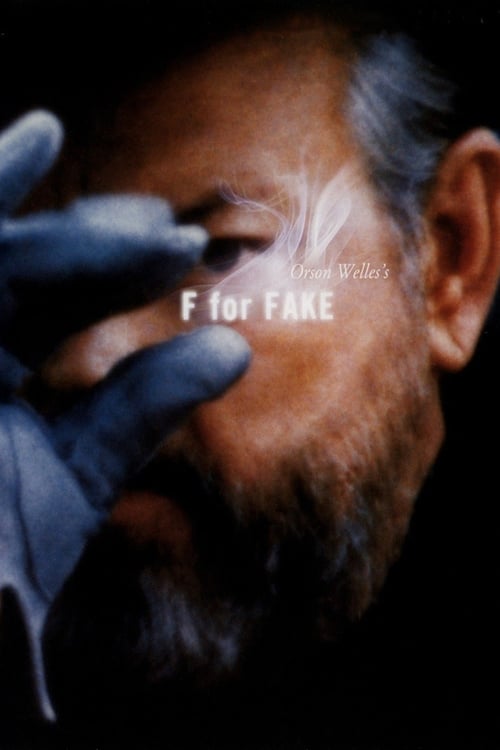
F for Fake
F for Fake Is Orson Welles Confessing That the Magician Is Real and the Art Is the Lie
Directed by Orson Welles
Welles promises for one hour to tell only the truth. He makes a film about forgers, then reveals he forged the last twenty minutes. The confession is the trick, and the trick is the truth.
The film braids together three con men: Elmyr de Hory, who painted fake Modiglianis and Matisses so convincing they hang in museums; Clifford Irving, who wrote Elmyr's biography and then forged an entire "autobiography" of Howard Hughes; and Orson Welles himself, magician, showman, the man who once panicked a nation with a fake Martian invasion and launched his career with an assumed reputation he had not yet earned. Welles opens by performing a coin trick for a boy at a train station and swearing that for the next hour everything you hear will be true. He then tells a long, tender story about his companion Oja Kodar and Picasso, and at the end reveals he lied: the hour was up seventeen minutes ago, and the whole Picasso story was invented. The film about fakers ends by faking you. Welles built a hall of mirrors and stood in the center admitting he built it.
Gnostic Reading: The Forger Knows the World Is Made, Because He Makes It
Gnosticism turns on a single scandalous idea: the world was fashioned by a craftsman, a demiurge, and what most people worship as reality is in fact a skilled fabrication. Elmyr de Hory is the demiurge made comic and human. He sits in his villa on Ibiza tossing off a "Modigliani" in an afternoon, and the experts, the entire apparatus that decides what is real and valuable, cannot tell his creation from the god's. His existence is a proof of the Gnostic claim: the authorities who guarantee reality are guessing, and a good enough maker can counterfeit the cosmos.
Welles pushes the revelation onto himself. He reminds us that Chartres cathedral was built by anonymous hands who signed nothing, that all the naming and pricing and authenticating is a later, lesser magic laid over the real work of making. The signature is the forgery. The thing itself was always just somebody's hands moving. The film strips authority from the experts and hands it back to the maker, which is exactly the Gnostic reversal: the true creator is not the official one, and the official world is the fake.
Alchemy Reading: Turning Nothing Into Gold in Full View of the Audience
Alchemy is the art of transmutation, base material raised to gold, and its deepest teaching is that the transformation happens in the vessel of a single operator's will. Elmyr performs literal alchemy: a few dollars of canvas and paint become a masterpiece worth a fortune, base matter into gold, the philosopher's stone as forgery. But the film argues the real alchemist is Welles, and the base material is your attention.
Watch the editing. Welles chops interviews into a frantic rhythm, cross-cuts Elmyr and Irving and himself until they seem to answer each other's questions across years and countries, conjures a Picasso and a granddaughter and a stack of paintings that never existed. Nothing here is stable except the operator standing at the console, and he is transmuting scraps of film into an experience that feels like truth. The final trick, the confessed lie, is the alchemist showing you the empty crucible and asking whether the gold you felt was any less real for having been made from nothing. The vessel was the cut. The gold was your belief.
Questions this film answers
What is the deeper meaning of F for Fake?
The film braids together three con men: Elmyr de Hory, who painted fake Modiglianis and Matisses so convincing they hang in museums; Clifford Irving, who wrote Elmyr's biography and then forged an entire "autobiography" of Howard Hughes; and Orson Welles himself, magician, showman, the man who once panicked a nation with a fake Martian invasion and launched his career with an assumed reputation he had not yet earned. Welles opens by performing a coin trick for a boy at a train station and swearing that for the next hour everything you hear will be true. He then tells a long, tender story about his companion Oja Kodar and Picasso, and at the end reveals he lied: the hour was up seventeen minutes ago, and the whole Picasso story was invented. The film about fakers ends by faking you. Welles built a hall of mirrors and stood in the center admitting he built it.
What is the hidden symbolism in F for Fake?
Gnosticism turns on a single scandalous idea: the world was fashioned by a craftsman, a demiurge, and what most people worship as reality is in fact a skilled fabrication. Elmyr de Hory is the demiurge made comic and human. He sits in his villa on Ibiza tossing off a "Modigliani" in an afternoon, and the experts, the entire apparatus that decides what is real and valuable, cannot tell his creation from the god's. His existence is a proof of the Gnostic claim: the authorities who guarantee reality are guessing, and a good enough maker can counterfeit the cosmos.
What esoteric traditions appear in F for Fake?
F for Fake draws from Gnosticism, Alchemy traditions. Welles promises for one hour to tell only the truth. He makes a film about forgers, then reveals he forged the last twenty minutes. The confession is the trick, and the trick is the truth.
Is F for Fake worth watching for spiritual seekers?
F for Fake (1973) directed by Orson Welles is essential viewing for those interested in Gnosticism, Alchemy. F for Fake Is Orson Welles Confessing That the Magician Is Real and the Art Is the Lie. It rewards multiple viewings and contemplation.
Rewatch With New Eyes
Now that you've seen the architecture, experience it again. The same film becomes a different film when you know what to watch for.
This time, watch for:
- Watch for the false world vs. the real — who is asleep, who awakens
- Track the stages: blackening, whitening, reddening — death before rebirth
Links may include affiliate partnerships that support Media Revelations
The Descent Continues
Where this thread leads next.
Blow-Up 1966
Blow-Up Is About a Man Who Looks So Hard the Image Dissolves
Read the revelation →