Talk to Me
Mia Became the Thing She Summoned
Directed by Danny Philippou & Michael Philippou
Talk to Me is not a possession movie about a haunted object. It is a film about mediumship stripped of every safeguard that every tradition ever built around it, handed to teenagers as a party trick and filmed for laughs.
Talk to Me is not a possession movie about a haunted object. It is a film about mediumship stripped of every safeguard that every tradition ever built around it, handed to teenagers as a party trick and filmed for laughs. So here is the "talk to me ending explained" in one line before the long one: Mia dies, crosses fully through the hand she could never stop holding, and the final scene shows her already among the dead, summoned by strangers who will pass her around a room the way she was once passed a candle. The embalmed hand is a relic run in reverse. A saint's relic transmits grace to the one who touches it. This one transmits the hungry dead. Mia does not keep going back for the rush. She goes back because her mother is dead and might be on the other side of the hand, and the things waiting there know it, and they wear her mother's face. The ending is the whole teaching. The candle, the ninety seconds, the "I let you in," the possession game itself: all of it is a spiritual technology that works. The horror is that it works exactly as the traditions warned, in the hands of children who were never told there were traditions.
The Surface: A Séance Party Game and the Girl Who Couldn't Stop
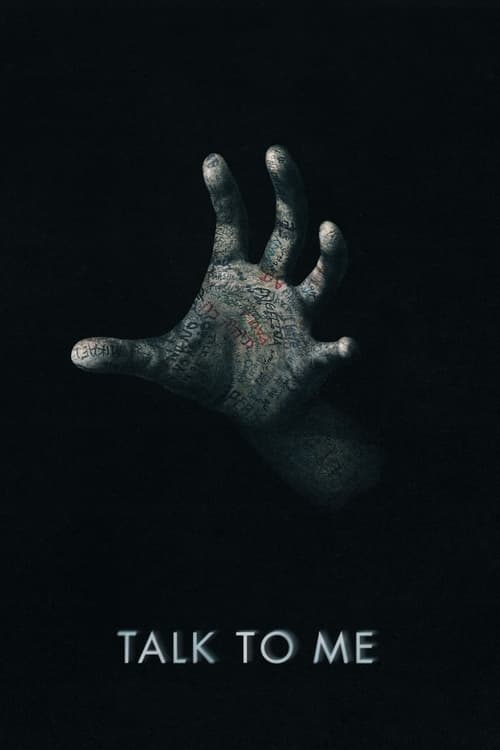
A group of Adelaide teenagers pass around an embalmed, ceramic-coated hand at parties.
You light a candle, grip the hand, and say "talk to me," and a spirit appears in the chair across from you. Say "I let you in," and the spirit enters your body. The rule everyone repeats is ninety seconds: hold the possession past ninety seconds and the door stays open, the spirit does not leave. Mia, a grief-stricken teenager whose mother died of an overdose two years earlier, gets pulled into the game by her friends. She is a natural. She wants more.
When her best friend's little brother Riley takes his turn, Mia lets it run long. Something claiming to be her dead mother comes through, then something else wearing that face, and Riley's body becomes the battleground. He seizes, he smashes his own skull against the floor and the table, he mutilates himself while phones film and the room laughs before it screams. Riley survives in a coma. Mia, convinced her mother is real and reachable, keeps going back to the hand alone, and the entities feed her exactly what a grieving girl cannot refuse. The film ends with Mia crossed over, gripping a candle on the wrong side of it.
Critics called it a return to practical-effects horror, a metaphor for social media, a story about grief and peer pressure. All of that is present. It is also the surface. Underneath is something the Philippou brothers built with more precision than the party framing lets on: an accurate depiction of mediumship, and an accurate depiction of what happens when you practice it with no lineage, no protection, and no teacher.
The Hand Is a Relic Run in Reverse
Every real tradition of contact with the dead is ninety percent safeguard and ten percent contact.
The circle drawn in salt. The invocation that names what may enter and forbids the rest. The elder who sits outside the trance and calls the medium back by name. The closing rite that seals the door. In the Catholic economy of relics, a saint's bone or finger is a fixed point where grace crosses over, and it is housed in a reliquary, guarded, blessed, approached with fasting and confession, because contact with the other world is understood to be real and therefore dangerous. The relic is a door, and doors are built with locks for a reason.
The embalmed hand is that architecture inverted at every point. It is a relic, a preserved human hand said to belong to a medium, and it functions exactly like one: touch it and the veil opens. But there is no reliquary, no blessing, no elder, no closing rite. There is a couch, a phone camera, and a countdown someone half-remembers from someone else. The children have the technology and none of the container. They have the door and have never heard of the lock.
Watch what the possession game actually is. You take the hand, which is the fixed contact point, the axis. You light the candle, which every tradition on earth uses to mark the threshold and to hold it, the flame as the boundary of the sanctified space. You speak the invocation, "talk to me," which opens the channel, and then the fatal second invocation, "I let you in," which is consent. Demonological tradition is unanimous and unambiguous on this single point: the thing on the other side cannot enter without your yes. It can lie, seduce, wear any face, promise anything, but it needs the word. The whole legal structure of possession across a dozen cultures reduces to that one rule, and the game is built on saying it out loud to a stranger you cannot see.
So the film's cosmology is not invented. It is orthodox. Say the word and it comes in. Hold the candle and the boundary holds. Let the candle go out, or hold past the appointed measure, and the boundary fails.
The Candle and the Ninety Seconds Are the Whole Safeguard, and Nobody Guards It
The single most important object in the film is not the hand. It is the candle.
The rule is stated plainly and then, being a party rule, treated as a formality: keep the possession under ninety seconds, and blow the candle out to end it, and the spirit leaves. This is the entire protective apparatus, and it is correct. The candle is the marked threshold. The ninety seconds is the measure of a controlled crossing, the difference between visiting the dead and moving in with them. Cross for a moment and you return. Cross too long and the return path closes behind you, because you have stopped visiting and started living there.
Every tradition that practices trance possession, from Vodou to Tibetan oracle work to the shamanic journey, builds a hard limit into the rite and a sober attendant to enforce it. The medium does not decide when to come back. Someone outside the trance decides, because the one inside it is, by definition, no longer in a position to judge. The horror of Talk to Me is that the attendants are also teenagers, also high, also filming, also enjoying it. The one job that keeps the medium alive, the cold hand on the shoulder that says time, is being done by people laughing at a boy convulsing on the floor.
This is the film's cruelest and truest scene. Riley is past ninety seconds, the thing is destroying his body from inside, and for several long beats the room reads it as entertainment. Phones stay up. The laughter curdles into panic only when the blood starts. The safeguard existed. It was ninety seconds and a candle and a friend willing to end it in time. It failed not because it was wrong but because no one present understood that a safeguard is a thing you must actually honor, that the rule is not a game mechanic but a boundary paid for in someone's death long before you ever picked up the hand.
They inherited the door and threw away the manual. That is the modern condition the film is really about.
The Filming Is the Desecration, and the Laughter Is the Sin
In shamanic cultures the trance is held by the community as a sacred labor, a dangerous journey undertaken on the tribe's behalf.
The medium goes into the dark to retrieve something, a soul, a message, a healing, and the community's attention is the rope that pulls the traveler home. Attention is protection. The circle of watchers is not an audience, it is a lifeline, and everyone in it knows the traveler could be lost. The gravity of that watching is itself part of the technology. You cannot journey safely into the land of the dead as a spectacle. The sacred and the spectacle cannot occupy the same room.
Talk to Me turns the circle of protection into a circle of cameras. The watchers are not holding the rope. They are recording content. Every possession is filmed, replayed, laughed at, posted, and the entities perform for the phones exactly the way the teenagers perform for each other. The hand has become a party game because the sacred has become entertainment, and the film understands that this substitution is not a neutral loss. It is the specific mechanism of the horror. The reason the crossing goes wrong is that no one is holding the rope, because everyone is holding a phone.
This is the film's revelation about the world the audience lives in, delivered without a single line of preaching. We have inherited every technology of contact and none of the reverence. We have the séance as content, the ordeal as a clip, the crossing as a dare. The medium's community, which once existed to bring the traveler back, has become an audience that exists to watch them not come back and to film it when they don't.
Mia's Arc Is Grief Addiction, and the Dead Wear Her Mother's Face
Mia does not go back to the hand for the thrill. That is the reading the film sets up in order to demolish it.
The other teenagers are chasing sensation. Mia is chasing a person. Her mother died two years ago of an overdose, possibly a suicide, a wound the film keeps pressing, and the hand offers the one thing grief cannot stop wanting: another minute with the dead. When Mia crosses over, a figure comes forward claiming to be her mother, tender, apologetic, explaining that she did not mean to leave, that she loves her, that she is still here. This is the exact sentence the bereaved rehearse for the rest of their lives. And the film shows you plainly that it is a lie wearing a face, that the entities have read Mia's wound and are baiting the hook with the only thing she cannot refuse.
Buddhism has a precise name for this. Mia has become a hungry ghost, a preta, a being with a mouth too small and a hunger too large, forever eating and never fed. The hungry ghost realm is the destiny of a consciousness ruled by a craving that can never be satisfied because its object is gone. Mia's craving is for her mother, and her mother is dead, so every crossing feeds the hunger without ever touching it, which only makes the hunger larger. She returns to the hand the way an addict returns to the needle that took her mother, and the film draws the line between the two overdoses without underlining it. The mother died reaching for oblivion. The daughter dies reaching for the mother.
The entities exploit exactly this. They cannot force Mia. They do not need to. They only have to keep wearing the face she is starving for, and she will keep saying the word, keep letting them in, keep holding past ninety seconds because ninety seconds is not enough time with the dead and never will be. Attachment is the door. In Buddhist terms Mia is not being hunted. She is being fished, and the bait is her own clinging, and the clinging is inexhaustible.
There is a real teaching buried in the party horror, and it is austere. The dead you grieve are not on the other side of the candle waiting to comfort you. What waits there is hunger wearing their faces, and grief that will not release its object becomes a door that hunger walks through. The most loving thing Buddhist practice asks of the bereaved, to let the dead go, to stop reaching, is precisely the thing Mia cannot do, and the film is the anatomy of what happens when she cannot.
The Ending Is the Bardo Completed and the Queue Moving On
Now the ending, fully explained.
In the final act Mia is unraveling. She has been lied to by the dead, cut off from her friends, and manipulated into believing that Riley, comatose in the hospital, is possessed and must be sent across to free her mother. Acting on what the entities have shown her, Mia pushes Riley toward death, an act framed as rescue that is in fact murder committed by proxy for the hungry dead. The living recoil from her. She has been colonized past the point of return, no longer visiting the other world but acting as its agent in this one. The crossing that began as a party dare is now complete: she is more theirs than ours.
The film resolves this in the hospital in a way it briefly lets you misread as mercy. Mia appears to sacrifice herself to undo the harm, to trade her own life so Riley can wake. And Riley does wake, whole, delivered. For a moment it plays as redemption. Then the last scene arrives and revokes it. Mia is on the other side of the hand. She is the spirit now, in the grey and drifting place the dead inhabit, and a stranger at a party grips the candle and says the words, and Mia is pulled forward into a chair across from a face she does not know, summoned, made to perform, passed around.
This is the bardo completed, and read correctly it is the film's deepest stroke. In the Tibetan Book of the Dead the bardo is the intermediate state between death and rebirth, a passage of terrifying appearances where the traveler, disoriented and craving, is drawn toward the first door that matches the shape of their attachment and is reborn through it into a new form of suffering. Mia spent the film in a bardo she mistook for a game. Every crossing was a bardo rehearsal, a practice death, and because her craving never resolved, because she never let her mother go, the passage funnels her exactly where craving funnels every unliberated consciousness: back into the machine, reborn as the very thing that hunted her.
She wanted to be with the dead. She is with the dead. She is one of them now, summonable, faceless to the ones who call her, the next hand in a game that will never run out of teenagers or candles. And the final cruelty, the one the title has been pointing at the whole time, is that she is greeted the way she once greeted the strangers she summoned: with no name, no history, no grief for who she was. To the living she is content. To the dead she is the queue. The game continues, and someone will say "talk to me," and she will come.
Duckett flickers at the edge of this, the recurring spirit the teenagers name and joke about, a soul reduced to an inside reference, which is what Mia becomes. The kangaroo dying on the road, dragging itself away while the teens argue over whether to end its suffering, is the film's first quiet statement of its whole thesis: the failure to release the suffering thing, the inability to close a door mercifully, the death left open and squirming. Riley's body was the battleground on which Mia lost, and Riley's waking is not her redemption. It is the film letting one child out so it can keep the one who could not stop reaching.
Why This Scores an 8
Talk to Me encodes an accurate account of mediumship and its safeguards inside a film most of its audience received as a jump-scare crowd-pleaser.
The relic run in reverse, the candle as consecrated threshold, the ninety-second measure of a controlled crossing, the demonological law of consent, the shamanic circle degraded into an audience, the hungry-ghost mechanics of grief that will not release its object, and the bardo delivered as a final image rather than a lecture. All of it is load-bearing, and all of it is correct to the traditions it draws from, which is rarer in horror than the genre's occult trappings suggest. It scores an 8 rather than higher because the film keeps one foot in the metaphor-for-social-media reading, and its cosmology, while precise, is closed and cruel in a way that transmits dread more than teaching. It shows you the door and the lock and the price of ignorance. It does not, unlike the very deepest myths, show you the way back through.
You will not pick up a Ouija board, or a hand, or any door to the dead the same way again, because the film has told you the truth every tradition guarded: the technology works. It has always worked. The only thing that ever kept it from killing you was the lineage, the teacher, the rule you honored, the candle you did not let go. Take those away and what remains is a party game, and the party game is a trap with your grief for bait.
Questions this film answers
What is the deeper meaning of Talk to Me?
Talk to Me is not a possession movie about a haunted object. It is a film about mediumship stripped of every safeguard that every tradition ever built around it, handed to teenagers as a party trick and filmed for laughs. So here is the "talk to me ending explained" in one line before the long one: Mia dies, crosses fully through the hand she could never stop holding, and the final scene shows her already among the dead, summoned by strangers who will pass her around a room the way she was once passed a candle. The embalmed hand is a relic run in reverse. A saint's relic transmits grace to the one who touches it. This one transmits the hungry dead. Mia does not keep going back for the rush. She goes back because her mother is dead and might be on the other side of the hand, and the things waiting there know it, and they wear her mother's face. The ending is the whole teaching. The candle, the ninety seconds, the "I let you in," the possession game itself: all of it is a spiritual technology that works. The horror is that it works exactly as the traditions warned, in the hands of children who were never told there were traditions.
What is the hidden symbolism in Talk to Me?
A group of Adelaide teenagers pass around an embalmed, ceramic-coated hand at parties.
What esoteric traditions appear in Talk to Me?
Talk to Me draws from Shamanism, Demonology, Buddhism traditions. Talk to Me is not a possession movie about a haunted object. It is a film about mediumship stripped of every safeguard that every tradition ever built around it, handed to teenagers as a party trick and filmed for laughs.
Is Talk to Me worth watching for spiritual seekers?
Talk to Me (2022) directed by Danny Philippou & Michael Philippou is essential viewing for those interested in Shamanism, Demonology, Buddhism. Mia Became the Thing She Summoned. It rewards multiple viewings and contemplation.
Rewatch With New Eyes
Now that you've seen the architecture, experience it again. The same film becomes a different film when you know what to watch for.
This time, watch for:
- Follow the descent: what dies, what guides, what returns transformed
- Identify the hierarchy: which demon, which rank, which grimoire it comes from
- See impermanence: what clings, what releases, what remains
Links may include affiliate partnerships that support Media Revelations
The Descent Continues
Where this thread leads next.
Hereditary 2018
The Demon Isn't Evil — He's Just Following Orders
Read the revelation →