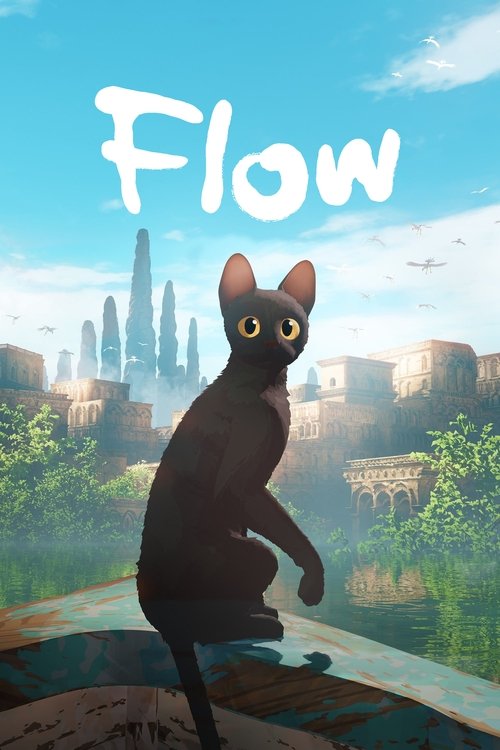
Flow
The Cat Survives by Learning When to Stop Swimming
Directed by Gints Zilbalodis
The flow movie meaning is hidden in plain sight, printed on the poster, spoken by nothing because nothing in this film speaks. A flood rises over a world with no humans left in it.
The flow movie meaning is hidden in plain sight, printed on the poster, spoken by nothing because nothing in this film speaks. A flood rises over a world with no humans left in it. A cat that has spent its whole life alone must survive water it cannot fight, and it survives not by mastering the flood but by learning the one thing the title names: when to swim, when to be carried, when to let the boat decide. Flow is a film about the exact thing its title says. The same current that drowns the old world also lifts the animals who stop resisting it, and by the end the cat is no longer a creature apart. It is one face among many, bent over the same still water, looking at a shared reflection.
The Surface: A Flood, No Humans, No Words
A grey cat lives alone in an empty house in an empty forest, surrounded by carved statues of cats and the abandoned works of people who are gone.
The water comes without warning and without cause. There is no storm shown, no reason given, no ark announced by any voice, because there are no voices at all. The cat runs from the rising flood and reaches a small sailboat already carrying a capybara who does nothing to stop it from climbing aboard. Over the film the boat gathers more passengers: a golden retriever separated from its pack, a ring-tailed lemur clutching a basket of shiny trinkets, and a wounded secretarybird cast out by its own flock. These five ride the flood together across a drowned landscape of submerged towers and forests, chased by the water, carried by it, learning to steer a boat none of them understands.
Critics called Flow a dialogue-free animal adventure, a technical marvel rendered in open-source software by a tiny Latvian team, a fable about cooperation and climate. All of that is true and none of it reaches the floor. The film has no dialogue because dialogue would be a lie here. What Flow depicts is older than language: the moment the separate self is confronted with a force it cannot argue with, and must either dissolve or drown.
The title is not a mood. It is an instruction. Everything the cat learns, it learns about flow.
Wu Wei: The Cat Survives by Stopping the Fight
Watch what nearly kills the cat, and you will see the film's entire teaching in a single behavior.
The cat's first response to water is the response of every separate self to what threatens it: resistance. It claws, it panics, it swims against the current with all the frantic strength of a small animal certain that effort is the same as safety. Early in the flood the cat exhausts itself thrashing, and the water wins every time. The film shows this plainly. The harder the cat fights the flood, the closer it comes to going under.
Then the boat. The cat does not save itself by swimming better. It saves itself by climbing aboard a vessel it cannot control and letting the water carry the vessel. This is wu wei, the Taoist heart of effortless action, rendered as literal survival. Wu wei does not mean doing nothing. It means the end of forcing, the action that moves with the grain of what is rather than against it. The cat learns to read the current instead of fighting it, to trim the sail the animals barely understand, to know the difference between the moment to paddle and the moment to be still and let the flood do the moving.
The capybara is the teacher who never teaches. It sits at the tiller of its own composure through every crisis, unbothered, half-asleep, supremely at ease while the others thrash and cling. The capybara has already arrived where the cat is going. It is equanimity given a body, the resting state toward which every other animal on the boat is slowly, unwillingly moving. The cat's whole arc is the distance between its opening panic and the capybara's opening calm.
By the end the cat can do what it could not do at the start: it can be carried without terror. It has learned that the water is not its enemy. The water is simply what is happening, vast and indifferent and total, and the only intelligence that survives it is the one that stops treating the inevitable as an insult.
The Flood Is the Dissolution of the Separate Self
Each animal on the boat is a fixed nature, and the flood is the solvent that loosens all of them at once.
This is the film's deepest architecture, and it is built into the casting of the passengers. The cat is fear: solitary, defensive, trusting nothing, a creature whose entire personality is the maintenance of distance. The golden retriever is the need to belong: it starts among a pack of dogs and spends the film aching toward company, wagging, forgiving, desperate to be part of something. The lemur is attachment to objects: it hoards a basket of glittering trinkets and mirrors and cannot release them even as the water rises, clutching its possessions the way a mind clutches its identity. The secretarybird is exile: a proud creature expelled from its flock, carrying the wound of not belonging that is the shadow of the dog's longing to belong. And the capybara is the goal, equanimity, the nature that has already let go.
A flood in the language of the psyche is not weather. It is the rising of the unconscious over the ordinary structures of the waking self, the deluge that drowns the old order so that something can be reconstituted. Every flood myth is a death of the world that precedes a remaking of it. Zilbalodis fills his ark not with breeding pairs to restart a species but with dispositions to be transformed. The boat is the vessel of the psyche crossing the flooded unconscious, and the passengers are the parts of one self that the crossing forces to change.
Watch what the water does to each fixed nature. The cat, all fear, learns to trust the others enough to sleep among them. The dog's blind need to belong is tempered by loss and by the harder, quieter belonging it finds on the boat. The lemur is forced, again and again, to choose between its trinkets and its life, and the film makes the choice cost it. Each nature is not destroyed by the flood but loosened by it, worn down at the edges where it was most rigid, moved a measure closer to the capybara's ease.
That is the work the flood performs. It does not judge the animals or reward them. It simply dissolves the certainty that each one is separate and complete, until by the end they can share a boat, a danger, a silence, and finally a reflection.
The Secretarybird's Ascension: Sacrifice Completes a Nature
There is one moment in Flow that abandons realism entirely, and it is the key to the whole film.
The secretarybird is the exile, the wounded one, cast out from its flock and carrying that expulsion like a broken wing. Through the film it is the passenger most at odds with itself, proud and injured, belonging nowhere. And then it does the thing that exiles are uniquely able to do: it defends the cat. In a confrontation that could have cost the cat everything, the secretarybird intervenes, spends itself in the defense, and pays.
What happens next is the film's single overtly mystical image. The secretarybird is lifted. A shaft of light opens in the sky and the bird ascends into it, drawn upward out of the drowned world, released. The film does not explain this and does not need to. Every initiatory tradition knows exactly what it is watching: a nature completed by sacrifice and released upward, the soul that finishes its work and is taken up.
This is why the exile, of all five, is the one who ascends. The initiate is always the one who has been cast out, because exile is the wound that forces the crossing. The secretarybird could not return to its flock. Belonging by the old means was closed to it. So it found the other door, the vertical one, the completion that comes not from being taken back in but from giving the last thing you have for something outside yourself. Its defense of the cat is the act that finishes it. In the grammar of initiation, the bird does not die. It graduates.
The light that takes the bird is the same light that will later break over the receding water. Zilbalodis plants his one supernatural gesture precisely at the point of sacrifice, and by placing it there he tells you what kind of story this is. Not a nature documentary that lost its narrator. A passage. A crossing with a real cost, in which at least one of the travelers pays the whole price and is answered.
The others do not ascend. They are not finished. They still have the flood to cross and the dry world to return to, still have fear and longing and attachment to work loose. Only the exile, having given everything, is released from the water that the rest must still learn to ride.
The Whale Is the Deep, and the Deep Cannot Follow You to Land
The whale saves the cat first, and the whale is the reason the film's ending breaks the heart of anyone who understands it.
Somewhere in the vast flooded middle of the film, when the cat is smallest and most alone against the most water, a whale rises out of the depths and carries it. The largest thing in the film emerges from the lowest place in the film to lift the smallest creature in it. This is the deep unconscious in its most exact image: the immense intelligence beneath the surface that no separate self can see or summon, that arrives from below precisely when the ego at the surface has run out of strength. The whale does not belong to the cat. It belongs to the depth. And out of the depth, unasked, it carries the small frightened thing across the water it could never have crossed alone.
Then the waters recede. The flood that lifted everything begins to drain back down, and the drowned world returns to air, and the animals come back toward dry land changed by what carried them. And there, stranded on the emerging ground, the whale lies dying.
This is the film's most devastating and most true image, and it is not cruelty. It is law. What carries you in the depths cannot follow you into the dry world. The whale that saved the cat is native to the flood, to the immersion, to the state where the ordinary boundaries are drowned and the deep can rise. When the numinous recedes and the ordinary world of solid ground returns, the thing that saved you in the depth cannot come with you. It is left behind, beached, dying in the very daylight that means the crossing is over. Every soul that has ever been carried through a dark passage by something larger than itself and then returned to normal life has stood, in some form, on that shore, looking back at what saved it and cannot follow.
The whale gives the cat the depths and cannot share the shore. The bird gives the cat its life and is taken into the light. The film keeps making the same shape: what completes you leaves you. You do not get to keep the thing that carried you across. You only get to be the one who arrived.
The Receding Flood: They Remain Changed, and Look at One Reflection
Flow ends not with a rescue but with a return, and the return is the whole point.
The waters go down. The world dries. Nothing is undone, because the flood was never a mistake to be corrected. It was a passage to be completed. And the animals who survive it do not scatter back into their fixed natures as if nothing happened. They remain together, remain changed, gathered at the edge of the water that carried them.
The final image is the seeing the whole film was building toward. The animals lean over the still surface of the receded water and look down, and what looks back is not five separate creatures. It is one shared reflection, five faces held together on the mirror of the water that dissolved them and made them, briefly, one. The cat that began the film surrounded by carved statues of its own kind, alone in a house full of images of solitude, ends it beside living others, looking into a surface that shows them all at once.
This is the return from the numinous rendered as a single frame. The initiate does not come back from the deep waters unchanged and does not come back to prove the journey was real. The initiate comes back able to see what was invisible before: that the separateness was the illusion, that the fear and the longing and the attachment were only faces on one surface, that the self which fought the flood so hard was never as alone as it believed. The mirror of the water holds them together because the crossing has already dissolved the belief that they were ever apart.
The cat learned when to swim, when to be carried, when to let the boat decide. That is the flow the title names, and it turns out to be the same lesson underneath all three traditions the film moves through. Stop forcing the current, and it carries you. Stop clinging to your fixed nature, and the flood loosens it. Stop believing you are separate, and the water shows you the shared face you always had.
Flow is a film with no humans, no dialogue, and no explanation, and it needs none, because it does not argue. It shows. A flood rises, a self dissolves, a sacrifice completes, a depth saves and is left behind, and a changed creature bends over still water and finally sees itself among others. You will not watch water the same way again once you understand what it was doing to the cat the whole time.
Questions this film answers
What is the deeper meaning of Flow?
The flow movie meaning is hidden in plain sight, printed on the poster, spoken by nothing because nothing in this film speaks. A flood rises over a world with no humans left in it. A cat that has spent its whole life alone must survive water it cannot fight, and it survives not by mastering the flood but by learning the one thing the title names: when to swim, when to be carried, when to let the boat decide. Flow is a film about the exact thing its title says. The same current that drowns the old world also lifts the animals who stop resisting it, and by the end the cat is no longer a creature apart. It is one face among many, bent over the same still water, looking at a shared reflection.
What is the hidden symbolism in Flow?
A grey cat lives alone in an empty house in an empty forest, surrounded by carved statues of cats and the abandoned works of people who are gone.
What esoteric traditions appear in Flow?
Flow draws from Buddhism, Jungian, Initiation traditions. The flow movie meaning is hidden in plain sight, printed on the poster, spoken by nothing because nothing in this film speaks. A flood rises over a world with no humans left in it.
Is Flow worth watching for spiritual seekers?
Flow (2024) directed by Gints Zilbalodis is essential viewing for those interested in Buddhism, Jungian, Wu Wei. The Cat Survives by Learning When to Stop Swimming. It rewards multiple viewings and contemplation.
Rewatch With New Eyes
Now that you've seen the architecture, experience it again. The same film becomes a different film when you know what to watch for.
This time, watch for:
- See impermanence: what clings, what releases, what remains
- Meet the shadow: what is rejected, projected, and finally integrated
- Mark the threshold: the old self dies, the ordeal transforms, the new self returns
Links may include affiliate partnerships that support Media Revelations
The Descent Continues
Where this thread leads next.
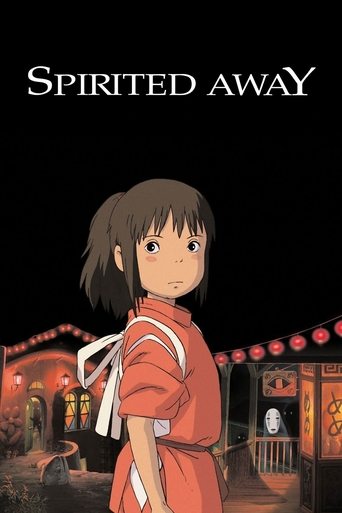
Spirited Away 2001
The Shamanic Descent of the Child Soul
Read the revelation →