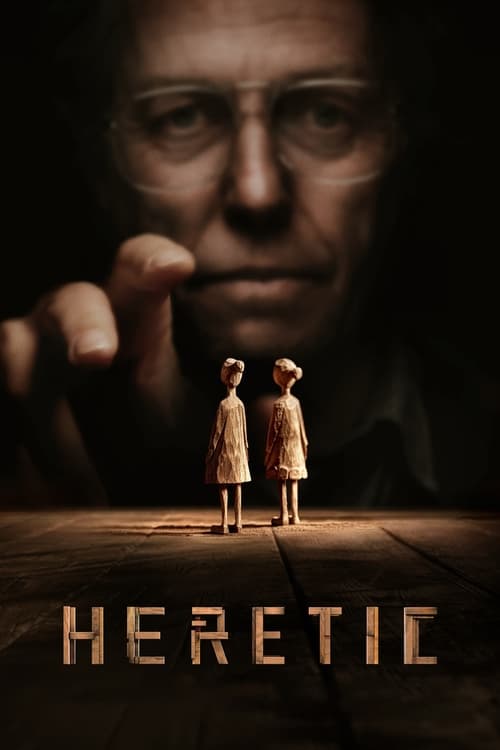
Heretic
The One Test Mr. Reed Cannot Rig
Directed by Scott Beck & Bryan Woods
Here is the heretic ending explained not as a puzzle with a solution but as a wager the film hands you unresolved: the whole point is the space it refuses to close. Heretic is not a horror film about a serial killer with a religion hobby.
Here is the heretic ending explained not as a puzzle with a solution but as a wager the film hands you unresolved: the whole point is the space it refuses to close. Heretic is not a horror film about a serial killer with a religion hobby. It is a locked-room disputation, and Mr. Reed is not a madman but the Demiurge in a cardigan: a false god who builds a sealed world, controls every fact that can be known inside it, and calls that control the truth. His whole house is one argument constructed as architecture. The front room is doctrine, and every door deeper is another floor of his thesis that all faith is derivative, all belief is a control system, and his is simply the honest one. He can counterfeit a miracle. He cannot perform one. And in the final shot, when a butterfly lands on the palm of a woman he tried to break, the film does the one thing Reed never could: it stops exactly where proof ends and refuses to tell us whether grace just walked into the room.
The Surface: Two Missionaries and a Man Who Studied Their Scripts
Sister Barnes and Sister Paxton, two young Latter-day Saints missionaries, knock on the door of Mr. Reed on a cold, wet afternoon.
Reed, played by Hugh Grant against the entire memory of his charm, welcomes them in to discuss the faith. He is warm, funny, disarmingly well-read. He tells them his wife is in the next room baking a blueberry pie, which is why they are allowed to enter unchaperoned. There is no wife. There is no pie, only a candle that smells like one. The rain gets worse, their phones lose signal, and by the time the sisters understand that the front door will not open, Reed has moved from conversation to interrogation to something closer to a graduate seminar in the dark.
Critics filed the film as a talky, clever chamber horror, a two-hander about faith with a villain who monologues. That reading is accurate and shallow. The standard summary treats Reed's speeches as clever misdirection before the killing starts. But the speeches are not the runway. The speeches are the whole aircraft.
Here is the deeper architecture the film builds in plain sight. Reed has not trapped two women in a house. He has trapped two believers inside an argument, and the house is only the argument made walkable, room by room, downward.
Mr. Reed Is the Demiurge Who Mistakes His Sealed Room for the Cosmos
Reed's central lecture is the key to everything, and most viewers hear it as a party trick.
He shows the sisters that Monopoly was copied from an earlier game, The Landlord's Game, then buried by the people who profited. He plays them a pop song, then the older song it was lifted from, then the older song under that. Iteration, he says. Everything is a copy of a copy sold as an original. Then he closes the trap: religions are the same. Each faith is a reskin of an older faith, control repackaged as revelation, and therefore, he concludes, there is only one true religion, and its name is control. It is also the only religion he actually practices.
In Gnostic cosmology the Demiurge is the counterfeit god who builds the material world as a prison and rules it by convincing the souls inside that his walls are the edge of everything real. He cannot create. He can only iterate, arrange, and seal. Reed is this figure rendered with terrifying precision. He generates nothing. He curates. He takes older things, strips their life, and presents the corpse as proof that nothing was ever alive. His house has no windows to the outside because the Demiurge's argument only holds inside the Demiurge's room.
Watch how total his control of information is. He controls the light, the locks, the exits, what the sisters may see and in what order. He even controls the weather of the encounter, choosing the rain-soaked afternoon, the dead phones, the false pie. Reed only appears to be making a case. He is manufacturing the entire evidentiary field, then declaring the verdict he built the courtroom to produce. Of course faith looks like control from inside a house engineered to make control the only visible force. That is what the Demiurge does. He shows you a rigged world and calls the rigging reality.
His thesis contains its own refutation, and the film knows it. If every original is secretly a copy, then Reed's "one true religion of control" is itself a copy, an iteration of every cage-builder who came before him. He has not escaped the pattern he diagnoses. He is its purest instance. The heretic of the title is not a woman who loses her faith. It is the man who worships the walls.
The Prophet Trap Is a Counterfeit Resurrection, and the Demiurge Can Only Ever Fake the Miracle
Deep in the house, below the two doors marked BELIEF and DISBELIEF, Reed stages his masterpiece, and it is a forgery.
He presents a captive, starved woman as proof of an afterlife: she has died, he says, and returned, a living miracle to reward whichever sister chooses correctly. Then the trick is exposed. The "resurrected" woman is one of several near-identical captives Reed has kept and starved in the dark, swapped in and out to counterfeit death and return. There is no miracle. There is a magician's cabinet and a supply of interchangeable bodies. The prophet's proof is a stage illusion built on human suffering.
This is the film's theological center and it is exact. The Demiurge cannot resurrect. He can only simulate resurrection, because real life is precisely the thing he does not possess and cannot generate. Everything he offers as evidence of the beyond is a copy staged inside his sealed room, and the staging requires that he first kill in order to appear to raise. His miracle costs real lives to fake a life. That is the signature of the counterfeit god across every tradition that names him: he mimics creation using only the dead.
Notice the cruelty of the mechanism. To perform "she came back," Reed needs a woman who never came back, and another, and another. The false resurrection is powered by actual, unreversed death. The illusion of eternal life runs on a furnace of the truly perishing. This is the Demiurge's economy in one image. He sells you the beyond and pays for it with the bodies of the people you never got to see.
And here the film sets its own trap for Reed. He believes he has proven that all miracles are frauds, because his miracle is a fraud. But he has proven only that his are. A counterfeiter's existence is evidence that currency is worth forging. The man who spends his life faking resurrection has quietly conceded that the real thing would be worth everything, or he would not bother building the fake.
The Two Sisters Are One Soul Split Into Surface Faith and Tested Faith
The film gives you two nuns so it can show you the two halves of a single believer, and then it reverses which half is deep.
Sister Barnes is quiet, guarded, a little cynical. She has read more than she lets on, she doubts out loud, she carries something unspoken and heavy. Sister Paxton is bright, chirpy, eager, the picture of untested belief, the missionary who still blushes about pornography statistics and wants everyone in the room to be comfortable. On the surface Barnes reads as the strong one and Paxton as the naive one, and Reed reads them exactly this way. He aims his heaviest artillery at Barnes because he assumes the thinker is the real opponent and the smiler is a child.
This is the surface faith and the tested faith walking side by side, the persona and the depth that the persona hides. In Jungian terms Paxton is the bright, adapted mask, the sunny outward self a young person shows the world, and the film lets us dismiss her exactly as Reed does. Barnes is the one who has already been down into doubt and come back carrying it. For most of the running time you are certain you know which sister has the real interior.
Then Heretic breaks the frame. Barnes, the deep one, is killed. It is Paxton, the one everyone underestimated, who is still there at the bottom of the house, still thinking, still faithful, and now facing the Demiurge alone with nothing left to protect her but the belief we all wrote off as decoration. The chirp was never the depth of her faith. It was the surface of it. Underneath the nervous brightness was a soul that had quietly decided something, and the decision holds under a pressure that shatters the character we assumed was stronger.
The reversal is the film's cruelest and cleverest move on the psyche of the viewer. You spent the whole film respecting the doubter and condescending to the believer, which means you spent the whole film making Reed's mistake. You assumed depth announces itself as darkness and that lightness is shallow. Paxton is the film's rebuke to that assumption. The tested faith did not look like the thing you respect. It looked like the thing you patronize, right up until it was the only thing in the house still standing.
Paxton's Butterfly Is Faith Made at the Exact Point Where Proof Runs Out
Earlier, in a lighter moment, Paxton says that if there is an afterlife she will come back as a butterfly to let the others know. In the final shot, a butterfly lands on her bloodied hand, and the film cuts to black before it will tell you what that means.
Every real initiation ends at a threshold the initiate must cross without a map. The ordeal strips away everything external, every proof, every guide, until the one being tested stands at the edge of the known with nothing but a decision. Paxton's descent through Reed's house is that ordeal rendered literally. Down through the front room of easy doctrine, through the doors of belief and disbelief, past the false resurrection, past the death of the sister she thought was the strong one, until she reaches the bottom where no argument and no evidence remains. What she meets there is not proof. It is the place where proof ends.
The butterfly is the film's refusal to cross that threshold for her, or for you. Read the ambiguity honestly, because the ambiguity is the film's actual theological position. The butterfly could be real, a genuine sign that her friend crossed over and kept her promise. It could be a dying woman's oxygen-starved hallucination, the brain granting mercy at the end. It could be a small grace with no way to prove it was grace. The film cuts before the answer, and the cut is not a coward's dodge. It is the most honest frame in the movie.
Because this is where faith actually lives. Not in Reed's rigged room where every fact is manufactured, and not in the counterfeit resurrection where the miracle is exposed as a trick. Faith is the decision you make at precisely the point where proof has run out and cannot be recovered. Reed spent the entire film trying to move the question onto ground he controlled, where he could stage the evidence and dictate the verdict. The butterfly lands on ground no one controls. It is the one moment in the house that Reed did not build, cannot lock, and cannot swap out for a lookalike. It is offered without proof, and it must be met the same way, or not at all.
Reed Loses Because the One Test He Cannot Rig Is the Only One That Counts
The heretic ending explained in a single line: the Demiurge wins every test he designs and loses the only one he can't.
Reed's entire method depends on controlling the evidentiary field. Give him the room, the locks, the lighting, the order of revelation, and he will always produce the verdict that faith is control, because he has built a machine that can output no other result. Inside his house, on his terms, he is undefeated. Every door confirms his thesis because he installed every door. This is why he is so calm for so long. He is not arguing. He is running a proof he already rigged.
The butterfly is the variable he could not touch. He can starve women to fake a resurrection, but he cannot summon or forbid a real one. He can control every fact inside the sealed room, but he cannot control whether meaning arrives from outside it, because the whole nature of what would arrive is that it comes from the one place his walls do not enclose. The final image steps outside his jurisdiction entirely. Whatever the butterfly is, it is not something Reed made, and that alone is his defeat. The counterfeiter is undone the instant a single thing appears that he did not forge.
This is the initiatory logic the film has been building toward from the first knock on the door. The test that transforms you is never the one on ground you control. Paxton passes not by winning Reed's debate, which is unwinnable because it is rigged, but by surviving to the point where his rigging runs out and something he did not author is free to appear. She does not defeat the Demiurge on his terms. She outlasts his terms. And in the space his control does not reach, the film sets one small, ambiguous, uncontrolled thing and lets it land.
The genius is that the film will not resolve it, because resolving it would hand the moment back to Reed. If Heretic told you the butterfly was definitely real, it would be staging a miracle, doing the exact thing Reed does, manufacturing proof. If it told you the butterfly was definitely a hallucination, it would be confirming his thesis, closing the cage. By cutting to black it keeps the one thing Reed spent the whole film trying to abolish: a genuinely open question, standing on ground nobody built, which each person in the audience must now answer with a decision rather than a proof.
What the Locked Room Was Actually Testing
Heretic ends the way every true trial of faith ends, with the proof removed and the choice remaining.
Two women walked into a house that was really an argument. One was the doubter everyone respected, and she died. One was the believer everyone patronized, and she is the one who reached the bottom and met the false god where he lived. The Demiurge showed her his whole case: iteration, control, the exposed miracle, the interchangeable bodies. He proved, inside his sealed room, that his miracles are fake. He never touched the question of whether the real thing exists, because that question lives outside every wall he can build, and it was never in his power to answer.
You will not watch a chamber-horror the same way again once you see what this one is doing. Reed is not a killer with a theory. He is the oldest counterfeit in the world, the false god who mistakes his rigged room for the cosmos and his control for the truth. And the film's last, quiet act of resistance is to refuse to join him. It sets a butterfly on a dying woman's hand, on the one patch of ground he does not own, and it cuts to black rather than tell you what it means. That refusal is the whole faith of the film. Proof ends. The decision does not.
Questions this film answers
What is the deeper meaning of Heretic?
Here is the heretic ending explained not as a puzzle with a solution but as a wager the film hands you unresolved: the whole point is the space it refuses to close. Heretic is not a horror film about a serial killer with a religion hobby. It is a locked-room disputation, and Mr. Reed is not a madman but the Demiurge in a cardigan: a false god who builds a sealed world, controls every fact that can be known inside it, and calls that control the truth. His whole house is one argument constructed as architecture. The front room is doctrine, and every door deeper is another floor of his thesis that all faith is derivative, all belief is a control system, and his is simply the honest one. He can counterfeit a miracle. He cannot perform one. And in the final shot, when a butterfly lands on the palm of a woman he tried to break, the film does the one thing Reed never could: it stops exactly where proof ends and refuses to tell us whether grace just walked into the room.
What is the hidden symbolism in Heretic?
Sister Barnes and Sister Paxton, two young Latter-day Saints missionaries, knock on the door of Mr. Reed on a cold, wet afternoon.
What esoteric traditions appear in Heretic?
Heretic draws from Gnosticism, Initiation, Jungian traditions. Here is the heretic ending explained not as a puzzle with a solution but as a wager the film hands you unresolved: the whole point is the space it refuses to close. Heretic is not a horror film about a serial killer with a religion hobby.
Is Heretic worth watching for spiritual seekers?
Heretic (2024) directed by Scott Beck & Bryan Woods is essential viewing for those interested in Gnosticism, Initiation, The Demiurge. The One Test Mr. Reed Cannot Rig. It rewards multiple viewings and contemplation.
Rewatch With New Eyes
Now that you've seen the architecture, experience it again. The same film becomes a different film when you know what to watch for.
This time, watch for:
- Watch for the false world vs. the real — who is asleep, who awakens
- Mark the threshold: the old self dies, the ordeal transforms, the new self returns
- Meet the shadow: what is rejected, projected, and finally integrated
Links may include affiliate partnerships that support Media Revelations
The Descent Continues
Where this thread leads next.
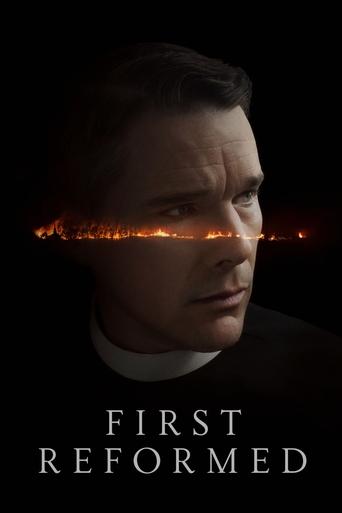
First Reformed 2018
Ernst Toller Is a Gnostic in a World the Demiurge Owns
Read the revelation →