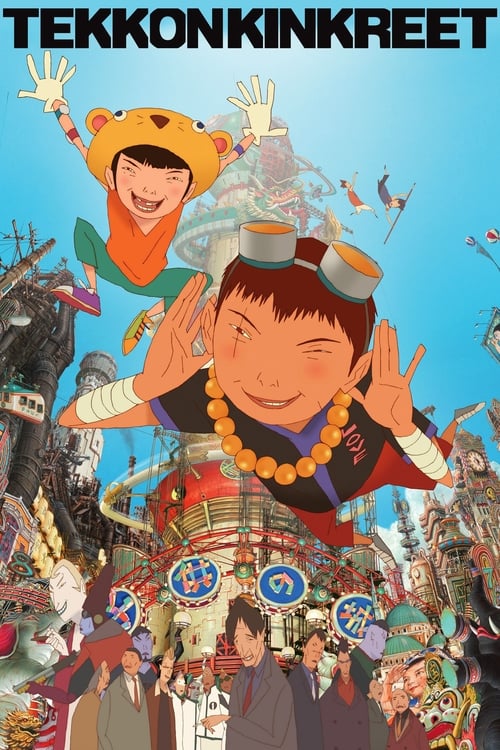
Tekkonkinkreet
Tekkonkinkreet Is an Alchemical Text: Black Descends Into Nigredo, White Pulls Him Back
Directed by Michael Arias
Two orphans share one soul between them, and when the darker half falls, only the purer half can descend far enough to bring him home.
Tekkonkinkreet is not a film about two boys surviving a city. It is a film about one psyche split into its two necessary halves, and what happens when the violent half goes all the way down. Black and White are not characters in the ordinary sense. They are stages. Black is the unrefined self, feral and protective, holding Treasure Town through sheer ferocity. White is something rarer: the part of the psyche that remains luminous when everything around it corrodes. When the Serpent corporation moves into Treasure Town to replace it with a theme park, the threat is not economic. It is ontological. The sacred ground of their childhood is being unmade. Black's response to that unmaking triggers a descent the film has been architecting since its first frame.
The Alchemical Reading: Nigredo Is Not Failure, It Is the Work
Alchemy names three phases in the transformation of base matter into gold. Nigredo is the blackening, the putrefaction, the stage where the prima materia decomposes entirely before it can be rebuilt as something new. The alchemists understood that this darkness cannot be skipped and cannot be shortened. You do not move from base lead to gold by polishing. You move by letting the lead die.
Watch Black in the second half of the film. After Kimura is murdered and Treasure Town begins to fall, something cracks in him and keeps cracking. He becomes capable of genuine atrocity. His eyes go flat. The violence that once protected White becomes violence aimed at nothing, for no one. This is textbook nigredo, not metaphorically but structurally: the instrument of protection dissolving into pure destructive force, the ego losing the frame that gave its aggression meaning. In his final dissociation he hallucinates a figure called the Minotaur, his own shadow made external, dragging him deeper.
The film understands, as the alchemists understood, that someone must descend into the nigredo to retrieve what fell. That task cannot be delegated to strength. Strength already failed; strength is what fell.
The Jungian Reading: White Carries the Soul the Ego Lost
In Jungian psychology, the Self is the totality that contains both the conscious ego and everything the ego has repressed or cannot hold. When the ego inflates, identifying with its own power and losing connection to the Self, the result is dissociation: the ego cracks under the weight of what it claimed to be.
Black's collapse is that dissociation made visible. He claimed ownership of Treasure Town as identity, as proof of existence, and when the city started dying, he had nowhere to stand.
White is what the Jungian framework calls the soul-carrier: the figure who maintains access to the Self when the ego cannot. He remains childlike not out of weakness but out of structural necessity. Innocence is not ignorance in this reading; it is the permeability that keeps the channel open. When White walks into the darkness to find Black, the scene where he reaches him through sheer constancy of presence, it reads as the Self reaching back through the crack to retrieve the ego that shattered. The reunion is not sentimental. It is the completion of a psychological process the film has built across its full length. The Jungian coniunctio, the sacred marriage of the two principles, closes the work.
These two readings carry the same architecture. One calls it nigredo and albedo; the other calls it ego-death and soul-retrieval. The film holds both because the territory they describe is the same territory.
Questions this film answers
What is the deeper meaning of Tekkonkinkreet?
Tekkonkinkreet is not a film about two boys surviving a city. It is a film about one psyche split into its two necessary halves, and what happens when the violent half goes all the way down. Black and White are not characters in the ordinary sense. They are stages. Black is the unrefined self, feral and protective, holding Treasure Town through sheer ferocity. White is something rarer: the part of the psyche that remains luminous when everything around it corrodes. When the Serpent corporation moves into Treasure Town to replace it with a theme park, the threat is not economic. It is ontological. The sacred ground of their childhood is being unmade. Black's response to that unmaking triggers a descent the film has been architecting since its first frame.
What is the hidden symbolism in Tekkonkinkreet?
Alchemy names three phases in the transformation of base matter into gold. Nigredo is the blackening, the putrefaction, the stage where the prima materia decomposes entirely before it can be rebuilt as something new. The alchemists understood that this darkness cannot be skipped and cannot be shortened. You do not move from base lead to gold by polishing. You move by letting the lead die.
What esoteric traditions appear in Tekkonkinkreet?
Tekkonkinkreet draws from Alchemy, Jungian traditions. Two orphans share one soul between them, and when the darker half falls, only the purer half can descend far enough to bring him home.
Is Tekkonkinkreet worth watching for spiritual seekers?
Tekkonkinkreet (2006) directed by Michael Arias is essential viewing for those interested in Alchemy, Jungian. Tekkonkinkreet Is an Alchemical Text: Black Descends Into Nigredo, White Pulls Him Back. It rewards multiple viewings and contemplation.
Rewatch With New Eyes
Now that you've seen the architecture, experience it again. The same film becomes a different film when you know what to watch for.
This time, watch for:
- Track the stages: blackening, whitening, reddening — death before rebirth
- Meet the shadow: what is rejected, projected, and finally integrated
Links may include affiliate partnerships that support Media Revelations