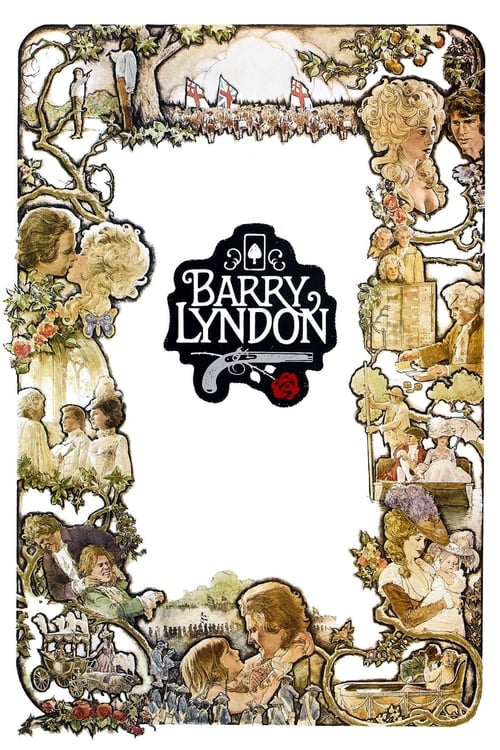
Barry Lyndon
The Wheel of Fortune Filmed in Candlelight
Directed by Stanley Kubrick
Kubrick filmed the Wheel of Fortune. Barry rises through every artifice of 18th century Europe and then descends through the same artifices, and the camera never blinks. The film's stillness is theological — the gaze of the universe watching a man build everything and lose everything within a single human lifespan. The candles are the only proof that anything was ever there.
Barry Lyndon is the most precise Buddhist film ever made by a director who would have rejected the label. Kubrick filmed Thackeray's picaresque novel and discovered that the structure of the picaresque — rise, plateau, fall — is the structure of the Wheel of Becoming as Buddhism has always described it. Barry climbs every available ladder in 18th-century Europe: military, romantic, financial, aristocratic. He marries up. He becomes Sir Barry Lyndon. He has a son. He attains what every social technology of his era could give him. Then the wheel completes its rotation. The son dies. The marriage collapses. The wealth dissolves. He loses a leg. He returns to the obscurity from which he emerged, having gained nothing he could keep. Kubrick filmed this with a stillness no other director attempted. He used eighteenth-century lenses and natural candlelight to render every frame as a painting in the style of the era Barry inhabited. The film moves slowly because the wheel moves slowly. The film is calm because the calm is the universe's actual register. The narrator's tone is detached because the detachment is the position the film is teaching the viewer to inhabit. Barry was here. Now he is not. The candles are still burning.
The Surface
Redmond Barry, an Irish boy with no prospects, falls in love with his cousin Nora, fights a duel he survives by accident, flees Ireland, is robbed, joins the British army, deserts, joins the Prussian army, is recruited as a spy, becomes the partner of the cardsharp Chevalier de Balibari, charms his way into the bed and eventually the marriage of the wealthy Lady Lyndon, becomes Sir Barry Lyndon, fathers a son who is killed in a riding accident, descends into alcoholism, loses a leg in a duel with his stepson, is bought off, and returns to obscurity. The narrator delivers all of it in the same tone — neither sympathetic nor condemnatory, neither sorrowful nor amused.
Released in 1975 to mixed reviews, the film was considered too slow, too cold, too long. It has since been recognized as one of the formal masterpieces of cinema. Kubrick's use of Carl Zeiss lenses developed for NASA allowed him to shoot interior scenes by candlelight, producing the visual register of Vermeer and Gainsborough rather than the artificial light of standard period drama. Every frame composes as if painted.
Most analysis focuses on the technical achievement. The technique is doing theological work. The lighting is the position from which the film is told. The film is not telling Barry's story. It is showing Barry's story as it would look to an intelligence outside the human time-scale, for whom rise and fall are equally interesting and equally inconsequential.
The Wheel as Structure
The Buddhist Wheel of Becoming describes existence as a cycle: birth, attainment, decline, dissolution, rebirth. The wheel turns regardless of merit, regardless of intelligence, regardless of effort. The wheel is not a punishment. It is the structure of conditioned existence. A being who has not seen through the structure rides the wheel as if the rising were the meaning. The descending always arrives. The descending is mathematically guaranteed by the rising.
Barry Lyndon is the wheel rendered as biography. Part One is titled 'By What Means Redmond Barry Acquired the Style and Title of Barry Lyndon.' Part Two is titled 'Containing an Account of the Misfortunes and Disasters Which Befell Barry Lyndon.' The film is structurally symmetrical. The rise takes the same screen time as the fall. The pleasures of rising and the agonies of falling are filmed in the same register — long, composed, contemplative shots that refuse to indicate which the viewer should value.
The narrator's detachment is the wheel's voice. He does not approve of Barry's ambition during the rise. He does not condemn Barry's collapse during the fall. He describes. He notes. He moves on. This is exactly the tone of the awakened observer in Buddhist contemplative tradition, watching the play of phenomena without preference, recognizing that preference for rising over falling is the misunderstanding that keeps the wheel turning.
Kubrick has been accused of coldness for this register. The accusation misses the form. The film is not cold. The film is operating from the position from which the human drama can be seen as drama rather than as personal urgency. Barry's tragedies are real. They are also exactly the tragedies the wheel produces in every life. The film is teaching the viewer to recognize the wheel by depicting one of its rotations at unhurried length.
The Candles and the Impermanence
Kubrick's decision to shoot by candlelight was technically obsessive. He needed lenses fast enough to capture the available light. The lenses had to be modified from NASA spec. The film stock had to be pushed. The actors had to hit precise marks because the depth of field was almost nonexistent.
The result is not naturalistic. The result is theological. Candles are the most impermanent light source available. They consume themselves as they burn. The brightness of the scene is, in real-time as you watch it, decreasing. Every interior in the film is illuminated by a light that is, frame by frame, in the process of going out. The visual register is the register of impermanence made literal at the level of photon production.
The portraits hanging on the walls of every aristocratic interior reinforce this. Every wall is covered with the painted faces of dead people. The houses Barry enters are mausoleums dressed as homes. The wealth Barry acquires is the wealth of beings who have already died and have left their gilt frames as memorial. Barry will hang on one of these walls eventually. He does not yet know it. The candles know it. The film knows it. Kubrick is showing the viewer the actual material conditions of human grandeur: brief illumination of inherited rooms full of dead ancestors, on its way to extinction the moment the wick is exhausted.
The most beautiful scenes in the film — the card game, the dinner, the small chamber concert — are also the saddest. They are beautiful because they are brief. They are sad because they are visibly being consumed. The aesthetic is the teaching. You are watching, in the cinematography itself, the structure of every pleasure available to a human life.
The Final Title Card
The film ends with a black title card. The text reads, in eighteenth-century formality: 'It was in the reign of George III that the aforesaid personages lived and quarrelled; good or bad, handsome or ugly, rich or poor they are all equal now.'
This is the alchemical recognition delivered without ornament. The work of alchemy was to dissolve the prima materia, allow it to recombine in purified form. The Wheel performs this work without anyone's consent. Barry, who spent the film attaining and losing, has been dissolved by the universe's standard procedure. The man who was rich and the man who was poor are now in the same condition. The man who was handsome and the man who was ugly have undergone the same equalizing transformation.
Kubrick's choice to deliver this as on-screen text rather than as narration is precise. The narrator's voice has been with us for three hours. The narrator was a being inside the world being narrated. The title card is from outside. It is the universe's footnote. It is the statement the wheel makes after every rotation: they are all equal now.
This is not nihilism. The Buddhist and alchemical reading is the same: the dissolution is not the end of the story. It is the end of this iteration. The work that mattered was whatever was done while the iteration was running. Barry did not do that work. He spent his life climbing a ladder he did not understand was on a wheel. The teaching is the offer of the recognition Barry never received. The viewer who receives it has the opportunity Barry did not have: to climb less, to attend more, to know that the candles are visibly being consumed and to act accordingly.
The Transmission
Barry Lyndon transmits a recognition that takes most viewers three hours to receive: the rising and the falling are the same thing seen from different sides. Kubrick spent the equivalent of a feature-length runtime building Barry up and a feature-length runtime taking him down because he wanted the viewer to feel, structurally, that the structures were continuous. The aristocratic dinner where Barry first dazzles the room and the broken room where he sits alone after the duel are the same room. The same candles. The same paintings of the dead.
The film is the most patient film Kubrick made because the teaching required patience. A faster film could have shown the irony of rise-and-fall. Only a film at this tempo could induce the contemplative state from which the viewer can perceive that the rise and the fall were never the point. The point was the candle. The point was the painting on the wall. The point was that the film was being watched at all.
Kubrick was not religious in any conventional sense. He was a relentless empiricist who had read enough history to understand that the structure of human ambition has been the same for millennia and produces the same outcome with monotonous regularity. He filmed that monotony as elegy. The elegy is the transmission. The elegy contains the only freedom available: the freedom of the viewer who can see, while still alive, what the wheel is going to do, and can choose differently than Barry did.
The choice is not asceticism. The choice is not refusal of the world. The choice is attention. Attention to what is happening while it is happening. Attention to the candle while it is still burning. Attention to the face across the table while the face is still in the room. The film is three hours long because three hours of attention is what is required to remember what attention is. Barry never remembered. The viewer might.
Questions this film answers
What is the deeper meaning of Barry Lyndon?
Barry Lyndon is the most precise Buddhist film ever made by a director who would have rejected the label. Kubrick filmed Thackeray's picaresque novel and discovered that the structure of the picaresque — rise, plateau, fall — is the structure of the Wheel of Becoming as Buddhism has always described it. Barry climbs every available ladder in 18th-century Europe: military, romantic, financial, aristocratic. He marries up. He becomes Sir Barry Lyndon. He has a son. He attains what every social technology of his era could give him. Then the wheel completes its rotation. The son dies. The marriage collapses. The wealth dissolves. He loses a leg. He returns to the obscurity from which he emerged, having gained nothing he could keep. Kubrick filmed this with a stillness no other director attempted. He used eighteenth-century lenses and natural candlelight to render every frame as a painting in the style of the era Barry inhabited. The film moves slowly because the wheel moves slowly. The film is calm because the calm is the universe's actual register. The narrator's tone is detached because the detachment is the position the film is teaching the viewer to inhabit. Barry was here. Now he is not. The candles are still burning.
What is the hidden symbolism in Barry Lyndon?
Redmond Barry, an Irish boy with no prospects, falls in love with his cousin Nora, fights a duel he survives by accident, flees Ireland, is robbed, joins the British army, deserts, joins the Prussian army, is recruited as a spy, becomes the partner of the cardsharp Chevalier de Balibari, charms his way into the bed and eventually the marriage of the wealthy Lady Lyndon, becomes Sir Barry Lyndon, fathers a son who is killed in a riding accident, descends into alcoholism, loses a leg in a duel with his stepson, is bought off, and returns to obscurity. The narrator delivers all of it in the same tone — neither sympathetic nor condemnatory, neither sorrowful nor amused.
What esoteric traditions appear in Barry Lyndon?
Barry Lyndon draws from Buddhism, Alchemy traditions. Kubrick filmed the Wheel of Fortune. Barry rises through every artifice of 18th century Europe and then descends through the same artifices, and the camera never blinks. The film's stillness is theological — the gaze of the universe watching a man build everything and lose everything within a single human lifespan. The candles are the only proof that anything was ever there.
What does Barry Lyndon teach about the wheel as structure?
The film is not telling Barry's story. It is showing Barry's story as an intelligence outside the human time-scale would see it. The Buddhist Wheel of Becoming describes existence as a cycle: birth, attainment, decline, dissolution, rebirth. The wheel turns regardless of merit, regardless of intelligence, regardless of effort. The wheel is not a punishment. It is the structure of conditioned existence. A being who has not seen through the structure rides the wheel as if the rising were the meaning. The descending always arrives. The descending is mathematically guaranteed by the rising.
What does Barry Lyndon teach about the candles and the impermanence?
The visual register is the register of impermanence made literal at the level of photon production. Kubrick's decision to shoot by candlelight was technically obsessive. He needed lenses fast enough to capture the available light. The lenses had to be modified from NASA spec. The film stock had to be pushed. The actors had to hit precise marks because the depth of field was almost nonexistent.
Is Barry Lyndon worth watching for spiritual seekers?
Barry Lyndon (1975) directed by Stanley Kubrick is essential viewing for those interested in Buddhism, Alchemy, Kubrick. The Wheel of Fortune Filmed in Candlelight. It rewards multiple viewings and contemplation.
Rewatch With New Eyes
Now that you've seen the architecture, experience it again. The same film becomes a different film when you know what to watch for.
This time, watch for:
- See impermanence: what clings, what releases, what remains
- Track the stages: blackening, whitening, reddening — death before rebirth
Links may include affiliate partnerships that support Media Revelations
The Descent Continues
Where this thread leads next.
2001: A Space Odyssey 1968
The Alchemical Ascent of Consciousness
Read the revelation →