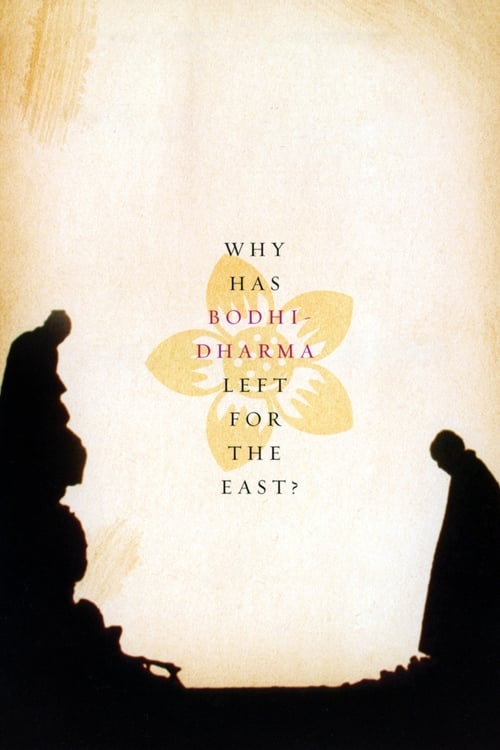
Why Has Bodhi-Dharma Left for the East?
The Master Seals His Eyes So the Young Monk Can Finally See
Directed by Bae Yong-kyun
Bae Yong-kyun filmed this over ten years, alone on a mountain, operating camera and performing roles simultaneously. The film knows what it is doing.
Three monks share a mountain hermitage: an ancient master, a young man who abandoned his blind mother to seek enlightenment, and a small orphan who has known nothing else. The surface reading presents a quiet film about monastic life and natural cycles. Bae constructs something older. This is a film about how the Dharma moves between humans, what it costs the one who carries it, and why the teacher must disappear before the transmission can complete. The title flips the classical Zen koan, "Why did Bodhidharma come from the West?", because Bae already knows the answer to that question. His is harder: why does the transmission leave? The film is the answer, and it arrives through images rather than doctrine.
Buddhist Reading: Dharma Transmission as Structured Disappearance
In the Zen tradition, dharma transmission is the living passage of understanding from master to student. It cannot be taught through language. The classic texts insist the transmission happens "outside scripture," mind to mind, flame to flame. Yet every account of it involves the same peculiar dynamic: the moment the student can receive the transmission is also the moment the master becomes dispensable.
Watch the film's pivotal scene with exact attention. The master, knowing death approaches, seats himself inside a small wooden enclosure. He takes squares of white paper and pastes them over his eyes. Then over his ears. He seals the senses that have gathered all his seeing and all his listening across a lifetime, not in horror but in deliberate ceremony, with the calm of a man completing a task. The young monk Kibong witnesses this. He has spent the film torn between the world he left and the one he entered, unable to fully inhabit either. The master's self-sealing does what sixty years of teaching could not: it shows Kibong what voluntary release looks like in the flesh. The teacher demonstrates the final lesson only by performing it on himself. When Kibong later gathers the master's burned bones and carries them up the mountain, he is not mourning. He is receiving. The bones are the transmission.
Initiatory Reading: The Child Inherits What Words Never Carried
The orphan boy Haejin moves through the film like a question the narrative keeps postponing. He catches small animals and ties strings around them; one dies, and he finds it with a stone in its mouth. He does not understand what he has done. Kibong, seeing this, ties an identical stone to the boy's back and instructs him to carry it up the mountain to free each of the animals. The scene has no doctrinal explanation. It operates below language, the way initiatory ordeals always do.
Classical initiation theory describes this exactly: the child cannot be taught the significance of death through concepts. The weight must be carried in the body. The ascent must happen in the muscles. By the film's closing sequence, after the master is gone and Kibong has walked out into a snowstorm that will likely take his life, the boy remains on the mountain. He has not been abandoned. He has been positioned. The hermitage now belongs to a child who learned from weight and fire rather than words. What passed from master to monk to boy was not knowledge, it was the capacity to carry.
Other films where the teacher's departure is the teaching itself: Spring, Summer, Fall, Winter... and Spring (the hermitage returns what it receives), Milarepa (a saint made by ordeal rather than instruction), Andrei Rublev (silence as the only vessel large enough for what was seen).
Questions this film answers
What is the deeper meaning of Why Has Bodhi-Dharma Left for the East??
Three monks share a mountain hermitage: an ancient master, a young man who abandoned his blind mother to seek enlightenment, and a small orphan who has known nothing else. The surface reading presents a quiet film about monastic life and natural cycles. Bae constructs something older. This is a film about how the Dharma moves between humans, what it costs the one who carries it, and why the teacher must disappear before the transmission can complete. The title flips the classical Zen koan, "Why did Bodhidharma come from the West?", because Bae already knows the answer to that question. His is harder: why does the transmission leave? The film is the answer, and it arrives through images rather than doctrine.
What is the hidden symbolism in Why Has Bodhi-Dharma Left for the East??
In the Zen tradition, dharma transmission is the living passage of understanding from master to student. It cannot be taught through language. The classic texts insist the transmission happens "outside scripture," mind to mind, flame to flame. Yet every account of it involves the same peculiar dynamic: the moment the student can receive the transmission is also the moment the master becomes dispensable.
What esoteric traditions appear in Why Has Bodhi-Dharma Left for the East??
Why Has Bodhi-Dharma Left for the East? draws from Buddhism, Initiation traditions. Bae Yong-kyun filmed this over ten years, alone on a mountain, operating camera and performing roles simultaneously. The film knows what it is doing.
Is Why Has Bodhi-Dharma Left for the East? worth watching for spiritual seekers?
Why Has Bodhi-Dharma Left for the East? (1989) directed by Bae Yong-kyun is essential viewing for those interested in Buddhism, Initiation. The Master Seals His Eyes So the Young Monk Can Finally See. It rewards multiple viewings and contemplation.
Rewatch With New Eyes
Now that you've seen the architecture, experience it again. The same film becomes a different film when you know what to watch for.
This time, watch for:
- See impermanence: what clings, what releases, what remains
- Mark the threshold: the old self dies, the ordeal transforms, the new self returns
Links may include affiliate partnerships that support Media Revelations
The Descent Continues
Where this thread leads next.
Forrest Gump 1994
The Holy Fool and the Feather of Grace
Read the revelation →