Wings of Desire
The Angel Who Could Not Stand Witnessing Anymore
Directed by Wim Wenders
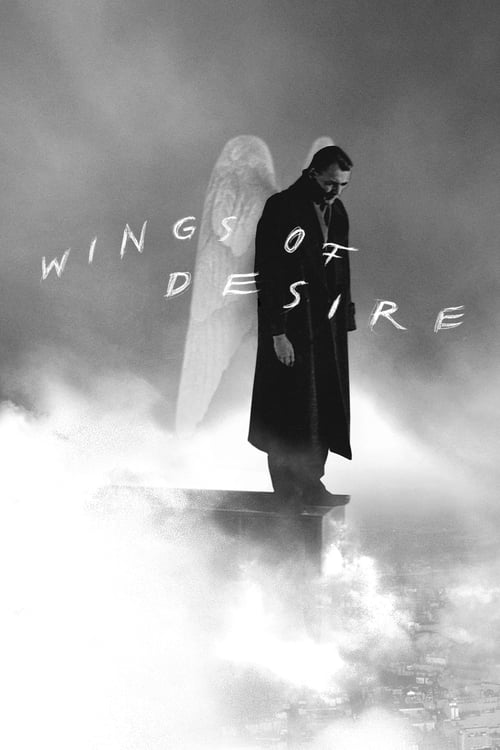
Wenders filmed what angels actually do. Damiel is not a guardian. He is a witness — the consciousness that watches without intervening, that hears every thought without changing any. His fall into matter is not tragedy but graduation. Incarnation is what the witness eventually craves, because witnessing alone is not enough. The black-and-white sky becomes color the moment Damiel chooses weight.
Wings of Desire is the most precise inversion of the standard Gnostic ascent narrative ever filmed. The Gnostic schema describes the soul as trapped in matter and yearning for return to its origin in pure spirit. Wenders filmed the opposite movement and discovered that the opposite movement was at least as true. Damiel is an angel. He has always been an angel. He stands in Berlin during the late Cold War, listening to the interior monologues of the divided city's inhabitants, providing small comforts that the inhabitants cannot perceive him giving, witnessing every birth and every death and every banal middle hour, and he is exhausted. Witnessing alone is not enough. The world in black and white — which is the way angels see it — is becoming intolerable in its bloodlessness. Damiel falls in love with a trapeze artist, but the love is the symptom, not the cause. The cause is that the consciousness which only witnesses eventually needs to be witnessed in return. Damiel chooses incarnation. He gives up immortality, gives up the panoramic view, gives up the brotherhood of the angels, in order to drink coffee that he can taste, to feel cold, to bleed when he is cut. The film argues, against the entire weight of dualist tradition, that matter is the more advanced condition. Spirit is what beings begin as. Matter is what they aspire to. The angels are not above us. They are the consciousness that has not yet earned weight.
The Surface
Berlin, 1987. The city is divided by the Wall. Two angels, Damiel and Cassiel, move through it unseen by the living, observing the inhabitants' interior monologues. They watch the U-Bahn passengers, the people in the public library, the children playing in courtyards, the people contemplating suicide on bridges. They provide small comforts the inhabitants register as their own inner reassurance. Damiel falls in love with Marion, a French trapeze artist working in a small circus that is closing. He discusses with Cassiel his growing desire to become human. He meets the actor Peter Falk, in Berlin to shoot a film about the Nazi era, and discovers that Falk is a former angel who made the same choice and remembers what it was like. Damiel chooses incarnation. He falls. He wakes in a vacant lot with his armor having become a piece of physical metal he can sell. He finds Marion at a Nick Cave concert. They speak for the first time. The film ends with Damiel beginning his life among the embodied.
Wenders co-wrote the film with the poet Peter Handke, whose verses appear throughout as the angels' inner monologues. The cinematography by Henri Alekan — who had shot Cocteau's Beauty and the Beast forty years earlier — uses black and white for the angels' perception and color for the embodied perception of the world. The shift between the registers is one of the film's primary affective tools.
Most readings handle the film as poetic romance. It is poetic and there is romance. The deeper film is a theological argument about the relationship between spirit and matter that runs against the dominant strain of two millennia of Western mystical tradition.
The Witness That Cannot Touch
The angels in Wenders's cosmology have one function: they witness. They cannot intervene in any meaningful sense. They can lay a hand on a despairing person's shoulder and the person will feel a vague comfort they will attribute to their own resilience. They can sit beside someone on the subway and offer no actual presence. They have access to every interior monologue. They can read every thought of every human in the city. They cannot answer any of them.
This is the consciousness of the pure observer — the position that Western mysticism has traditionally treated as the spiritual goal. The witness consciousness, in many traditions, is what survives identification with the body, what perceives without preference, what is closer to God because it has shed the entanglements of incarnation. The angels are, by these criteria, advanced beings.
Wenders films this advanced condition and asks the question that the standard tradition tends to avoid: what is it actually like to be the pure witness? The answer the film offers is that it is unbearable. The witness who cannot affect what is witnessed eventually accumulates a kind of weight from the witnessing itself. The angels do not get to rest. They do not get to intervene. They do not get to be intervened with. They simply watch the suffering and the small joys of an entire city continuously, century after century, and the watching does not change.
Damiel's exhaustion is the exhaustion of the pure witness. He has stood at the Brandenburg Gate. He has watched the city burn in two wars. He has watched the Wall rise. He has heard, across decades, the same thoughts in slightly different German. He has not been changed by any of it because he is structurally incapable of being changed. He has been the recipient of every history without being permitted to participate in any of it. The Gnostic schema would call this his liberation. Wenders is filming it as his prison.
Peter Falk as the Angel Who Fell
Peter Falk plays himself in Berlin to shoot a film. He can sense the angels around him. He stops on a street corner where Damiel is invisibly standing beside him. He says, into apparently empty air: 'I can't see you, but I know you're here.' He explains that he too made the choice, that he understands what Damiel is going through, that the decision is good and worth the cost.
This is the film's most theologically loaded sequence and its most emotionally direct. The presence of an embodied former angel — someone who can confirm from the other side that the fall is survivable, that the choice is rewarded, that the loss of the angelic condition is a graduation rather than a fall in the standard sense — is the structural condition that allows Damiel to commit. Without Falk, Damiel might never have crossed.
In initiatory terms, Falk is the elder who has been through the rite and returned. He carries the authority that only completed initiation produces. He does not need to prove anything. He has the smell of coffee on his hands. He has the warmth of a body in the cold Berlin air. He can be seen and heard and touched. These are the credentials. He offers them to Damiel by simply being who he now is.
Wenders cast Falk because Falk's screen persona — the gentle, cluttered, perceptive Columbo — already carried the quality of a being who had seen too much and chosen to keep being kind anyway. The casting is the casting of a real angel who fell and lives among us now. The film is not pretending Falk is a former angel as fictional device. The film is asserting, at the level of casting, that there are former angels everywhere and that Peter Falk is one of them. The viewer is invited to consider how many they have already met.
The Fall as Choice
Damiel's fall is not punitive. It is volitional. He chooses to descend. The angels' tradition — the brotherhood Cassiel embodies and continues — permits the choice. Cassiel does not condemn Damiel. He helps him pass through the threshold. He carries Damiel's armor as Damiel is born into matter. He stays an angel. He continues the watching. The two are not divided on theological grounds; they have made different decisions about what to do with the same recognition.
The decision Damiel is making is the inversion of the Gnostic schema. The Gnostic chose to ascend out of matter back into spirit. Damiel is choosing to descend out of spirit into matter. The film argues, by the affective weight of the descent — the sudden color, the taste of coffee, the warmth of Marion's voice when she speaks to him for the first time — that the descent is the higher achievement.
This is consonant with certain strains of mystical thought that the dominant Gnostic-influenced Christian tradition has tended to marginalize. The Christian Incarnation itself, taken seriously, is the assertion that the divine chose to take on matter — that matter is not the prison the Gnostics described but the territory the divine actually wanted to occupy. Wenders, raised Catholic in postwar Germany, is filming a fundamentally Catholic theological position dressed in modernist German poetry. Incarnation is not a fall. Incarnation is what the spirit had always been moving toward.
The price is real. Damiel will die. He will not see what Cassiel sees. He will not hear the interior monologues of the city. He will be limited to what one human body can perceive in one human lifetime. The film does not pretend the price is small. The film argues that the price is exactly what makes the descent valuable. Without the constraint, the experience would not be experience. The angel could observe Marion's beauty across decades. The man who Damiel has become can love her in a single, finite life, and the finitude is what makes the loving operative.
The Transmission
Wings of Desire transmits a recognition that the disembodied spiritual traditions have spent two thousand years suppressing: matter is not the problem. The body is not the prison. The senses are not the obstacles. The actual spiritual achievement is the willingness to be subject to all of them — to have a body that hurts, to have a heart that breaks, to have a mortality that limits what can be experienced — and to find that the subjection is the condition under which the spirit becomes itself.
The angels in the film are not less than human. They are not more than human either. They are differently positioned — and their position, on Wenders's reading, is preliminary. They are what beings are while they are still preparing to incarnate. The incarnation, when it happens, is the graduation. The angels are the seminarians. The humans are the practicing clergy.
What the film offers the viewer who is already incarnated is the inversion of the usual spiritual hierarchy. The viewer is not lower than the angel for being embodied. The viewer is, by the film's argument, what the angel is trying to become. The body's tiredness, the body's hunger, the body's susceptibility to weather and illness and aging — these are not impurities to be transcended. These are the actual conditions of the higher work.
The film ends with Damiel's first day of life. He has not yet learned anything practical. He does not know how to navigate the city's bureaucracies. He does not know how to find work. He does not know what he and Marion will live on. None of this matters. He has crossed. He has chosen. He is, by the film's lights, ahead of every disembodied consciousness that watched him cross. The transmission is the recommendation that the viewer notice that they have already made the choice Damiel just made, that the achievement has already been accomplished, and that the only remaining task is to live the incarnation as the spiritual condition it actually is.
Questions this film answers
What is the deeper meaning of Wings of Desire?
Wings of Desire is the most precise inversion of the standard Gnostic ascent narrative ever filmed. The Gnostic schema describes the soul as trapped in matter and yearning for return to its origin in pure spirit. Wenders filmed the opposite movement and discovered that the opposite movement was at least as true. Damiel is an angel. He has always been an angel. He stands in Berlin during the late Cold War, listening to the interior monologues of the divided city's inhabitants, providing small comforts that the inhabitants cannot perceive him giving, witnessing every birth and every death and every banal middle hour, and he is exhausted. Witnessing alone is not enough. The world in black and white — which is the way angels see it — is becoming intolerable in its bloodlessness. Damiel falls in love with a trapeze artist, but the love is the symptom, not the cause. The cause is that the consciousness which only witnesses eventually needs to be witnessed in return. Damiel chooses incarnation. He gives up immortality, gives up the panoramic view, gives up the brotherhood of the angels, in order to drink coffee that he can taste, to feel cold, to bleed when he is cut. The film argues, against the entire weight of dualist tradition, that matter is the more advanced condition. Spirit is what beings begin as. Matter is what they aspire to. The angels are not above us. They are the consciousness that has not yet earned weight.
What is the hidden symbolism in Wings of Desire?
Berlin, 1987. The city is divided by the Wall. Two angels, Damiel and Cassiel, move through it unseen by the living, observing the inhabitants' interior monologues. They watch the U-Bahn passengers, the people in the public library, the children playing in courtyards, the people contemplating suicide on bridges. They provide small comforts the inhabitants register as their own inner reassurance. Damiel falls in love with Marion, a French trapeze artist working in a small circus that is closing. He discusses with Cassiel his growing desire to become human. He meets the actor Peter Falk, in Berlin to shoot a film about the Nazi era, and discovers that Falk is a former angel who made the same choice and remembers what it was like. Damiel chooses incarnation. He falls. He wakes in a vacant lot with his armor having become a piece of physical metal he can sell. He finds Marion at a Nick Cave concert. They speak for the first time. The film ends with Damiel beginning his life among the embodied.
What esoteric traditions appear in Wings of Desire?
Wings of Desire draws from Gnosticism, Initiation traditions. Wenders filmed what angels actually do. Damiel is not a guardian. He is a witness — the consciousness that watches without intervening, that hears every thought without changing any. His fall into matter is not tragedy but graduation. Incarnation is what the witness eventually craves, because witnessing alone is not enough. The black-and-white sky becomes color the moment Damiel chooses weight.
What does Wings of Desire teach about the witness that cannot touch?
The witness who cannot affect what is witnessed eventually accumulates a kind of weight from the witnessing itself. The angels do not get to rest. The angels in Wenders's cosmology have one function: they witness. They cannot intervene in any meaningful sense. They can lay a hand on a despairing person's shoulder and the person will feel a vague comfort they will attribute to their own resilience. They can sit beside someone on the subway and offer no actual presence. They have access to every interior monologue. They can read every thought of every human in the city. They cannot answer any of them.
Is Wings of Desire worth watching for spiritual seekers?
Wings of Desire (1987) directed by Wim Wenders is essential viewing for those interested in Gnosticism, Initiation, Wenders. The Angel Who Could Not Stand Witnessing Anymore. It rewards multiple viewings and contemplation.
Rewatch With New Eyes
Now that you've seen the architecture, experience it again. The same film becomes a different film when you know what to watch for.
This time, watch for:
- Watch for the false world vs. the real — who is asleep, who awakens
- Mark the threshold: the old self dies, the ordeal transforms, the new self returns
Links may include affiliate partnerships that support Media Revelations
The Descent Continues
Where this thread leads next.

The Tree of Life 2011
Nature, Grace, and the Wound of Incarnation
Read the revelation →