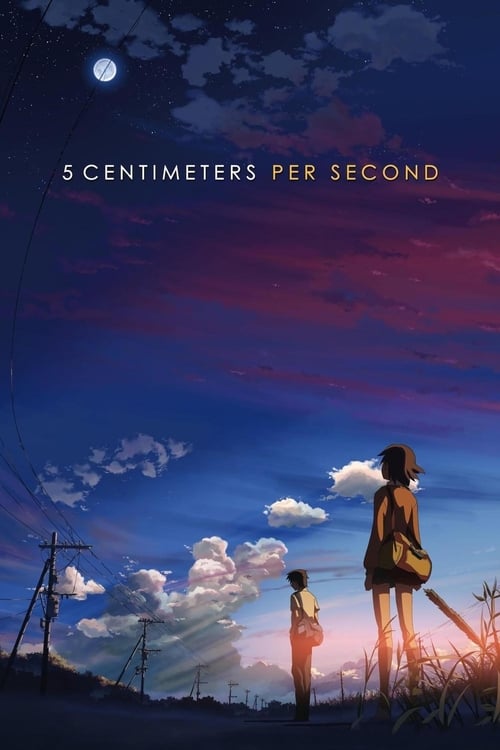
5 Centimeters per Second
5 Centimeters per Second Is About a Man Who Grieves a Person He Could Have Simply Called
Directed by Makoto Shinkai
Shinkai named the film after the speed a cherry blossom falls. The whole film is that image: something beautiful, drifting downward, mistaken for something eternal because it is slow enough to watch.
5 Centimeters per Second is not a tragic love story. It is a study of how a man builds a shrine to a feeling and then lives inside it while his actual life passes outside the walls. Takaki and Akari are separated as children by nothing more dramatic than their families moving. There is no war, no death, no forbidding parent. There is only distance, and a decision, never quite made, to close it. The film follows Takaki across two decades as he preserves the memory of Akari with total fidelity and lets every real relationship, every present moment, thin into a background hum. The devastation is subtler: he chose the memory over everyone who was actually there, and called that loyalty.
Buddhist Reading: Clinging as the Root of the Suffering Takaki Mistakes for Love
The Buddhist diagnosis of suffering is precise: dukkha arises from tanha, the craving that grips what is impermanent and demands it stay. Everything in this film is impermanent by design. The snow melts. The train is late. The blossoms fall at their fixed five centimeters per second. Takaki's error is not that he loved Akari; it is that he refused the teaching every falling petal offered him, that forms arise and pass and holding them is the whole of the pain.
The middle chapter, "Cosmonaut," makes the mechanism visible through Kanae, a girl who loves Takaki and watches him gaze at a horizon she cannot see. He texts, but the messages go to no one; he is writing to a person who no longer exists, the thirteen-year-old Akari frozen in the snow at Iwafune station years before. He is faithful to a photograph and absent from every person breathing beside him. The rocket launch Kanae watches, a probe fired into infinite empty space to search for nothing it will ever reach, is Takaki's inner life rendered as an image. Longing aimed at a void, mistaken for devotion.
Jungian Reading: Akari as the Anima Projected, and the Cost of Never Withdrawing It
Akari is not, by the film's end, a woman. She is Takaki's anima, the inner feminine image Jung described, projected outward onto a real girl and then never called home. In healthy development the projection is eventually withdrawn: you recognize that the impossible perfection you saw in the beloved was your own soul's image, and you take responsibility for it. Takaki never withdraws it. He keeps Akari suspended as the anima incarnate, luminous and lost, and so he can never fully see any real woman, because each one is measured against an inner figure no person could match.
The final sequence is the anima's quiet correction. Grown Takaki passes a woman at a railroad crossing who might be Akari. The train passes between them. When it clears, she is gone, and he waits, and then he smiles slightly and walks on. That small smile is the projection beginning to release. He does not chase her. For the first time the image loosens its grip, and he steps into his own life alone, which is the only place individuation was ever going to happen.
Questions this film answers
What is the deeper meaning of 5 Centimeters per Second?
5 Centimeters per Second is not a tragic love story. It is a study of how a man builds a shrine to a feeling and then lives inside it while his actual life passes outside the walls. Takaki and Akari are separated as children by nothing more dramatic than their families moving. There is no war, no death, no forbidding parent. There is only distance, and a decision, never quite made, to close it. The film follows Takaki across two decades as he preserves the memory of Akari with total fidelity and lets every real relationship, every present moment, thin into a background hum. The devastation is subtler: he chose the memory over everyone who was actually there, and called that loyalty.
What is the hidden symbolism in 5 Centimeters per Second?
The Buddhist diagnosis of suffering is precise: dukkha arises from tanha, the craving that grips what is impermanent and demands it stay. Everything in this film is impermanent by design. The snow melts. The train is late. The blossoms fall at their fixed five centimeters per second. Takaki's error is not that he loved Akari; it is that he refused the teaching every falling petal offered him, that forms arise and pass and holding them is the whole of the pain.
What esoteric traditions appear in 5 Centimeters per Second?
5 Centimeters per Second draws from Buddhism, Jungian traditions. Shinkai named the film after the speed a cherry blossom falls. The whole film is that image: something beautiful, drifting downward, mistaken for something eternal because it is slow enough to watch.
Is 5 Centimeters per Second worth watching for spiritual seekers?
5 Centimeters per Second (2007) directed by Makoto Shinkai is essential viewing for those interested in Buddhism, Jungian. 5 Centimeters per Second Is About a Man Who Grieves a Person He Could Have Simply Called. It rewards multiple viewings and contemplation.
Rewatch With New Eyes
Now that you've seen the architecture, experience it again. The same film becomes a different film when you know what to watch for.
This time, watch for:
- See impermanence: what clings, what releases, what remains
- Meet the shadow: what is rejected, projected, and finally integrated
Links may include affiliate partnerships that support Media Revelations
The Descent Continues
Where this thread leads next.

The Garden of Words 2013
The Garden of Words Is a Rain Ritual Two Broken People Perform Without Knowing Its Name
Read the revelation →