A Man Escaped
A Man Escaped Is a Prayer Disguised as an Escape Plan
Directed by Robert Bresson
Bresson filmed a French Resistance fighter scraping through a cell door with a spoon. He was actually filming the mechanics of grace.
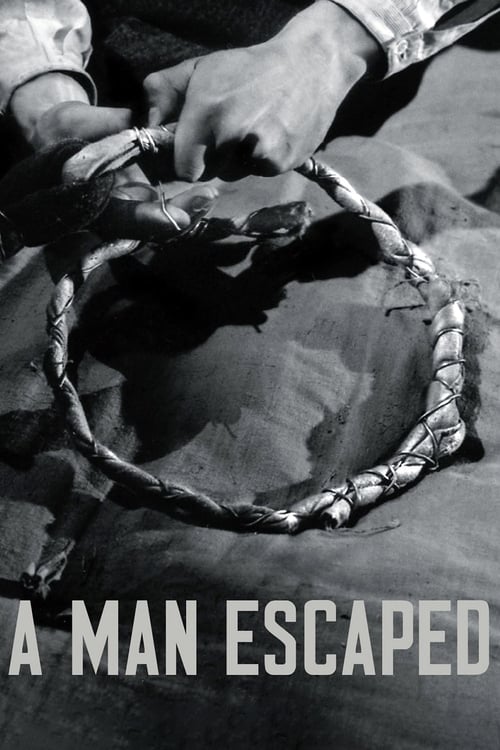
Lieutenant Fontaine is condemned to death in a Nazi prison in Lyon. He decides to escape. The film shows him doing it: he dismantles his cell door panel by panel with a sharpened spoon, twists wire from his bed frame into hooks, braids rope from blankets and mattress ticking. Bresson refuses every convention of the prison-break thriller. There is no swelling music at the crucial moment, no montage, almost no faces. There are hands, wood, iron, cloth, the sound of a spoon working against a door in the dark. The surface reading is that this is the purest suspense film ever made, tension distilled to pure procedure. The actual film is a treatise on how salvation arrives: through relentless, patient labor that is nevertheless not enough, until something else that cannot be worked for finishes the work.
Gnostic Reading: The Prison Is Matter, the Door Is Gnosis
Bresson's full title is A Man Escaped, or The Wind Bloweth Where It Listeth, quoting Christ to Nicodemus on the Spirit. The prison is the Gnostic image made literal: the soul locked in the material world, the archon-guards patrolling corridors, the walls that define the whole of the visible. Fontaine does not accept the walls as final. Every object he touches he converts from its prison-function to its liberation-function. The spoon meant for eating becomes a chisel. The blanket meant for sleep becomes rope. This is the Gnostic operation exactly: taking the apparatus of the trap and turning it, through knowing, into the instrument of exit. The knowledge is not abstract. It is in the fingers, in the exact grain of the door, in the hours of scraping that no guard can see.
And yet Bresson is precise that labor alone does not free anyone. The knock on the door, the transfer order, the arrival of Jost the young cellmate whom Fontaine must decide to trust or kill: these are given, not earned. Fontaine works as if everything depends on him and receives as if nothing does. The wind blows where it wills.
Initiatory Reading: The Guide Who Must Choose His Successor
Late in the film a boy named Jost is thrown into Fontaine's cell, half in German uniform, possibly an informer. Fontaine has finished his preparations. He can escape alone, or he can bring the boy and risk betrayal. He chooses the boy. This is the initiatory turn that the escape plot conceals. The initiate cannot complete his passage as a solitary act of will. He must become a guide, must gamble the whole enterprise on trust extended to someone unproven.
The two men go over the wall together in the final minutes, the older lowering the younger, the younger anchoring the older. Neither could have crossed alone. The freedom was never a solo achievement to begin with. It required the exact person the plan had not accounted for.
Other Bresson films where grace arrives through matter: Pickpocket (the hands that steal and are saved), Au Hasard Balthazar (sanctity carried by a donkey), Diary of a Country Priest (grace is everywhere).
Questions this film answers
What is the deeper meaning of A Man Escaped?
Lieutenant Fontaine is condemned to death in a Nazi prison in Lyon. He decides to escape. The film shows him doing it: he dismantles his cell door panel by panel with a sharpened spoon, twists wire from his bed frame into hooks, braids rope from blankets and mattress ticking. Bresson refuses every convention of the prison-break thriller. There is no swelling music at the crucial moment, no montage, almost no faces. There are hands, wood, iron, cloth, the sound of a spoon working against a door in the dark. The surface reading is that this is the purest suspense film ever made, tension distilled to pure procedure. The actual film is a treatise on how salvation arrives: through relentless, patient labor that is nevertheless not enough, until something else that cannot be worked for finishes the work.
What is the hidden symbolism in A Man Escaped?
Bresson's full title is A Man Escaped, or The Wind Bloweth Where It Listeth, quoting Christ to Nicodemus on the Spirit. The prison is the Gnostic image made literal: the soul locked in the material world, the archon-guards patrolling corridors, the walls that define the whole of the visible. Fontaine does not accept the walls as final. Every object he touches he converts from its prison-function to its liberation-function. The spoon meant for eating becomes a chisel. The blanket meant for sleep becomes rope. This is the Gnostic operation exactly: taking the apparatus of the trap and turning it, through knowing, into the instrument of exit. The knowledge is not abstract. It is in the fingers, in the exact grain of the door, in the hours of scraping that no guard can see.
What esoteric traditions appear in A Man Escaped?
A Man Escaped draws from Gnosticism, Initiation traditions. Bresson filmed a French Resistance fighter scraping through a cell door with a spoon. He was actually filming the mechanics of grace.
Is A Man Escaped worth watching for spiritual seekers?
A Man Escaped (1956) directed by Robert Bresson is essential viewing for those interested in Gnosticism, Initiation. A Man Escaped Is a Prayer Disguised as an Escape Plan. It rewards multiple viewings and contemplation.
Rewatch With New Eyes
Now that you've seen the architecture, experience it again. The same film becomes a different film when you know what to watch for.
This time, watch for:
- Watch for the false world vs. the real — who is asleep, who awakens
- Mark the threshold: the old self dies, the ordeal transforms, the new self returns
Links may include affiliate partnerships that support Media Revelations