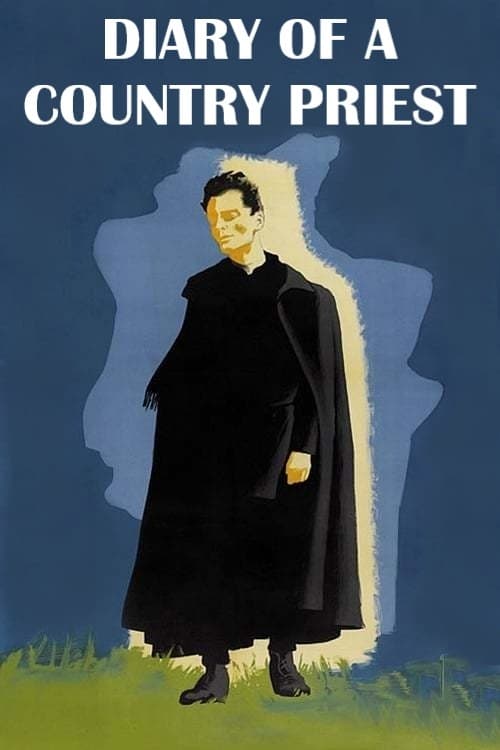
Diary of a Country Priest
Diary of a Country Priest Is the Record of a Man Being Emptied Until Grace Can Enter
Directed by Robert Bresson
Bresson films a saint the way a physician films a wasting disease. The two turn out to be the same footage.
The young priest of Ambricourt cannot eat. He lives on bread soaked in cheap wine and sugar, and it is killing him. The parish despises him. He fails at every practical task a priest is supposed to perform: he cannot manage the accounts, cannot charm the count, cannot make the children love him. He records all of it in a diary in his own cramped hand, and Bresson keeps returning to the page and the pen, the ink drying, the words being formed. The surface reading is that this is a film about a failed priest dying young and unloved. What Bresson actually filmed is the opposite. This is a man whose every worldly capacity is stripped from him one by one, on schedule, so that the only thing left in him at the end is God. The stomach cancer is not the tragedy. It is the method.
Sufi Reading: Poverty of the Self as the Condition for Presence
The Sufi word faqr means spiritual poverty: the emptying of the self of everything it clings to, until nothing remains between the servant and the Real. The faqir is not merely poor in money. He is poor in self-importance, poor in the will to control, poor even in the consolation of feeling holy. Bresson's priest is a portrait of faqr enacted in a French village.
Watch what is taken from him. His health goes first, so he cannot rely on his body. His reputation goes, so he cannot rely on being seen as good. In the great scene with the Countess, he strips her of her frozen grief over her dead son, breaks the resentment she has nursed against God for years, and she dies that same night at peace. He saves a soul. And then her daughter lies about the conversation, the village turns further against him, and he receives no credit, no evidence, nothing. The one real thing he did in his priesthood is buried in slander. This is faqr precisely. The Sufis say the servant is not permitted to keep even the fruit of his own good works. Everything is returned to the Giver. The priest is left with empty hands, which is the only posture in which the hands can finally be filled.
Initiatory Reading: The Dark Night as the Curriculum, Not the Obstacle
Every genuine initiation passes through a phase the mystics call the dark night: the withdrawal of all felt consolation, where God seems absent and prayer turns to ash in the mouth. The initiate must continue without the reward of feeling anything. The priest lives this. He confesses in his diary that he can no longer pray, that when he kneels there is only silence and dread, that God has become a wall.
The film's initiatory secret is its final line, spoken as he dies in a friend's shabby room, unable to receive last rites: "Does it matter? All is grace." This is the graduation. He has passed through the night without ever being shown the dawn, and at the exact moment of maximum deprivation, having lost his health, his parish, his ability to pray, and now his last sacrament, he arrives at the recognition that the deprivation itself was the grace. The dark night did not obstruct the path. The dark night was the path walked to its end.
Other Bresson films where salvation arrives through total stripping: Au Hasard Balthazar (the same grace witnessed through an animal's suffering), A Man Escaped (the will emptied until the door opens), Pickpocket (the hand that must be caught before the heart can open).
Questions this film answers
What is the deeper meaning of Diary of a Country Priest?
The young priest of Ambricourt cannot eat. He lives on bread soaked in cheap wine and sugar, and it is killing him. The parish despises him. He fails at every practical task a priest is supposed to perform: he cannot manage the accounts, cannot charm the count, cannot make the children love him. He records all of it in a diary in his own cramped hand, and Bresson keeps returning to the page and the pen, the ink drying, the words being formed. The surface reading is that this is a film about a failed priest dying young and unloved. What Bresson actually filmed is the opposite. This is a man whose every worldly capacity is stripped from him one by one, on schedule, so that the only thing left in him at the end is God. The stomach cancer is not the tragedy. It is the method.
What is the hidden symbolism in Diary of a Country Priest?
The Sufi word faqr means spiritual poverty: the emptying of the self of everything it clings to, until nothing remains between the servant and the Real. The faqir is not merely poor in money. He is poor in self-importance, poor in the will to control, poor even in the consolation of feeling holy. Bresson's priest is a portrait of faqr enacted in a French village.
What esoteric traditions appear in Diary of a Country Priest?
Diary of a Country Priest draws from Sufism, Initiation traditions. Bresson films a saint the way a physician films a wasting disease. The two turn out to be the same footage.
Is Diary of a Country Priest worth watching for spiritual seekers?
Diary of a Country Priest (1951) directed by Robert Bresson is essential viewing for those interested in Sufism, Initiation. Diary of a Country Priest Is the Record of a Man Being Emptied Until Grace Can Enter. It rewards multiple viewings and contemplation.
Rewatch With New Eyes
Now that you've seen the architecture, experience it again. The same film becomes a different film when you know what to watch for.
This time, watch for:
- Feel the love that transforms: what the heart sees that the mind cannot
- Mark the threshold: the old self dies, the ordeal transforms, the new self returns
Links may include affiliate partnerships that support Media Revelations