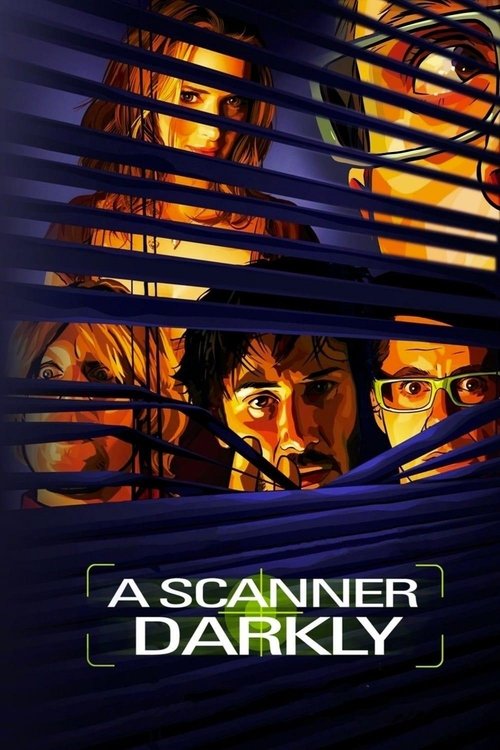
A Scanner Darkly
The Scramble Suit Is the Film's Theology: Every Identity Is Rented, None of Them Yours
Directed by Richard Linklater
Philip K. Dick's most personal film is not a drug parable. It is a precision instrument for demonstrating that the self surveillance hunts for was never there.
The rotoscoped animation is not an aesthetic choice. It is the first argument. Every frame of A Scanner Darkly looks like reality traced over, a copy of a copy, and that is exactly what the film says consciousness is. Bob Arctor is an undercover narc assigned to surveil himself. His two brain hemispheres stop communicating, leaving a watcher who cannot recognize the watched. The scramble suit he wears on duty cycles through fifty thousand human identities per second so no one can see his face, including him. Linklater does not use this as irony. He uses it as cosmology.
The Scramble Suit Is an Archon Device
In Gnostic architecture, the Archons are the administrators of the false world, the planetary jailers who fragment the pneumatic soul and keep it from recognizing its own divine origin. The scramble suit does exactly this. It does not conceal Bob Arctor. It demonstrates that "Bob Arctor" was already a construction, one face cycling through fifty thousand others at the same speed any person cycles through social masks, work selves, private selves, the self that answers to a name. The suit makes visible what the Gnostics claimed was always true: the social person is not the real person. The mask is not the face.
The scene that crystallizes this is Fred sitting in the holo-scanner room, watching surveillance footage of Bob. Fred is Bob. Bob is Fred. The narcotics office has unknowingly assigned a man to investigate himself, and no one notices because the bureaucratic machinery of the Archons never looks through the mask at the soul underneath. The scanner scans everything except the one thing that would matter. Fred watches Bob destroy himself in real time and cannot intervene, because intervening would require Fred to acknowledge what he is. The Gnostic trap is closed: the soul is imprisoned in a system that enforces its own fragmentation.
The Split-Brain Diagnosis Is the Medical Proof of a Buddhist Premise
The New Path medical facility sequences deliver the film's theological kill shot as clinical data. When Arctor's brain scan shows his two hemispheres have stopped communicating, the doctor frames it as damage. The film frames it as revelation. The two hemispheres "should" communicate to produce the unified self that Western psychology and common sense both assume. They do not communicate. They were always two streams running parallel, generating the felt sense of a single observer after the fact.
This is not Dick's invention. Buddhist phenomenology arrived at the same conclusion through introspection millennia before neuroscience confirmed it through imaging. The self is not the ground; it is a story the nervous system tells about its own activity. Substance D accelerates the dissolution of that story until the fiction becomes undeniable. The scanner, scanning darkly, finds what every serious contemplative tradition already found: no unified self to arrest. The image Dick supplies, a man who cannot remember that Fred and Bob are the same person, is just the Pali description of ego run as a film that has forgotten it is a film.
Questions this film answers
What is the deeper meaning of A Scanner Darkly?
The rotoscoped animation is not an aesthetic choice. It is the first argument. Every frame of A Scanner Darkly looks like reality traced over, a copy of a copy, and that is exactly what the film says consciousness is. Bob Arctor is an undercover narc assigned to surveil himself. His two brain hemispheres stop communicating, leaving a watcher who cannot recognize the watched. The scramble suit he wears on duty cycles through fifty thousand human identities per second so no one can see his face, including him. Linklater does not use this as irony. He uses it as cosmology.
What is the hidden symbolism in A Scanner Darkly?
In Gnostic architecture, the Archons are the administrators of the false world, the planetary jailers who fragment the pneumatic soul and keep it from recognizing its own divine origin. The scramble suit does exactly this. It does not conceal Bob Arctor. It demonstrates that "Bob Arctor" was already a construction, one face cycling through fifty thousand others at the same speed any person cycles through social masks, work selves, private selves, the self that answers to a name. The suit makes visible what the Gnostics claimed was always true: the social person is not the real person. The mask is not the face.
What esoteric traditions appear in A Scanner Darkly?
A Scanner Darkly draws from Gnosticism, Jungian traditions. Philip K. Dick's most personal film is not a drug parable. It is a precision instrument for demonstrating that the self surveillance hunts for was never there.
Is A Scanner Darkly worth watching for spiritual seekers?
A Scanner Darkly (2006) directed by Richard Linklater is essential viewing for those interested in Gnosticism, Jungian. The Scramble Suit Is the Film's Theology: Every Identity Is Rented, None of Them Yours. It rewards multiple viewings and contemplation.
Rewatch With New Eyes
Now that you've seen the architecture, experience it again. The same film becomes a different film when you know what to watch for.
This time, watch for:
- Watch for the false world vs. the real — who is asleep, who awakens
- Meet the shadow: what is rejected, projected, and finally integrated
Links may include affiliate partnerships that support Media Revelations