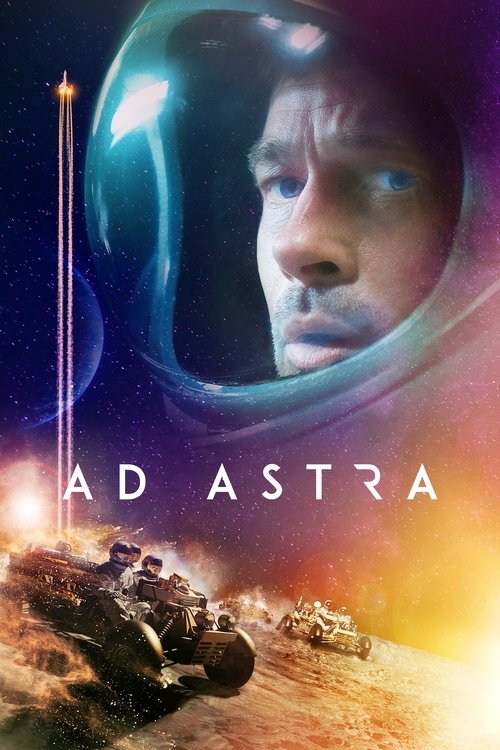
Ad Astra
Ad Astra Sends a Son to the Edge of the Solar System to Kill the Idea of the Perfect Father
Directed by James Gray
The mission is to reach Neptune. The real mission is to survive discovering that the man he worshipped found nothing out there and would not come home.
Roy McBride is an astronaut whose resting heart rate never breaks eighty, even in freefall from the top of the atmosphere. He is calm because he is dead inside, and he is dead inside because his father left for deep space when Roy was a boy and never returned. Now the surges threatening earth trace back to his father's abandoned ship at Neptune, and the agency sends Roy to make contact. The film wears the skin of hard science fiction, a plausible near-future of moon pirates and commercial spaceports. Beneath the vacuum-sealed calm it is one of the most naked father films ever made. James Gray uses the entire solar system as the distance a son must cross to reach a father who was never reachable, and the discovery at the end of that crossing is that the greatness he inherited as a wound was itself a wound.
Jungian Reading: The Father Complex Projected Across the Planets
Jung described the father complex as an inner constellation, an image of the father that governs a man's sense of authority, worth, and his own capacity to feel, often long after the actual father is gone. Roy's father Clifford is that image made literal, a legend at the edge of the system, worshipped by the culture, silent and unreachable. Roy has organized his entire self around him: the same profession, the same suppressed affect, the same abandonment of a wife he could not stay present for. He is becoming his father by trying to reach him.
The journey outward is the journey inward. Each leg strips Roy of another layer of the persona, until on the long solo transit to Neptune he speaks aloud the confessions he has never made. When he finally finds Clifford, the confrontation delivers the Jungian shock: the great father is a frightened, obsessed old man who found no intelligent life, refuses to accept that his life's work was empty, and will not return even for his son. Roy must let him drift off into the dark to save himself. Individuation here is exact: the son withdraws the projection, sees the father as a limited man rather than a god, and is freed to feel. He comes home with a pulse that finally rises.
Sufi Reading: The Annihilation of the Beloved Who Was Never God
In Sufi practice the seeker moves through fana, the annihilation of the false self and its idols, toward baqa, the abiding in true love that follows. The danger the tradition warns against is fixing the infinite longing onto a finite object, mistaking a created thing for the Beloved. Clifford is Roy's idol, the finite man onto whom Roy has projected the absolute. His father searched the void for God in the form of alien contact and found only silence, and could not bear that the silence might be the answer.
Roy's release of his father into space is fana enacted, the burning away of the idol. What returns to him is baqa: not cosmic revelation but the ordinary presence he abandoned, his wife's face, the willingness to be touched. The teaching lands quietly. The love he crossed four billion miles to find was never at Neptune. It was the thing he kept refusing at home because he was still worshipping a man who was only a man.
Other journeys where the destination is a father or a void: Contact (the daughter who crosses the galaxy to meet her father again), Solaris (the mission that returns the traveler to his own grief), Interstellar (the father and child divided by the same immensity).
Questions this film answers
What is the deeper meaning of Ad Astra?
Roy McBride is an astronaut whose resting heart rate never breaks eighty, even in freefall from the top of the atmosphere. He is calm because he is dead inside, and he is dead inside because his father left for deep space when Roy was a boy and never returned. Now the surges threatening earth trace back to his father's abandoned ship at Neptune, and the agency sends Roy to make contact. The film wears the skin of hard science fiction, a plausible near-future of moon pirates and commercial spaceports. Beneath the vacuum-sealed calm it is one of the most naked father films ever made. James Gray uses the entire solar system as the distance a son must cross to reach a father who was never reachable, and the discovery at the end of that crossing is that the greatness he inherited as a wound was itself a wound.
What is the hidden symbolism in Ad Astra?
Jung described the father complex as an inner constellation, an image of the father that governs a man's sense of authority, worth, and his own capacity to feel, often long after the actual father is gone. Roy's father Clifford is that image made literal, a legend at the edge of the system, worshipped by the culture, silent and unreachable. Roy has organized his entire self around him: the same profession, the same suppressed affect, the same abandonment of a wife he could not stay present for. He is becoming his father by trying to reach him.
What esoteric traditions appear in Ad Astra?
Ad Astra draws from Jungian, Sufism traditions. The mission is to reach Neptune. The real mission is to survive discovering that the man he worshipped found nothing out there and would not come home.
Is Ad Astra worth watching for spiritual seekers?
Ad Astra (2019) directed by James Gray is essential viewing for those interested in Jungian, Sufism. Ad Astra Sends a Son to the Edge of the Solar System to Kill the Idea of the Perfect Father. It rewards multiple viewings and contemplation.
Rewatch With New Eyes
Now that you've seen the architecture, experience it again. The same film becomes a different film when you know what to watch for.
This time, watch for:
- Meet the shadow: what is rejected, projected, and finally integrated
- Feel the love that transforms: what the heart sees that the mind cannot
Links may include affiliate partnerships that support Media Revelations