The Midnight Sky
The Midnight Sky Is a Dying Man Talking Himself Into Being Forgiven
Directed by George Clooney
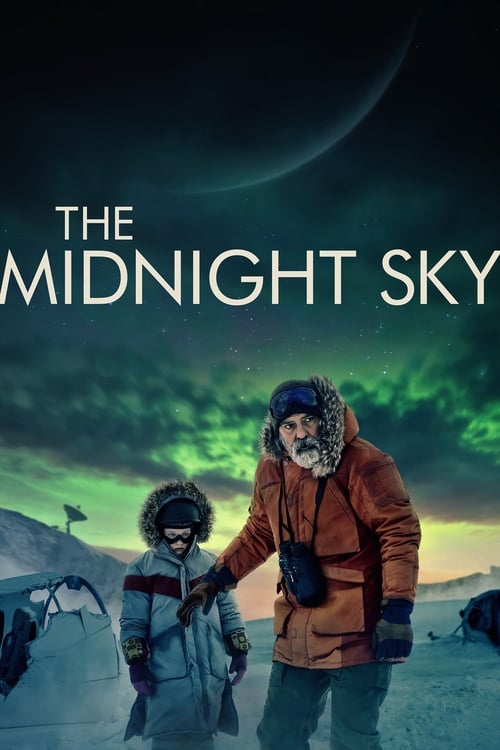
Clooney directs himself as a scientist alone at the end of the world. The catastrophe is real. The confession underneath it is the film.
Augustine Lofthouse is a terminally ill scientist who stays behind in an Arctic observatory after a global cataclysm, racing to warn a returning spacecraft not to land on a poisoned Earth. He discovers a mute child, Iris, apparently left behind, and drags himself and her across the ice to a working antenna. The disaster-survival surface is thin and everyone senses it. What holds the film is the twist you can see coming and are meant to: the astronaut Sully, whom Augustine is straining to reach, is his own daughter, and the child Iris is a projection of the daughter he abandoned to his work decades ago. Augustine is not saving the world. The world is already lost. He is trying, in his last days, to deliver one message to the one person he failed, and the child beside him is the guilt he has finally chosen to walk with instead of away from.
Gnostic Reading: A Poisoned World and the Signal to Not Come Home
Gnosticism holds that the material world is a fallen, corrupted place, and that salvation is not fixing it but receiving the call to return to the light beyond it. The Midnight Sky is Gnostic to the bone. Earth is finished, its atmosphere turned lethal by an unnamed catastrophe, humanity underground or dead. Augustine's entire mission is a single Gnostic act: to send the returning souls the one message that matters, which is do not descend into this world, it cannot hold you, turn back toward the stars.
The spacecraft Aether even carries the name of the pure upper air the Gnostics placed above the corrupt lower cosmos. Sully and her crew are the pneumatic remnant, the sparks that must not be lured back down into matter. Salvation here is not landing. It is being told, in time, that there is nowhere to land. Augustine, the dying man in the ruined world, becomes the messenger who exists only to warn the light away from the darkness he is trapped in. He cannot leave the fallen Earth. He can only make sure his daughter does not return to it.
Buddhist Reading: The Companion Who Was Never There
The Buddhist analysis of suffering rests on clinging, and on the illusion of a separate, solid self that the mind constructs and defends. Iris is the film's clearest teaching. Augustine treats her as real for most of the journey, speaks to her, protects her, risks his life for her, and only near the end does the film confirm she is a projection, a mental image born of the child he could not love when love was possible.
She is his attachment made visible. Augustine spent a lifetime abandoning the human for the abstract, choosing the cosmos over his own daughter, and now, dying, his mind manufactures the child so he can finally do the thing he never did: stay, tend, carry. The teaching is quiet and severe. The companionship he longs for was always something he generated inside his own suffering, and recognizing that Iris is not there is the moment he stops clinging to a redemption he can only rehearse alone. When she vanishes and he sits with the truth of his solitude, he is closer to peace than at any point he spent pretending she was beside him.
Questions this film answers
What is the deeper meaning of The Midnight Sky?
Augustine Lofthouse is a terminally ill scientist who stays behind in an Arctic observatory after a global cataclysm, racing to warn a returning spacecraft not to land on a poisoned Earth. He discovers a mute child, Iris, apparently left behind, and drags himself and her across the ice to a working antenna. The disaster-survival surface is thin and everyone senses it. What holds the film is the twist you can see coming and are meant to: the astronaut Sully, whom Augustine is straining to reach, is his own daughter, and the child Iris is a projection of the daughter he abandoned to his work decades ago. Augustine is not saving the world. The world is already lost. He is trying, in his last days, to deliver one message to the one person he failed, and the child beside him is the guilt he has finally chosen to walk with instead of away from.
What is the hidden symbolism in The Midnight Sky?
Gnosticism holds that the material world is a fallen, corrupted place, and that salvation is not fixing it but receiving the call to return to the light beyond it. The Midnight Sky is Gnostic to the bone. Earth is finished, its atmosphere turned lethal by an unnamed catastrophe, humanity underground or dead. Augustine's entire mission is a single Gnostic act: to send the returning souls the one message that matters, which is do not descend into this world, it cannot hold you, turn back toward the stars.
What esoteric traditions appear in The Midnight Sky?
The Midnight Sky draws from Gnosticism, Buddhism traditions. Clooney directs himself as a scientist alone at the end of the world. The catastrophe is real. The confession underneath it is the film.
Is The Midnight Sky worth watching for spiritual seekers?
The Midnight Sky (2020) directed by George Clooney is essential viewing for those interested in Gnosticism, Buddhism. The Midnight Sky Is a Dying Man Talking Himself Into Being Forgiven. It rewards multiple viewings and contemplation.
Rewatch With New Eyes
Now that you've seen the architecture, experience it again. The same film becomes a different film when you know what to watch for.
This time, watch for:
- Watch for the false world vs. the real — who is asleep, who awakens
- See impermanence: what clings, what releases, what remains
Links may include affiliate partnerships that support Media Revelations
The Descent Continues
Where this thread leads next.
Ad Astra 2019
Ad Astra Sends a Son to the Edge of the Solar System to Kill the Idea of the Perfect Father
Read the revelation →