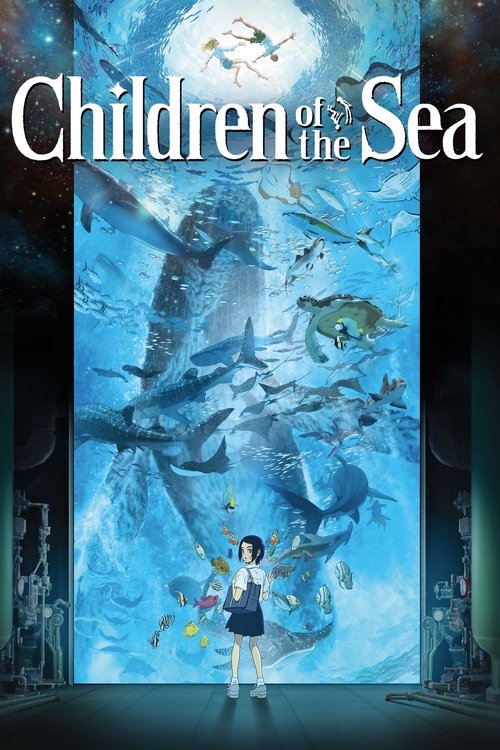
Children of the Sea
Children of the Sea Stages a Cosmic Birth and Asks You to Feel It Instead of Understand It
Directed by Ayumu Watanabe
Ayumu Watanabe adapts Daisuke Igarashi's manga into a film that abandons plot at its climax and becomes pure sensory cosmology. If you leave confused, you were watching correctly. The confusion is the point of entry.
Ruka is a lonely teenage girl whose parents have separated and whose summer is a wound. At her father's aquarium she meets Umi and Sora, two boys raised in the ocean by dugongs, who glow, who cannot survive long out of water, and who are somehow connected to a global phenomenon: sea creatures vanishing, meteors falling, the whole ocean gathering toward a single event. The boys speak in riddles about the sea being a womb and the sky being an ocean and stars being living things. The narrative deliberately dissolves. By the final act there is no more explanation, only a wordless cosmic festival that pours through Ruka's body. The film is not withholding its meaning. It is insisting the meaning cannot be told, only undergone.
Shamanic Reading: The Girl Who Is Chosen as the Vessel of the Ceremony
Ruka is a shamanic initiate, selected not for what she knows but for what she can hold. The film marks her as chosen through a physical sign: she swallows a small meteorite fragment, a luminous seed, which lives inside her body and makes her the human vessel for the great event. This is the shaman's calling rendered literally. She did not seek it, she cannot explain it, and her ordinary life becomes unlivable until she surrenders to the ceremony her body has been drafted into.
The old man Jim and the researcher Anglade are the tradition-keepers, the ones who have studied the signs across cultures and know a birth is coming but cannot themselves be the vessel. Umi and Sora are psychopomps, guides between the human world and the oceanic other-world, and like all true guides they cannot survive the crossing they enable. Sora dissolves into light. The climactic sequence is a full shamanic journey: Ruka's consciousness leaves her body, travels through the birth of a cosmos, witnesses the marriage of sea and sky, and returns. She comes back unable to articulate it. Every returning shaman says the same thing. There are no words for the other side.
Gnostic Reading: The Universe Remembering It Is One Thing
The film's cosmology is a direct transmission of the Gnostic intuition that the material multiplicity we see is a fragmentation of an original unity, and that the true event is the pleroma, the fullness, briefly becoming visible. The boys keep saying the sea and the sky are the same thing, that living beings are stars and stars are living beings, that everything separate is secretly one body. This is not metaphor in the film's logic. The great festival is the moment the fragmented cosmos gathers back into wholeness and a new totality is born from it.
Ruka's role is to receive the spark. The luminous seed inside her is gnosis in its purest form, not knowledge as information but knowledge as substance, a piece of the source lodged in an ordinary body. When the ceremony completes, she carries the memory of unity back into a world of separation, which is exactly the Gnostic's predicament: to have seen the fullness and then to live inside the fragments. Her final calm is the calm of someone who no longer believes the surface is the whole story, because for one night her body was the doorway the whole story passed through.
Questions this film answers
What is the deeper meaning of Children of the Sea?
Ruka is a lonely teenage girl whose parents have separated and whose summer is a wound. At her father's aquarium she meets Umi and Sora, two boys raised in the ocean by dugongs, who glow, who cannot survive long out of water, and who are somehow connected to a global phenomenon: sea creatures vanishing, meteors falling, the whole ocean gathering toward a single event. The boys speak in riddles about the sea being a womb and the sky being an ocean and stars being living things. The narrative deliberately dissolves. By the final act there is no more explanation, only a wordless cosmic festival that pours through Ruka's body. The film is not withholding its meaning. It is insisting the meaning cannot be told, only undergone.
What is the hidden symbolism in Children of the Sea?
Ruka is a shamanic initiate, selected not for what she knows but for what she can hold. The film marks her as chosen through a physical sign: she swallows a small meteorite fragment, a luminous seed, which lives inside her body and makes her the human vessel for the great event. This is the shaman's calling rendered literally. She did not seek it, she cannot explain it, and her ordinary life becomes unlivable until she surrenders to the ceremony her body has been drafted into.
What esoteric traditions appear in Children of the Sea?
Children of the Sea draws from Shamanism, Gnosticism traditions. Ayumu Watanabe adapts Daisuke Igarashi's manga into a film that abandons plot at its climax and becomes pure sensory cosmology. If you leave confused, you were watching correctly. The confusion is the point of entry.
Is Children of the Sea worth watching for spiritual seekers?
Children of the Sea (2019) directed by Ayumu Watanabe is essential viewing for those interested in Shamanism, Gnosticism. Children of the Sea Stages a Cosmic Birth and Asks You to Feel It Instead of Understand It. It rewards multiple viewings and contemplation.
Rewatch With New Eyes
Now that you've seen the architecture, experience it again. The same film becomes a different film when you know what to watch for.
This time, watch for:
- Follow the descent: what dies, what guides, what returns transformed
- Watch for the false world vs. the real — who is asleep, who awakens
Links may include affiliate partnerships that support Media Revelations