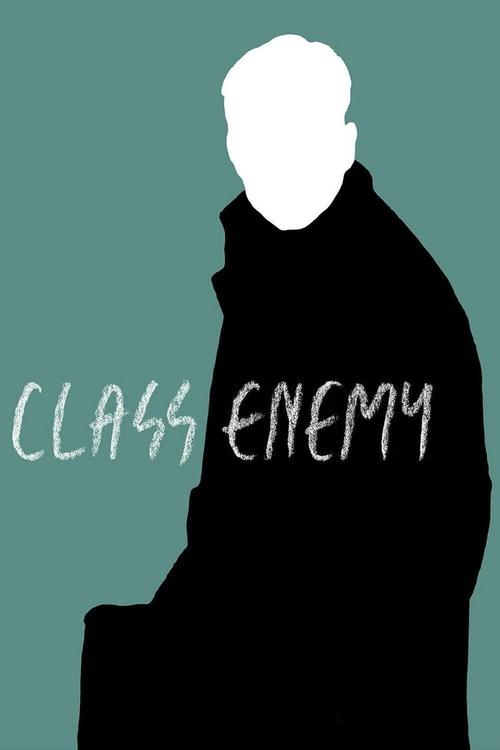
Class Enemy
Class Enemy Is About a Classroom That Needs a Villain More Than It Needs the Truth
Directed by Rok Biček
A girl dies, a room of teenagers require a face to blame, and the cold new German teacher volunteers to be the wound they can point at.
Robič, the substitute teacher, arrives rigid, formal, and unloved. He speaks in the vocabulary of discipline and demand. When a fragile student, Sabina, takes her own life shortly after a private conversation with him, the class seizes on a single explanation: he killed her. The surface reading is a drama about an authoritarian teacher and a rebellion against him. What the film actually stages is something colder and more universal: a group of grieving young people who cannot metabolize a meaningless death, and who manufacture a guilty party because guilt is bearable and randomness is not. The teacher may be cruel. He is almost certainly not a murderer. The class does not need him to be one. They need someone to carry the unbearable, and he is standing there in a suit, refusing to perform warmth, perfectly cast for the role.
Jungian Reading: The Scapegoat as the Group's Projected Shadow
Jung understood that a collective under stress does not sit with its own darkness. It finds a carrier. The shadow, the disowned guilt and helplessness of the group, gets loaded onto a single figure who is then cast out, and the ritual of expulsion gives the group a temporary, false sense of cleanliness. This is exactly the mechanism the class runs.
The students had their own failures with Sabina. They ignored her, mocked her, left her isolated. That guilt is intolerable, so it is transferred wholesale onto Robič, whose Germanness, coldness, and talk of order make him the ideal screen. Watch how the accusation hardens into certainty without any evidence appearing. The graffiti, the boycott, the chants against the "Nazi" teacher: none of it investigates what happened. It only strengthens the projection. The film's discomfort comes from how right the ritual feels to the students and how clearly we see it is a defense. They are not seeking justice. They are exporting their shadow so they do not have to face it in themselves.
Initiatory Reading: A Failed Threshold and the Teacher Who Would Not Bless It
Every real initiation requires an elder who holds firm while the young are broken open and reformed. The classic initiator is stern, even frightening, because his refusal to coddle is what forces the initiate to find their own strength. Robič is shaped exactly like this elder. He demands rigor, refuses flattery, treats the students as capable of more than they want to be.
But initiation only completes if the elder eventually offers the blessing, the moment of recognition that says: you have crossed, you are now more than you were. Robič never gives it, or gives it too late and too coldly to land. The threshold experience arrives anyway, in the form of Sabina's death, an encounter with mortality dropped into the middle of adolescence. The students stand at a genuine gate. Without an elder they trust to guide the passage, they cannot move through it into maturity. So they invert the initiation. Instead of being reshaped by the encounter with death, they attack the man who might have led them through it. The unblessed initiate does not simply fail to grow. He turns on the failed guide, and the film ends with the wound still open, the crossing refused.
Questions this film answers
What is the deeper meaning of Class Enemy?
Robič, the substitute teacher, arrives rigid, formal, and unloved. He speaks in the vocabulary of discipline and demand. When a fragile student, Sabina, takes her own life shortly after a private conversation with him, the class seizes on a single explanation: he killed her. The surface reading is a drama about an authoritarian teacher and a rebellion against him. What the film actually stages is something colder and more universal: a group of grieving young people who cannot metabolize a meaningless death, and who manufacture a guilty party because guilt is bearable and randomness is not. The teacher may be cruel. He is almost certainly not a murderer. The class does not need him to be one. They need someone to carry the unbearable, and he is standing there in a suit, refusing to perform warmth, perfectly cast for the role.
What is the hidden symbolism in Class Enemy?
Jung understood that a collective under stress does not sit with its own darkness. It finds a carrier. The shadow, the disowned guilt and helplessness of the group, gets loaded onto a single figure who is then cast out, and the ritual of expulsion gives the group a temporary, false sense of cleanliness. This is exactly the mechanism the class runs.
What esoteric traditions appear in Class Enemy?
Class Enemy draws from Jungian, Initiation traditions. A girl dies, a room of teenagers require a face to blame, and the cold new German teacher volunteers to be the wound they can point at.
Is Class Enemy worth watching for spiritual seekers?
Class Enemy (2013) directed by Rok Biček is essential viewing for those interested in Jungian, Initiation. Class Enemy Is About a Classroom That Needs a Villain More Than It Needs the Truth. It rewards multiple viewings and contemplation.
Rewatch With New Eyes
Now that you've seen the architecture, experience it again. The same film becomes a different film when you know what to watch for.
This time, watch for:
- Meet the shadow: what is rejected, projected, and finally integrated
- Mark the threshold: the old self dies, the ordeal transforms, the new self returns
Links may include affiliate partnerships that support Media Revelations
The Descent Continues
Where this thread leads next.

The Wicker Man 1973
The Sacrifice the Christian Did Not Know He Volunteered For
Read the revelation →