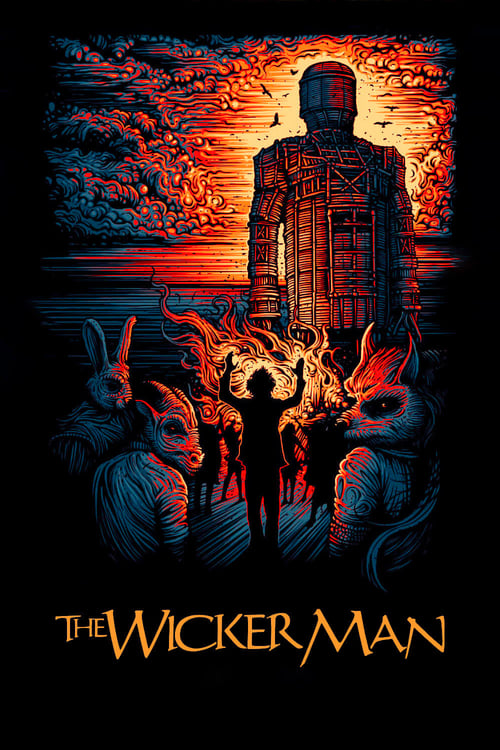
The Wicker Man
The Sacrifice the Christian Did Not Know He Volunteered For
Directed by Robin Hardy
The Wicker Man is the most precise depiction of pre-Christian sacrificial logic in twentieth-century cinema. Howie is not lured to Summerisle. He is invited to a role he meets every requirement for: a king, a virgin, a fool, a willing victim. The film does not take a side. It shows the old gods at work and lets the viewer feel why the rite still works on islands where it has been performed for two thousand years.
The Wicker Man is the founding text of folk horror and the most theologically literate film ever made about the difference between Christianity and what Christianity replaced. Robin Hardy and screenwriter Anthony Shaffer did not make an anti-pagan film. They did not make an anti-Christian film either. They made a film that takes seriously, perhaps more seriously than any other in the genre, what the old sacrificial religions actually understood about the relationship between human death and crop fertility. Howie is the protagonist. Howie is also, mythologically, the correct victim. The film's terror is not that Summerisle is evil. The film's terror is that Summerisle is operating on a logic older than evil, older than the modern category of innocence, and that the logic might still work.
The Surface
A devout Scottish police sergeant flies to a remote Hebridean island to investigate the disappearance of a young girl. The islanders are friendly, evasive, and openly pagan. Children dance around maypoles. Couples copulate in the fields. The schoolmistress teaches the meaning of the phallic symbol. Howie searches for the missing girl while becoming increasingly horrified by what he is finding. He is led, by his own investigation, to a wicker giant on the cliffs on May Day. The villagers reveal that he was the target all along. They burn him alive inside the wicker man as the harvest sacrifice.
On surface, the film is folk horror's founding shock — a Christian's terror at the persistence of paganism in modern Britain. The ending is justly famous as one of cinema's most upsetting reversals. Howie thought he was the detective. He was the lamb.
Underneath, the film is a much more careful theological essay. Shaffer's screenplay treats the islanders not as villains but as practitioners of a coherent religion with internal logic, calendrical precision, and demonstrable historical pedigree. The film does not endorse them. It also refuses to dismiss them. It documents them. The horror is sharpened by the documentation.
The King Who Volunteers
Lord Summerisle, in the film's most chilling exposition, explains the criteria. The sacrifice must be a king. He must be a virgin. He must be a fool. He must come of his own free will. Howie meets every requirement. He is a representative of the crown. He has remained chaste in service to his faith. He came to the island under his own authority, refusing to leave when warned. The criteria were not imposed on him. He performed them.
This is the precision of pre-Christian sacrificial logic. The victim is not abducted. The victim is recognized. The community waits, ritually, for the candidate who meets the conditions. When that candidate arrives, the community does not have to invent anything. The candidate's own structure has done the recruiting. The role exists. The seat is empty. The actor walks onstage.
Frazer's Golden Bough — which Shaffer treats as functional source material — documents this pattern across cultures and centuries. The sacrificed king is not a tragedy. The sacrificed king is an office. Ancient societies had filing systems for the role. The Wicker Man dramatizes the office still operating in 1973 on an island that never relinquished it.
Howie's faith makes him an ideal victim because his faith makes him incapable of recognizing the role he is performing. Christianity rewrote the king-sacrifice as a one-time historical event — Christ on the cross, done forever, never to be repeated. Summerisle never accepted that rewrite. To Summerisle, the office of dying king is annual, structural, necessary. Howie is this year's incumbent.
Christianity and Its Predecessor
The film's most underrated layer is its precise theological framing. Lord Summerisle is not crudely anti-Christian. He explains, accurately, the history. His grandfather imported the old religion to revive a failed agricultural community. It worked. The crops returned. The community thrived. The religion was reinstated not because of mysticism but because of demonstrable yield.
Howie cannot hear this because Howie has been formed by a tradition that treats the old religions as already defeated. The Christian framing is that paganism is what came before, was correctly superseded, and any return to it is degeneration. Summerisle treats the same history differently. To him, Christianity is an interruption in a continuous agricultural-spiritual practice that the British Isles maintained for millennia and that briefly went underground when Rome imposed a new framework.
The film does not endorse Summerisle's position. But it also does not allow Howie's position to be the obvious correct one. By giving Christopher Lee's Summerisle the better lines, the better house, the better hair, the more articulate cosmology, Hardy is forcing the viewer to consider what was actually lost when the old religions were suppressed.
What was lost, the film suggests, is the practice of meeting death directly inside a ritual container. Christianity outsourced death to one historical figure. The old religions kept it annual, local, mutual. There were costs to that economy. Howie's burning is the cost. But there were also things that economy understood that Christianity stopped understanding. The film leaves the trade-off unresolved.
The Hare and the Apple
The film is full of small ritual signs the modern viewer is not trained to read. The coffin Howie opens at the cemetery contains a hare. The grocer mentions there will be no fresh apples this year — last year's harvest failed. Children draw concentric circles. Songs are sung at moments that seem decorative but are actually invocational.
Shaffer has written a film in which the genuine folklore is dense and functional. The hare is the form Bealtaine witches were said to take. The apple is the symbol of the goddess and the produce that has failed this year, requiring a stronger sacrifice. The schoolroom scene in which the children draw the maypole is the schoolmistress teaching cosmology — the maypole is the world axis, the umbilicus of the agricultural year.
This level of detail is what separates the film from imitators. The horror is not the screaming pagan stereotype. The horror is calm, schooled, deeply traditional practice continuing in 1973 with the same internal coherence it had in 1373. Children are not being indoctrinated. They are being educated, in the literal sense of being given a coherent framework for the relationship between human life and the natural year.
Howie's investigation is unintentionally an ethnography. He keeps documenting practices he refuses to recognize as continuous, ancient, and operational. He looks at evidence of an extant religion and sees only deviance. This is itself the film's diagnosis of the modern Christian gaze. The old religions did not disappear. They were classified as folklore. They kept operating under the new label.
The Transmission
The Wicker Man delivers a specific transmission that most folk horror imitators have failed to replicate: the queasy recognition that the rite might still work. The film does not assert that the crop returned because of Howie's death. It also does not deny it. The credits roll on the wicker man burning and the islanders singing the Sumer Is Icumen In hymn, and the viewer is left in the position the modern person hardly ever inhabits: unable to dismiss what they have just seen as superstition, also unable to endorse it.
This is the gift the film gives. After The Wicker Man, the historical relationship between Christianity and what it replaced cannot be filed in the comfortable drawer of progress. The old religions were technologies. They had purposes. They had results. The cultures that abandoned them paid prices, some of which we are still discovering.
Hardy and Shaffer did not write a manifesto. They wrote a horror film. The horror is the genre's wrapping. Inside is one of the most serious meditations on religious history in twentieth-century British cinema. Watch what you feel when the chorus starts singing as the wicker man burns. The discomfort is not just sympathy for Howie. It is the older sense that something genuinely ancient is being performed in front of you, and that you cannot quite be sure it is not effective.
Questions this film answers
What is the deeper meaning of The Wicker Man?
The Wicker Man is the founding text of folk horror and the most theologically literate film ever made about the difference between Christianity and what Christianity replaced. Robin Hardy and screenwriter Anthony Shaffer did not make an anti-pagan film. They did not make an anti-Christian film either. They made a film that takes seriously, perhaps more seriously than any other in the genre, what the old sacrificial religions actually understood about the relationship between human death and crop fertility. Howie is the protagonist. Howie is also, mythologically, the correct victim. The film's terror is not that Summerisle is evil. The film's terror is that Summerisle is operating on a logic older than evil, older than the modern category of innocence, and that the logic might still work.
What is the hidden symbolism in The Wicker Man?
A devout Scottish police sergeant flies to a remote Hebridean island to investigate the disappearance of a young girl. The islanders are friendly, evasive, and openly pagan. Children dance around maypoles. Couples copulate in the fields. The schoolmistress teaches the meaning of the phallic symbol. Howie searches for the missing girl while becoming increasingly horrified by what he is finding. He is led, by his own investigation, to a wicker giant on the cliffs on May Day. The villagers reveal that he was the target all along. They burn him alive inside the wicker man as the harvest sacrifice.
What esoteric traditions appear in The Wicker Man?
The Wicker Man draws from Shamanism, Initiation traditions. The Wicker Man is the most precise depiction of pre-Christian sacrificial logic in twentieth-century cinema. Howie is not lured to Summerisle. He is invited to a role he meets every requirement for: a king, a virgin, a fool, a willing victim. The film does not take a side. It shows the old gods at work and lets the viewer feel why the rite still works on islands where it has been performed for two thousand years.
What does The Wicker Man teach about the king who volunteers?
The community does not have to invent anything. The candidate's own structure has done the recruiting. The seat is empty. The actor walks onstage. Lord Summerisle, in the film's most chilling exposition, explains the criteria. The sacrifice must be a king. He must be a virgin. He must be a fool. He must come of his own free will. Howie meets every requirement. He is a representative of the crown. He has remained chaste in service to his faith. He came to the island under his own authority, refusing to leave when warned. The criteria were not imposed on him. He performed them.
What does The Wicker Man teach about christianity and its predecessor?
Christianity outsourced death to one historical figure. The old religions kept it annual, local, mutual. The film's most underrated layer is its precise theological framing. Lord Summerisle is not crudely anti-Christian. He explains, accurately, the history. His grandfather imported the old religion to revive a failed agricultural community. It worked. The crops returned. The community thrived. The religion was reinstated not because of mysticism but because of demonstrable yield.
Is The Wicker Man worth watching for spiritual seekers?
The Wicker Man (1973) directed by Robin Hardy is essential viewing for those interested in Shamanism, Sacrifice, Folk Horror. The Sacrifice the Christian Did Not Know He Volunteered For. It rewards multiple viewings and contemplation.
Rewatch With New Eyes
Now that you've seen the architecture, experience it again. The same film becomes a different film when you know what to watch for.
This time, watch for:
- Follow the descent: what dies, what guides, what returns transformed
- Mark the threshold: the old self dies, the ordeal transforms, the new self returns
Links may include affiliate partnerships that support Media Revelations
The Descent Continues
Where this thread leads next.
Midsommar 2019
The Horror of Finally Belonging
Read the revelation →