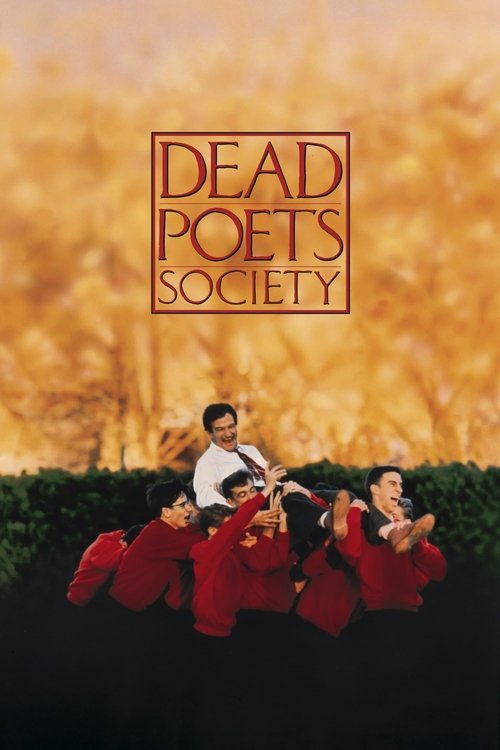
Dead Poets Society
Dead Poets Society Is an Initiation That Kills the Initiate the School Was Never Going to Let Live
Directed by Peter Weir
Keating does not teach poetry. He runs an initiation into being alive inside an institution built to prevent exactly that. The tragedy is structural: the awakening he offers and the world the boys must return to cannot both exist.
Welton Academy runs on four pillars: Tradition, Honor, Discipline, Excellence. The boys recite them like a liturgy. Into this sealed machine walks John Keating, an English teacher who tells them to rip the introduction out of their poetry textbook, stand on their desks to see the world from a new angle, and hear the dead urging carpe diem from behind the glass of old photographs. The film is remembered as a feel-good ode to inspiring teachers. It is closer to a horror story about what happens when a genuine initiator lights a fire inside boys whose entire external world is engineered to extinguish it. Neil Perry does not die because Keating fails. He dies because the initiation succeeded and there was nowhere to take it.
Initiatory Reading: The Cave, the Awakening, and the Guide Who Cannot Follow
Every real initiation has the same shape: the initiate is drawn into a hidden space, shown a truth the ordinary world conceals, transformed by it, and then must find a way to carry that transformation back. Keating gives the boys the hidden space literally. The old cave where the original Dead Poets met becomes the boys' underworld, the place outside the school's rules where they read verse, summon feeling, and become briefly real. This is the classic initiatory chamber, the space set apart where the soul is worked on.
Neil is the one who fully awakens. He discovers he is a person who wants to act, to make something, to live from his own center rather than his father's script. His performance as Puck in A Midsummer Night's Dream is the moment of genuine transformation, a boy fully inhabiting his own life for the first time. But the initiatory law the film obeys is the hard one: the guide cannot follow the initiate into the return. Keating can wake Neil. He cannot protect him from a father who treats the awakening as insubordination. Neil, unable to return the fire to the world that made him and unwilling to let it die, chooses the only exit left. The initiation was real. That is exactly why it was fatal.
Gnostic Reading: The School Is the Archon System, and Waking Up Is Forbidden
Welton is a perfect Gnostic prison. Its four pillars are the laws of a lower order that mistakes obedience for virtue and conformity for excellence. The parents, the headmaster Nolan, Neil's father: these are the Archons of the system, powers that manage the boys' lives entirely, deciding their careers, their feelings, their futures, and reacting to any spark of independent awareness as a malfunction to be corrected.
Keating is the Gnostic messenger, the outsider who slips in to tell the trapped sparks that they are more than the roles assigned to them. "We are food for worms, lads," he says over the old photographs, which sounds morbid but is pure Gnostic gnosis: your time in the machine is short, so wake up now. The system's response is the response every controlling order gives to a messenger of awakening. It finds a death to blame on him, extracts forced confessions from the boys, and expels the teacher. The final image, the boys standing on their desks as Keating leaves, is not victory. It is a handful of sparks acknowledging the one who woke them, even as the machine closes back over them.
Questions this film answers
What is the deeper meaning of Dead Poets Society?
Welton Academy runs on four pillars: Tradition, Honor, Discipline, Excellence. The boys recite them like a liturgy. Into this sealed machine walks John Keating, an English teacher who tells them to rip the introduction out of their poetry textbook, stand on their desks to see the world from a new angle, and hear the dead urging carpe diem from behind the glass of old photographs. The film is remembered as a feel-good ode to inspiring teachers. It is closer to a horror story about what happens when a genuine initiator lights a fire inside boys whose entire external world is engineered to extinguish it. Neil Perry does not die because Keating fails. He dies because the initiation succeeded and there was nowhere to take it.
What is the hidden symbolism in Dead Poets Society?
Every real initiation has the same shape: the initiate is drawn into a hidden space, shown a truth the ordinary world conceals, transformed by it, and then must find a way to carry that transformation back. Keating gives the boys the hidden space literally. The old cave where the original Dead Poets met becomes the boys' underworld, the place outside the school's rules where they read verse, summon feeling, and become briefly real. This is the classic initiatory chamber, the space set apart where the soul is worked on.
What esoteric traditions appear in Dead Poets Society?
Dead Poets Society draws from Initiation, Gnosticism traditions. Keating does not teach poetry. He runs an initiation into being alive inside an institution built to prevent exactly that. The tragedy is structural: the awakening he offers and the world the boys must return to cannot both exist.
Is Dead Poets Society worth watching for spiritual seekers?
Dead Poets Society (1989) directed by Peter Weir is essential viewing for those interested in Initiation, Gnosticism. Dead Poets Society Is an Initiation That Kills the Initiate the School Was Never Going to Let Live. It rewards multiple viewings and contemplation.
Rewatch With New Eyes
Now that you've seen the architecture, experience it again. The same film becomes a different film when you know what to watch for.
This time, watch for:
- Mark the threshold: the old self dies, the ordeal transforms, the new self returns
- Watch for the false world vs. the real — who is asleep, who awakens
Links may include affiliate partnerships that support Media Revelations
The Descent Continues
Where this thread leads next.
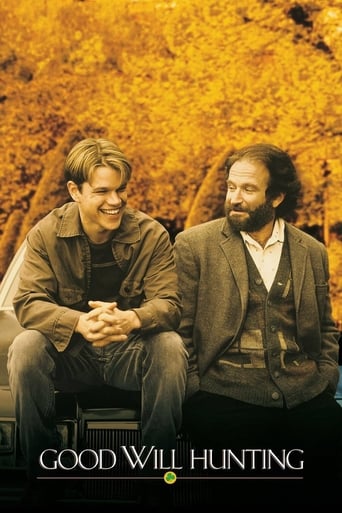
Good Will Hunting 1997
Good Will Hunting Is About a Genius Using Brilliance to Avoid Being Known
Read the revelation →