Dunkirk
Three Tempos Converging at the Threshold of Survival
Directed by Christopher Nolan
Nolan filmed a survival story using three different time signatures braided into one. The mole — one week. The sea — one day. The air — one hour. The three streams meet at the climax because the threshold they cross is the same threshold. The film is not about heroism. It is about the formal demonstration that time itself can be experienced at different rates by different bodies and that the meeting point is always the moment of transition.
Dunkirk is the rare Nolan film whose form is the whole content and whose content is the form. Nolan and editor Lee Smith built a war film without a war film's narrative architecture. There is no character backstory. There is almost no dialogue. There is no political contextualization. There are three braided timelines — the soldiers on the beach over a week, the civilian boat over a day, the Spitfire pilot over an hour — and the three meet at the moment of evacuation. The braid is the film's argument. Under conditions of survival pressure, time is not a single substance moving at a single rate. Time is a relation between bodies, threats, and remaining attention. The film transmits this not through dialogue but through pure cinematic operation. The Hans Zimmer score, built around a Shepard tone that perpetually rises without ever actually rising, embodies the same teaching at the level of sound. The viewer feels the tightening even though no event explains why the tightening is occurring. The film is what Buddhist phenomenology of time would look like if it had a hundred million dollar budget and IMAX cameras.
The Surface
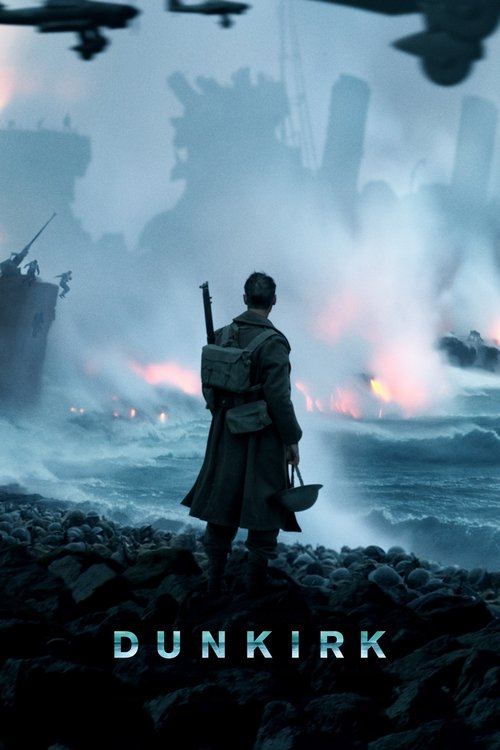
British and French troops are surrounded at the French port of Dunkirk in May and June of 1940. Nearly 400,000 soldiers must be evacuated across the Channel before German forces can complete the encirclement. The British navy is unable to commit destroyers due to risk of loss. The civilian fleet is requested. Hundreds of small civilian boats cross the Channel and bring the army home. The evacuation succeeds. The film follows three threads — a young soldier trying to get off the mole, a civilian father piloting his weekend boat across the Channel, a Spitfire pilot covering the retreat from above — and ends with the three threads converging.
On release the film was praised for its visceral immersion. Christopher Nolan's commitment to practical effects, IMAX cinematography, and a near-wordless screenplay were widely admired. Some criticism focused on the absence of broader political and historical context — the film does not name Hitler, does not show the Germans clearly, does not explain the strategic situation in detail.
These criticisms misread what the film is. It is not a history of Dunkirk. It is a meditation on what survival pressure does to time and attention. The historical setting is the materia. The film's actual operation is the demonstration of how cinema can do what verbal narrative cannot: layer simultaneous experiences of duration so that the viewer feels what the abstract concept of relativity actually means for the bodies that have to live through it.
Three Tempos as Three Realms
Buddhist cosmology distinguishes realms by, among other features, the experience of time native to each. The realm of the gods experiences time as nearly stopped. The realm of the hungry ghosts experiences time as agonizingly slow. The hell realms experience time as both unbearably long and continuously crisis-laden. The realms are not metaphors. They are descriptions of how a consciousness in a given karmic position actually experiences duration.
Nolan's three threads are three realms. The week on the mole is the realm of the hungry ghost — soldiers waiting, exposed, with food and water dwindling and salvation always just out of reach. Time is the enemy. Each hour is an opportunity for further death. The day on the sea is the realm of the human — a competent civilian doing the practical work, with time as both pressure and resource. The hour in the air is the realm of the heroic agent — fuel measured to the minute, every decision life or death, time compressed and crystallized to the point that single seconds carry strategic weight.
The film does not introduce this scheme to the viewer. The viewer is given the three threads in alternation and gradually realizes that the threads are operating at different rates. The realization is itself the teaching. Two characters meet in two threads at different time signatures. A character glimpsed on the mole at the start of his week is encountered by the civilian boat at the end of his day. The two are in the same shot. They have just experienced wildly different durations. The shot is both of their realities, simultaneously.
Nolan's most consistent thematic obsession across his career is the manipulation of time in service of psychological clarity. Memento, Inception, Interstellar, Tenet — all reach for the same operation. Dunkirk is the rare entry where the operation succeeds without metaphysical machinery. The relativity is not science-fictional. The relativity is what survival actually feels like to bodies under pressure.
The Shepard Tone as Sound of the Threshold
Hans Zimmer scored the film around a single auditory illusion: the Shepard tone, a layered set of notes engineered to seem to rise continuously while never actually exceeding its starting frequency. The score never resolves. The tension never releases. The film ends in a major key not because the threat has gone but because the perspective has shifted to the survivors who have made it home.
This is one of the most precise applications of musical theory to dramatic purpose in twenty-first century filmmaking. The Shepard tone is the sound equivalent of the film's narrative structure. The three timelines never stop pressuring. Even when one timeline cuts to relief, another is in crisis. The composite experience is sustained, escalating dread without the catharsis that conventional film grammar requires.
Buddhist contemplative practice would recognize this as the sound of the threshold experience. The bardo is described as a state of perpetual heightening — the consciousness in transit feels each moment as more urgent than the last, with no anchor in stable rhythm. The Shepard tone is the closest cinematic instrument has come to making that experience audible to a viewer who has not, yet, undergone the transition itself.
Combined with the film's near-absence of dialogue, the score becomes the actual narrator. It tells the viewer how to feel without telling them what to think. The technique is so effective that many viewers describe physical exhaustion after a single viewing. The film's runtime is barely 100 minutes. The compressed duration is part of the work. A longer film with conventional scoring could not have produced the same effect.
The Civilian Heroism Reframed
The film's emotional center is the civilian boat — the small craft sailed by Mr. Dawson, his son, and a local boy across the Channel into the war zone. They are not military. They have no formal training. They have a boat, knowledge of the sea, and a decision to make. The decision is to go.
Nolan films Dawson with the most respect available in his filmography. The man is competent without bravado. He does not lecture. He knows what Spitfires sound like. He knows what shock looks like in a young soldier. He has lost an older son to the war already, in the air, and the loss has not produced bitterness but rather a kind of quiet readiness. He is not the patriotic hero. He is the elder who has been initiated by prior loss into the position from which civilian heroism becomes possible.
His son George dies on the journey, struck in the head during a panic. Dawson does not perform the death. The civilian sailor accidentally responsible for the death is told George is fine. The boat continues. This is not a film about the false comfort. It is a film about the necessity of allowing the suffering man to keep functioning long enough to finish the mission. Dawson chooses what the moment requires. The choice is not heroic in the conventional sense. The choice is what the elder is for.
The civilian fleet that arrives at Dunkirk is the film's emblematic image. The hundreds of small boats appearing across the horizon. The commander turning to the colonel and saying, simply, 'Home.' This is what the older communal initiations were for — the production of a population capable of recognizing the moment when collective action is the only available response and capable, then, of performing it. The film locates this capacity in the civilians, not in the military. The military are passengers. The civilians are the saving instrument.
The Transmission
Dunkirk transmits a particular and unusual perception: that the body's experience of time under pressure is not a defect to be corrected but a window into how time actually operates. Most cinema flattens duration. Two hours of screen time conveys two hours of fictional time, or two years compressed to a montage. Dunkirk does the opposite. It expands and contracts duration so that the viewer leaves the theater with a calibrated sense that they have just been through something whose elapsed clock-time does not match the experiential weight.
What the film leaves viewers with is the sense — not the idea, the sense — that time is a relation, not a substance. This is a contemplative recognition that takes most meditation practitioners years to access directly. Nolan delivers it as the result of a feature-film experience. The film is operating as practice instrument without ever announcing itself as such.
The famous final beats — the soldier reading aloud Churchill's speech from a newspaper, the train carrying the men inland through countryside they thought they would never see again, the Spitfire's slow glide to its inevitable beach landing in enemy territory — close the film in a register of muted, exhausted gratitude that is something other than triumph. The men are alive. They feel they have failed. The civilians at the train station hand them blankets and tea. The film does not editorialize. The image is the gift. Survival, when it occurs against the run of probability, is the moment for which language has not yet been adequate. The film is the language attempting itself anyway.
Questions this film answers
What is the deeper meaning of Dunkirk?
Dunkirk is the rare Nolan film whose form is the whole content and whose content is the form. Nolan and editor Lee Smith built a war film without a war film's narrative architecture. There is no character backstory. There is almost no dialogue. There is no political contextualization. There are three braided timelines — the soldiers on the beach over a week, the civilian boat over a day, the Spitfire pilot over an hour — and the three meet at the moment of evacuation. The braid is the film's argument. Under conditions of survival pressure, time is not a single substance moving at a single rate. Time is a relation between bodies, threats, and remaining attention. The film transmits this not through dialogue but through pure cinematic operation. The Hans Zimmer score, built around a Shepard tone that perpetually rises without ever actually rising, embodies the same teaching at the level of sound. The viewer feels the tightening even though no event explains why the tightening is occurring. The film is what Buddhist phenomenology of time would look like if it had a hundred million dollar budget and IMAX cameras.
What is the hidden symbolism in Dunkirk?
British and French troops are surrounded at the French port of Dunkirk in May and June of 1940. Nearly 400,000 soldiers must be evacuated across the Channel before German forces can complete the encirclement. The British navy is unable to commit destroyers due to risk of loss. The civilian fleet is requested. Hundreds of small civilian boats cross the Channel and bring the army home. The evacuation succeeds. The film follows three threads — a young soldier trying to get off the mole, a civilian father piloting his weekend boat across the Channel, a Spitfire pilot covering the retreat from above — and ends with the three threads converging.
What esoteric traditions appear in Dunkirk?
Dunkirk draws from Buddhism, Initiation traditions. Nolan filmed a survival story using three different time signatures braided into one. The mole — one week. The sea — one day. The air — one hour. The three streams meet at the climax because the threshold they cross is the same threshold. The film is not about heroism. It is about the formal demonstration that time itself can be experienced at different rates by different bodies and that the meeting point is always the moment of transition.
What does Dunkirk teach about three tempos as three realms?
The relativity is not science-fictional. The relativity is what survival actually feels like to bodies under pressure. Buddhist cosmology distinguishes realms by, among other features, the experience of time native to each. The realm of the gods experiences time as nearly stopped. The realm of the hungry ghosts experiences time as agonizingly slow. The hell realms experience time as both unbearably long and continuously crisis-laden. The realms are not metaphors. They are descriptions of how a consciousness in a given karmic position actually experiences duration.
What does Dunkirk teach about the civilian heroism reframed?
The elder who has been initiated by prior loss into the position from which civilian heroism becomes possible. The film's emotional center is the civilian boat — the small craft sailed by Mr. Dawson, his son, and a local boy across the Channel into the war zone. They are not military. They have no formal training. They have a boat, knowledge of the sea, and a decision to make. The decision is to go.
Is Dunkirk worth watching for spiritual seekers?
Dunkirk (2017) directed by Christopher Nolan is essential viewing for those interested in Initiation, Buddhism, Nolan. Three Tempos Converging at the Threshold of Survival. It rewards multiple viewings and contemplation.
Rewatch With New Eyes
Now that you've seen the architecture, experience it again. The same film becomes a different film when you know what to watch for.
This time, watch for:
- See impermanence: what clings, what releases, what remains
- Mark the threshold: the old self dies, the ordeal transforms, the new self returns
Links may include affiliate partnerships that support Media Revelations
The Descent Continues
Where this thread leads next.
Interstellar 2014
Love as the Fifth-Dimensional Force
Read the revelation →