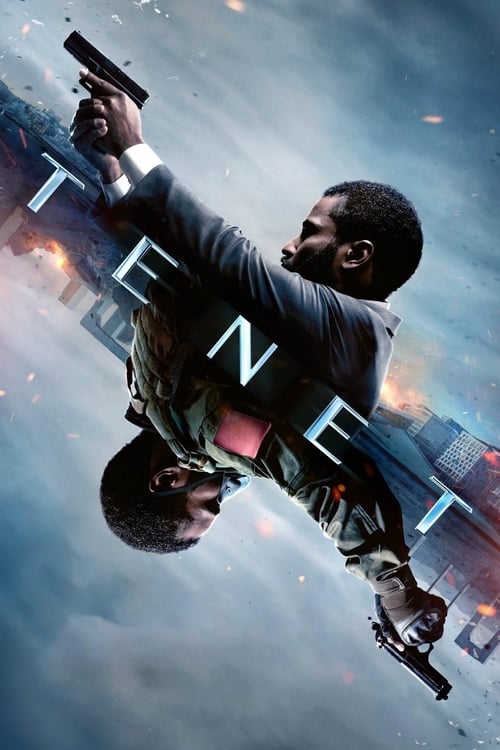
Nolan made the most expensive metaphysical puzzle ever attempted in a major studio film, and the puzzle is the teaching. The film's title is a palindrome. The film's structure is a palindrome. The middle is the mirror. The same agent appears on both sides of the mirror operating in opposite temporal directions. The film is not science fiction. The film is a Kabbalistic diagram with car chases.
Tenet is widely considered Nolan's most confusing film, and the confusion is the function. Underneath the bombastic action and the deliberately obscure exposition, Nolan and his collaborators have built a film whose structure is the ancient Sator Square — the Latin palindrome whose five words can be read in any direction and whose magical properties were taken seriously by Roman, medieval, and esoteric traditions for two thousand years. Every named element in the film comes from the square: Sator, Arepo, Tenet, Opera, Rotas. The film's structure is the palindrome made cinematic — every action on the forward leg has its mirror on the backward leg, and the protagonist meets himself at the center without recognition. This is not random. This is Nolan composing a Kabbalistic operation in the language of the spy thriller. The film's actual subject is not the prevention of an algorithm that reverses entropy. The film's actual subject is the recognition that consciousness moving forward in time is one possible configuration of awareness, not the necessary one, and that the structure of reality has room for the inverse direction even if our daily experience does not.
The Surface
An unnamed CIA agent — the Protagonist — survives an opera-house siege in Kyiv that turns out to have been a test. He is recruited into a secret organization called Tenet. The organization is concerned with technology from the future that allows objects (and eventually people) to move backwards through time at the level of their personal entropy. A future-aligned arms dealer, Sator, intends to assemble an Algorithm that will reverse the entropy of the entire planet, effectively destroying it from the perspective of forward-moving consciousness. The Protagonist, along with the mysterious operative Neil, must prevent this. The film moves through Mumbai, the Amalfi Coast, Vietnam, Norway, and Stalsk-12 in Russia. At the climax, the team conducts a 'temporal pincer movement' — half the squad moving forward through the operation, half moving backward. They succeed. Neil sacrifices himself. The Protagonist eventually realizes he is the founder of the Tenet organization that recruited him. Neil is implied to be the future grown-up son of Sator's wife Kat, sent back by an older version of the Protagonist to support the mission and to die. The film ends with the Protagonist beginning his work.
On release the film was praised for its ambition and criticized for its sound mixing and exposition. Audiences emerged confused. The pandemic delayed wide release and depressed box office. Nolan defended the film's complexity as intentional.
What is rarely discussed is that the film is structured according to a specific historical esoteric pattern. The Sator Square is not a Nolan invention. It is a five-word Latin palindrome that has been found in Pompeii, in medieval cathedrals, in early Christian iconography, and in alchemical texts. Each word can be read forward or backward. The square forms a magic word grid. Esoteric traditions have used the square as a meditation device for two millennia. Nolan and his team have built the film around it. Sator the villain is the title word. Arepo is the forger. Tenet is the organization. Opera is the opening setpiece. Rotas is the security firm storing the Algorithm. The film is the square dramatized.
The Sator Square as Operating Schematic
The Sator Square reads: SATOR AREPO TENET OPERA ROTAS It is symmetrical along multiple axes. SATOR backward is ROTAS. AREPO backward is OPERA. TENET is its own reverse, the axis around which the others mirror. The word TENET sits at the center of the square. It sits at the center of the film. It is the only word that does not have a separate inverse because it is its own inverse.
Kabbalistic and Hermetic traditions have long studied palindromes and word squares as encoded teachings. The idea is that linguistic structures whose symmetry survives reflection point at metaphysical truths beneath the conventional flow of meaning. Time, in such teachings, is itself an aspect of reality whose deeper structure may have symmetries the daily mind cannot directly perceive.
Nolan's film is the Sator Square as a story whose form encodes the same teaching. The Protagonist is a TENET — he is his own mirror. He is the one who, looking back, will turn out to have created the organization that recruited him. He has no name because the name would interfere with the structural function. Neil is the partner who has known him from the other side of the palindrome. The two have already had the friendship Neil knows is ending. The Protagonist is meeting Neil for the first time. The viewer experiences the asymmetry of their friendship as the film's most affecting throughline.
The film does not announce its esoteric structure. It does not flag the Sator Square. The choice to leave the teaching implicit is itself a teaching. The square has been hidden in plain sight for two thousand years. The film is hidden in plain sight inside its own action spectacle. Those who notice notice. Those who do not are still entertained. This is the classical esoteric mode.
The Temporal Pincer as Tantric Operation
The film's climactic operation — a 'temporal pincer movement' in which one squad advances forward through time and another retreats backward through time, with the two meeting at the objective from opposite directions — is the film's most original cinematic invention. It is also, structurally, an inversion of the meditation technique Tibetan tantra calls 'meeting the moment from both sides.'
In certain advanced Tibetan practices, the practitioner is trained to hold awareness simultaneously of the moment before an event and the moment after, collapsing the linear experience of cause-and-effect into a single, doubly-perceived now. The practice is difficult. Most practitioners take years to access it briefly. The fruit of the practice is a kind of liberation from the assumption that one is being carried forward by time in only one direction.
Nolan films this practice as a battle. The squads have the same objective. They approach it from opposite temporal directions. The forward squad sees the backward squad as moving backwards. The backward squad sees the forward squad as moving backwards. Both are correct from their own frame. The viewer's perceptual challenge is exactly the perceptual challenge the practice trains. Holding both perspectives simultaneously without collapsing one into the other.
The technique never resolves into clarity. The viewer remains slightly off-balance throughout the sequence. This is not a failure of the film. This is the film succeeding at modeling a perceptual state the viewer's daily life does not provide. Few films attempt this. None has attempted it on this scale. The Wachowskis' Cloud Atlas and Aronofsky's The Fountain are nearest, and neither has the spatial coherence the temporal pincer manages.
Sator as the Dying God Who Takes the World With Him
Kenneth Branagh's Sator is the film's only conventional villain, and he is conventional only on first viewing. On closer examination, Sator is the dying king who, given the technology to terminate the planet on his way out, intends to use it. His motivation is precisely the motivation of the Gnostic Demiurge dying in his bedroom — if I cannot have the world, no one will.
His pancreatic cancer is the film's most precise structural choice. Sator is going to die. He has known this for some time. He has accumulated power, beauty, intelligence, his wife Kat — and he is going to lose all of it. The Algorithm is his attempt to ensure that the world does not continue without him. The future faction that recruited him into the project is exploiting his terminal diagnosis. They have promised him agency. He believes he is doing it for them. He is actually doing it to escape the unbearability of a continuing world that will be enjoyed by other beings.
This is the most Gnostic diagnosis of evil available in twenty-first century cinema. Sator is not malicious in the cartoonish sense. Sator is small. The Algorithm is the small soul's revenge on a cosmos that did not arrange itself to include him permanently. Nolan films Sator's final scene — on his yacht, dying, watching what he thinks is the successful end of the world — with a kind of pity. The pity does not absolve him. The pity makes him intelligible.
Kat's response — killing him before he can see the operation's apparent success, robbing him of his last satisfaction — is the cleanest moment of justice in the film. The instrument is the wife he abused. The act is the refusal of the final possession. Sator does not get to die with the world dying. He dies with the world continuing. This is the appropriate sentence.
The Transmission
Tenet transmits a particular and difficult recognition: that the directionality of time may not be the only valid orientation a consciousness can have to reality. Most viewers receive this teaching as confusion. A smaller portion receives it as opening. The film is content to be misread by the majority because the structure encodes the teaching whether or not the viewer can articulate what they have received.
What it does for the viewer who watches more than once is install a permanent awareness that things one thought were one-way may be two-way under conditions one had not previously imagined. The friendship the Protagonist will have with Neil, the operation the Protagonist will found, the consequences the Protagonist will eventually take responsibility for — these are visible to the viewer at the end of the film in a way the Protagonist himself does not yet see. The viewer becomes the time-aware observer the Protagonist is on his way to becoming.
This is not just a structural trick. This is a teaching about how mature responsibility actually works. By the time you can see the whole pattern, the events that constitute the pattern have already happened. You did not choose them in the way you imagine choosing. You inherited them. Your job is to do the work that allows the pattern, retroactively, to make sense. The Protagonist begins the work at the end of the film because the work is what was always needed and the only person who could begin it is the person who has now seen the entire structure. The viewer who has watched the film twice has seen the structure too. The next step, the film implies, is in the viewer's hands.
Questions this film answers
What is the deeper meaning of Tenet?
Tenet is widely considered Nolan's most confusing film, and the confusion is the function. Underneath the bombastic action and the deliberately obscure exposition, Nolan and his collaborators have built a film whose structure is the ancient Sator Square — the Latin palindrome whose five words can be read in any direction and whose magical properties were taken seriously by Roman, medieval, and esoteric traditions for two thousand years. Every named element in the film comes from the square: Sator, Arepo, Tenet, Opera, Rotas. The film's structure is the palindrome made cinematic — every action on the forward leg has its mirror on the backward leg, and the protagonist meets himself at the center without recognition. This is not random. This is Nolan composing a Kabbalistic operation in the language of the spy thriller. The film's actual subject is not the prevention of an algorithm that reverses entropy. The film's actual subject is the recognition that consciousness moving forward in time is one possible configuration of awareness, not the necessary one, and that the structure of reality has room for the inverse direction even if our daily experience does not.
What is the hidden symbolism in Tenet?
An unnamed CIA agent — the Protagonist — survives an opera-house siege in Kyiv that turns out to have been a test. He is recruited into a secret organization called Tenet. The organization is concerned with technology from the future that allows objects (and eventually people) to move backwards through time at the level of their personal entropy. A future-aligned arms dealer, Sator, intends to assemble an Algorithm that will reverse the entropy of the entire planet, effectively destroying it from the perspective of forward-moving consciousness. The Protagonist, along with the mysterious operative Neil, must prevent this. The film moves through Mumbai, the Amalfi Coast, Vietnam, Norway, and Stalsk-12 in Russia. At the climax, the team conducts a 'temporal pincer movement' — half the squad moving forward through the operation, half moving backward. They succeed. Neil sacrifices himself. The Protagonist eventually realizes he is the founder of the Tenet organization that recruited him. Neil is implied to be the future grown-up son of Sator's wife Kat, sent back by an older version of the Protagonist to support the mission and to die. The film ends with the Protagonist beginning his work.
What esoteric traditions appear in Tenet?
Tenet draws from Kabbalah, Buddhism, Gnosticism traditions. Nolan made the most expensive metaphysical puzzle ever attempted in a major studio film, and the puzzle is the teaching. The film's title is a palindrome. The film's structure is a palindrome. The middle is the mirror. The same agent appears on both sides of the mirror operating in opposite temporal directions. The film is not science fiction. The film is a Kabbalistic diagram with car chases.
Is Tenet worth watching for spiritual seekers?
Tenet (2020) directed by Christopher Nolan is essential viewing for those interested in Kabbalah, Time, Nolan. The Palindrome as Cosmology. It rewards multiple viewings and contemplation.
Rewatch With New Eyes
Now that you've seen the architecture, experience it again. The same film becomes a different film when you know what to watch for.
This time, watch for:
- Notice the vessels: what contains, what shatters, what repairs
- See impermanence: what clings, what releases, what remains
- Watch for the false world vs. the real — who is asleep, who awakens
Links may include affiliate partnerships that support Media Revelations
The Descent Continues
Where this thread leads next.

Inception 2010
Dream Yoga and the Totem of Attachment
Read the revelation →