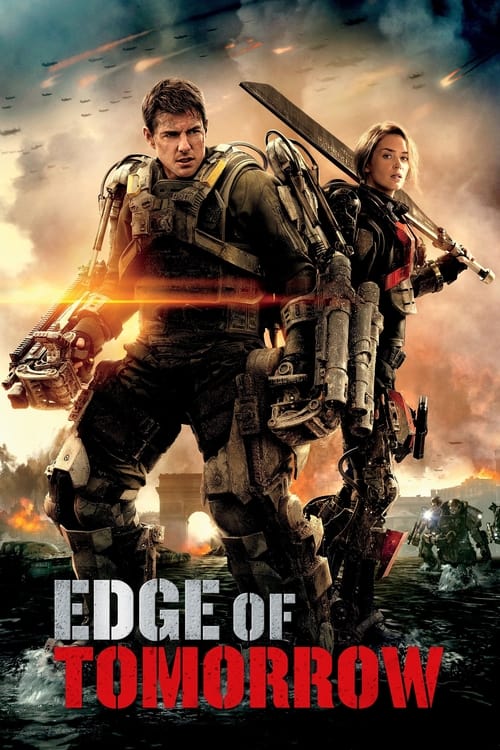
Edge of Tomorrow
Edge of Tomorrow Is a Coward Forced to Rehearse His Own Awakening Until It Takes
Directed by Doug Liman
The tagline was "Live. Die. Repeat." The teaching underneath it: you will keep dying at the same beach until you stop being the man who dies there.
Major William Cage is a public-relations officer who has never seen combat and will do anything to avoid it. He tries to blackmail a general to stay off the front. He is arrested, stripped of rank, and dropped onto a beach where he is dead within minutes. Then he wakes up on the same morning, at the same base, with the same duffel bag hitting the same pavement. The film's marketing sold it as a video-game action loop, and it is that. But the loop is not a gimmick laid over the story. The loop IS the story: a man of no courage and no character is sentenced to repeat a single day until courage and character are burned into him, and the alien enemy that grants him this power is, structurally, a machine of rebirth. Cage does not win the war by getting lucky. He wins it by becoming, across hundreds of erased lifetimes, a completely different human being.
Buddhist Reading: Samsara With the Mercy Left In
Cage lives and dies inside a perfect model of samsara. Each cycle he is reborn into the identical set of conditions, carrying forward only the residue of what he learned, dying again the instant his skill or nerve runs out. The Wheel of Life in Tibetan iconography is held in the jaws of Yama, Lord of Death, and it turns because beings keep grasping and keep flinching. Cage flinches constantly at first. He hides behind vehicles. He begs Rita to let him quit. His deaths are not heroic, they are the deaths of a man who has not yet stopped clinging to his own survival.
What breaks the wheel in Buddhist teaching is not force but the extinction of the grasping self. Watch the shift in Cage across the loops. Early, he fights to stay alive. Later, he throws himself onto grenades to reset the day faster, spending his own death like small change because he has stopped treating it as the ultimate loss. When Rita is killed on the farmhouse road for the hundredth time and he chooses to let the day end rather than drag her through it again, that is the exact moment the film locates liberation: he no longer acts to preserve himself or even his attachment. The loop only releases him once he has nothing left to protect.
Initiatory Reading: Rita Vrataski Is the Guide Who Cannot Cross With Him
Every initiation needs a hierophant who has already walked the passage. Rita has. She held this same power at Verdun, ran her own thousand deaths, and lost it when she was given a blood transfusion. She trains Cage the way a master trains a novice: by killing him. When he makes a mistake, she shoots him herself so the day will reset and the lesson can begin again. Her drillyard is the beach, her curriculum is his own repeated destruction, and she remembers none of it between cycles.
That is the initiatory tragedy the exemplars keep returning to. The guide gives the initiate everything and cannot follow. Cage carries Rita through the same road so many times that he knows her whole life, and she never knows him back. He graduates alone. She is the ferryman who cannot board the boat.
Questions this film answers
What is the deeper meaning of Edge of Tomorrow?
Major William Cage is a public-relations officer who has never seen combat and will do anything to avoid it. He tries to blackmail a general to stay off the front. He is arrested, stripped of rank, and dropped onto a beach where he is dead within minutes. Then he wakes up on the same morning, at the same base, with the same duffel bag hitting the same pavement. The film's marketing sold it as a video-game action loop, and it is that. But the loop is not a gimmick laid over the story. The loop IS the story: a man of no courage and no character is sentenced to repeat a single day until courage and character are burned into him, and the alien enemy that grants him this power is, structurally, a machine of rebirth. Cage does not win the war by getting lucky. He wins it by becoming, across hundreds of erased lifetimes, a completely different human being.
What is the hidden symbolism in Edge of Tomorrow?
Cage lives and dies inside a perfect model of samsara. Each cycle he is reborn into the identical set of conditions, carrying forward only the residue of what he learned, dying again the instant his skill or nerve runs out. The Wheel of Life in Tibetan iconography is held in the jaws of Yama, Lord of Death, and it turns because beings keep grasping and keep flinching. Cage flinches constantly at first. He hides behind vehicles. He begs Rita to let him quit. His deaths are not heroic, they are the deaths of a man who has not yet stopped clinging to his own survival.
What esoteric traditions appear in Edge of Tomorrow?
Edge of Tomorrow draws from Buddhism, Initiation traditions. The tagline was "Live. Die. Repeat." The teaching underneath it: you will keep dying at the same beach until you stop being the man who dies there.
Is Edge of Tomorrow worth watching for spiritual seekers?
Edge of Tomorrow (2014) directed by Doug Liman is essential viewing for those interested in Buddhism, Initiation. Edge of Tomorrow Is a Coward Forced to Rehearse His Own Awakening Until It Takes. It rewards multiple viewings and contemplation.
Rewatch With New Eyes
Now that you've seen the architecture, experience it again. The same film becomes a different film when you know what to watch for.
This time, watch for:
- See impermanence: what clings, what releases, what remains
- Mark the threshold: the old self dies, the ordeal transforms, the new self returns
Links may include affiliate partnerships that support Media Revelations
The Descent Continues
Where this thread leads next.

Source Code 2011
Source Code Is a Man Learning to Die Well, Eight Minutes at a Time
Read the revelation →