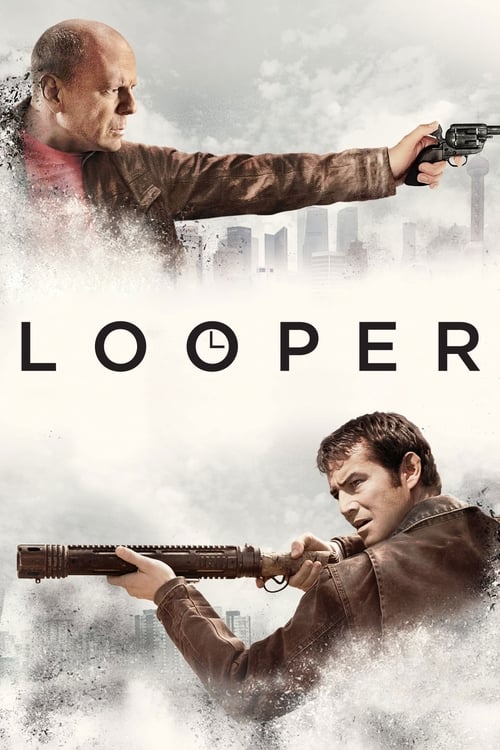
Looper
Looper Is About a Man Who Must Kill His Own Future to Free the Child He Would Otherwise Become
Directed by Rian Johnson
Time travel is the surface mechanism. The real machine is a man forced to confront the exact person he will turn into, and decide whether to let that person live.
In Looper, hired killers murder targets the mob sends back from the future, and eventually every looper is sent back his own older self to kill, "closing the loop." Young Joe hesitates, Old Joe escapes, and the two versions of one man hunt across the same landscape with opposite aims. Old Joe wants to murder the child who will grow into the crime lord who took his wife. Young Joe slowly grasps that the child, Cid, becomes a monster precisely because he watches his mother die at Old Joe's hands. The film's final move is not a shootout. Young Joe turns the gun on himself. He kills his own future so that the wound that would create the monster is never inflicted. This is not a paradox to be solved. It is a Jungian operation filmed as an action climax.
Jungian Reading: Old Joe Is the Shadow Made Flesh and Sent Back to Be Met
Jung insisted that what you refuse to face in yourself does not disappear. It goes autonomous, gains power, and eventually returns wearing your own face to demand recognition. Looper makes this literal. Old Joe is Young Joe's shadow, the sum of every choice made in cowardice and appetite, hardened by thirty more years of the same. He arrives with his face hooded, unrecognized, exactly as the shadow arrives in dreams. The two share a diner scene that is the whole film in miniature: the young self and the old self sit across a table, and the old self says the young self will understand when he has lived it.
The catastrophe of the film is what the shadow does when it is not integrated but obeyed. Old Joe decides to murder children to protect his own happiness, and in doing so he creates the very evil he came to prevent. This is the precise Jungian warning: the unmet shadow, acting on its own logic, manufactures the darkness it claims to be fighting. Young Joe's suicide is the act of integration. He does not fight the shadow. He absorbs its consequence into himself and refuses to let it run.
Initiatory Reading: The Loop Closes Only Through Voluntary Death
Every initiation demands that the candidate die on purpose. Looper builds an entire genre apparatus to arrive at exactly this threshold. "Closing the loop" is the film's own phrase for it, and for most of the runtime it means the failure to become whole, the killer murdering his elder self only to spend thirty years drifting toward the same blade. That is the initiation refused, the cycle that repeats because no one will consciously enter the death.
Young Joe finally sees the whole pattern from above. He sees the mother, the child, the run of violence spooling into the future, and he understands that only one death breaks the chain, and it must be chosen, not inflicted. He steps into it. That is not suicide. That is the initiate lying down on the altar he was always meant for. The loop closes not when the elder self is killed, but when the self volunteers to end the line of harm that runs through it.
Questions this film answers
What is the deeper meaning of Looper?
In Looper, hired killers murder targets the mob sends back from the future, and eventually every looper is sent back his own older self to kill, "closing the loop." Young Joe hesitates, Old Joe escapes, and the two versions of one man hunt across the same landscape with opposite aims. Old Joe wants to murder the child who will grow into the crime lord who took his wife. Young Joe slowly grasps that the child, Cid, becomes a monster precisely because he watches his mother die at Old Joe's hands. The film's final move is not a shootout. Young Joe turns the gun on himself. He kills his own future so that the wound that would create the monster is never inflicted. This is not a paradox to be solved. It is a Jungian operation filmed as an action climax.
What is the hidden symbolism in Looper?
Jung insisted that what you refuse to face in yourself does not disappear. It goes autonomous, gains power, and eventually returns wearing your own face to demand recognition. Looper makes this literal. Old Joe is Young Joe's shadow, the sum of every choice made in cowardice and appetite, hardened by thirty more years of the same. He arrives with his face hooded, unrecognized, exactly as the shadow arrives in dreams. The two share a diner scene that is the whole film in miniature: the young self and the old self sit across a table, and the old self says the young self will understand when he has lived it.
What esoteric traditions appear in Looper?
Looper draws from Jungian, Initiation traditions. Time travel is the surface mechanism. The real machine is a man forced to confront the exact person he will turn into, and decide whether to let that person live.
Is Looper worth watching for spiritual seekers?
Looper (2012) directed by Rian Johnson is essential viewing for those interested in Jungian, Initiation. Looper Is About a Man Who Must Kill His Own Future to Free the Child He Would Otherwise Become. It rewards multiple viewings and contemplation.
Rewatch With New Eyes
Now that you've seen the architecture, experience it again. The same film becomes a different film when you know what to watch for.
This time, watch for:
- Meet the shadow: what is rejected, projected, and finally integrated
- Mark the threshold: the old self dies, the ordeal transforms, the new self returns
Links may include affiliate partnerships that support Media Revelations
The Descent Continues
Where this thread leads next.
2046 2004
2046 Is the Realm You Enter When You Refuse to Finish Grieving
Read the revelation →