Holy Motors
Holy Motors Is a Bardo Manual. The Nine Appointments Are Nine Deaths.
Directed by Leos Carax
Leos Carax sent a man through Paris in a limousine and accidentally made the most precise film about consciousness-between-lives ever committed to celluloid.
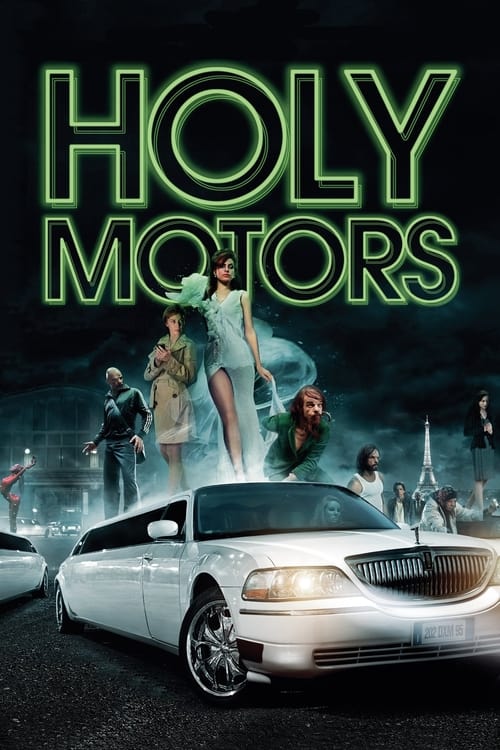
M. Oscar has no face of his own. He leaves his home at dawn, climbs into a white stretch limousine driven by a woman who barely speaks, and spends the next twelve hours inhabiting nine completely different people: an old beggar woman, a motion-capture demon, an assassin, a dying father, a man weeping on a street, a sewer-dwelling goblin who eats flowers and kidnaps models. Between each appointment, he sits in the back of the limousine and transforms, applying makeup, changing clothes, reviewing the dossier of the next character. The transformation is never complete before the car door opens. He steps out already becoming someone else. Carax gives you no stable identity to anchor to because Oscar is not a character in a story. He is consciousness moving through form, and Holy Motors is the instruction manual.
Tibetan Buddhist: The Limousine Is the Bardo, the Appointments Are Rebirths
The Tibetan Book of the Dead describes the bardo as the intermediate state between death and rebirth, a zone where consciousness encounters projections of its own making and, if it cannot recognize them as projections, takes them as real and enters the next life unprepared. The bardo is not a place. It is the space between identities, the naked interval before the next body arrives.
The limousine is that interval. Watch what Oscar does in transit: he does not rest, does not decompress, does not mourn the appointment he just left. He prepares. The transformation begins in the back seat while Paris streams past unobserved outside the tinted windows. The character being assembled is a projection, and he walks into it fully, every time, without resistance. This is not acting. This is rebirth mechanics made visible.
The most devastating appointment comes at the film's midpoint: Oscar arrives at a construction site in motion-capture gear, crouching and convulsing, and becomes Merde, the id-demon from Carax's earlier film Tokyo, a creature that eats flowers, stalks a fashion shoot, drags the model Kay M underground. He bites her fingers off. He sleeps curled around her in a crypt beneath Paris. Then the limousine retrieves him. He removes the suit, stares at his own hands in the back seat for a long moment, and says nothing. The bardo has no continuity of guilt. The next appointment is already waiting.
Gnostic: Oscar Is the Pneumatic Spark Assigned to Material Masks by a Demiurge He Never Meets
Who sends the appointments? We never see. The dossiers arrive in a file on the seat. Instructions from an invisible authority, demanding the soul take this form, then this one, then this one. The woman at the wheel receives orders through an earpiece. The entire apparatus hums with obedience to a system that has no face.
Gnostic cosmology names this: the Demiurge and its archons assign the pneumatic soul to material existence, role after role, binding the spark in flesh it did not choose. Oscar never refuses an appointment. He grieves them, sometimes, in the back seat between lives, but he performs them completely. Late in the film, a mysterious man stops his limousine and asks him why he still does this. "For the beauty of the act," Oscar says. Then, quieter: "I miss the beauty of the motions." The pneuma mourning its own captivity is the oldest cry in Gnostic literature. He performs every mask assigned to him and grieves, in the interval, the self that keeps disappearing between them.
The same architecture of dissolved identity runs through Persona, where one soul colonizes another until neither survives the merger, and Synecdoche, New York, where a man stages his own life until the staging and the life become indistinguishable. For the purest bardo-cinema, Enter the Void traces the naked consciousness as it moves from death into rebirth in real time, with none of Holy Motors' black comedy to soften the passage.
Questions this film answers
What is the deeper meaning of Holy Motors?
M. Oscar has no face of his own. He leaves his home at dawn, climbs into a white stretch limousine driven by a woman who barely speaks, and spends the next twelve hours inhabiting nine completely different people: an old beggar woman, a motion-capture demon, an assassin, a dying father, a man weeping on a street, a sewer-dwelling goblin who eats flowers and kidnaps models. Between each appointment, he sits in the back of the limousine and transforms, applying makeup, changing clothes, reviewing the dossier of the next character. The transformation is never complete before the car door opens. He steps out already becoming someone else. Carax gives you no stable identity to anchor to because Oscar is not a character in a story. He is consciousness moving through form, and Holy Motors is the instruction manual.
What is the hidden symbolism in Holy Motors?
The Tibetan Book of the Dead describes the bardo as the intermediate state between death and rebirth, a zone where consciousness encounters projections of its own making and, if it cannot recognize them as projections, takes them as real and enters the next life unprepared. The bardo is not a place. It is the space between identities, the naked interval before the next body arrives.
What esoteric traditions appear in Holy Motors?
Holy Motors draws from Buddhism, Gnosticism traditions. Leos Carax sent a man through Paris in a limousine and accidentally made the most precise film about consciousness-between-lives ever committed to celluloid.
Is Holy Motors worth watching for spiritual seekers?
Holy Motors (2012) directed by Leos Carax is essential viewing for those interested in Buddhism, Gnosticism. Holy Motors Is a Bardo Manual. The Nine Appointments Are Nine Deaths.. It rewards multiple viewings and contemplation.
Rewatch With New Eyes
Now that you've seen the architecture, experience it again. The same film becomes a different film when you know what to watch for.
This time, watch for:
- See impermanence: what clings, what releases, what remains
- Watch for the false world vs. the real — who is asleep, who awakens
Links may include affiliate partnerships that support Media Revelations
The Descent Continues
Where this thread leads next.
Forrest Gump 1994
The Holy Fool and the Feather of Grace
Read the revelation →