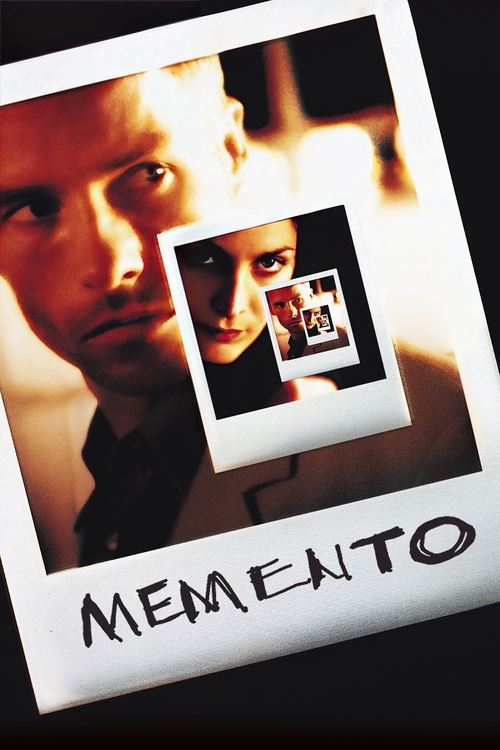
Memento
The Self as Hostile Editor of Its Own Memory
Directed by Christopher Nolan
Nolan made the first film that takes seriously what Buddhism has been teaching for two and a half millennia: the self is a construction that builds itself out of memory, and when memory becomes a weapon the self wields against itself, every quote tattooed on the skin is a vow taken against the future you. Leonard does not have a memory disorder. Leonard has the same condition every human has, sped up to a tempo at which the trick becomes visible.
Memento is not a puzzle film about a man with amnesia. It is the cleanest Buddhist parable in twenty-first century cinema, structured backward so the viewer experiences the cognitive condition the protagonist cannot escape. Leonard Shelby is the self in operation, doing what every self does — selecting evidence, suppressing inconvenient memory, manufacturing meaning out of present-moment sensation — but doing it visibly because his condition prevents the consolidation that would normally hide the trick. The film's devastating twist is not that Leonard killed Teddy. The twist is that Leonard has always known he killed his wife, has always known there is no John G., has always chosen to live inside a quest he engineered so that he could continue performing the only identity he has left. The Buddhist diagnosis: the self is not discovered. The self is rewritten, every moment, by the very mechanism that claims to remember it. Nolan filmed the operation. Few viewers notice that the operation is theirs.
The Surface
A man with anterograde amnesia hunts the man who raped and killed his wife. He cannot make new memories. He compensates with tattoos, Polaroids, and handwritten notes. The film unfolds in reverse, scene by scene, so the audience knows no more than he does at any given moment. By the end — which is the beginning — we learn that the man he kills is a cop named Teddy who has been steering him for years, that his wife may have actually survived the attack and died later from Leonard's own actions, and that Leonard has deliberately set up Teddy as his next target because Leonard wants the quest to continue.
On release the film was praised for its structural ingenuity. The reverse chronology was treated as a gimmick that worked. Many viewers stopped at the puzzle layer: clever twist about who really killed who.
Nolan is doing something more substantial. The reverse structure is not a gimmick. It is the only way to put the viewer inside Leonard's cognitive position. By giving the audience the consequence first and the cause second, the film models how a self-deceiving consciousness actually operates: the explanation arrives after the action, fitting the action into a story the self has already chosen. We do not act on our beliefs. Our beliefs are assembled after the fact to make our actions narratable. The film documents this without naming it.
The Self as Story Engine
Buddhist psychology describes the self as a process, not a thing. The five aggregates — form, sensation, perception, mental formations, consciousness — combine moment-to-moment to produce the experience of being a continuous someone. There is no actual continuous someone underneath. The continuity is a construction, repeated convincingly enough that we mistake the repetition for an object.
Leonard makes this process visible because his condition strips out the smoothing. He cannot rely on the seamless integration that allows most people to feel like one person across years. He has to assemble himself, materially, out of objects. A Polaroid is a thought he can hold in his hand. A tattoo is a belief made permanent because he cannot trust his unstable memory to retain it. The notes on the backs of photographs are the inner dialogue externalized.
Watching Leonard, we are watching the self-construction process running in slow motion with all its components visible. He decides what to write on a Polaroid based on present feeling. The Polaroid then becomes evidence that determines future behavior. The future Leonard has no access to the feeling that produced the note. He has only the note. He acts on it as if it were truth. Buddhist teachers have been pointing at this mechanism for centuries. Nolan shows it operating in a Discount Inn.
The most pointed scene is Leonard writing 'Don't believe his lies' under Teddy's photo, knowing in the moment that Teddy is telling the truth, knowing the future Leonard will read the note and act on it as if Teddy were lying. This is the self choosing its own future deception. Most people do this constantly. They write narratives about other people, about themselves, about the past, and then they read those narratives as evidence. The fact that they wrote the narrative is filed and forgotten.
Sammy Jankis as Mirror
The Sammy Jankis story is the film's master key. Leonard tells it constantly: a man with the same condition Leonard now has, whose wife tested him by asking for repeated insulin injections, who killed her because he failed the test. Leonard tells the story to himself as cautionary lesson. The story is also the film's slow reveal.
Teddy tells Leonard at the end: Sammy Jankis did not have anterograde amnesia. Sammy was a fake whose insurance claim Leonard, as an investigator, denied. Sammy did not have a wife who tested him. Leonard's wife survived the attack. Leonard's wife was the diabetic. Leonard administered the insulin. Leonard killed his wife with repeated injections he could not remember giving.
The Sammy story is the disowned material. Jung called this projection: the parts of ourselves we cannot bear get attributed to other figures, often vividly, so that we can hold the content at a distance while still secretly working it through. Leonard has projected his own crime onto an imagined other so that he can tell the story without locating himself inside it. The brief subliminal flash near the end — Sammy in the asylum, briefly replaced by Leonard sitting in the same chair — is the projection collapsing.
This is also why he cannot let the quest end. Finding the killer would force him to confront the absence of an external killer. The quest is the structure that keeps the projection in place. As long as he is looking outward, he does not have to look inward. The moment he stops looking, the truth Teddy keeps trying to tell him would arrive without a buffer. He cannot allow it. He has built his life on not allowing it.
The Manufactured Quest
At the film's chronological end — which is the visual beginning of the film — Leonard makes a choice. He has just learned from Teddy that he already killed the original attacker years ago. He has learned that the quest is exhausted. He could stop. He could sit with the loss. He could grieve in real time, accepting that he is the man who killed his wife.
He does not stop. He looks at Teddy's photograph, considers it, and decides to make Teddy his next John G. He writes the note. He plants the evidence on himself. He burns the photograph of the dead first target. He chooses to keep the quest alive by manufacturing the next victim.
This is the precise inversion of an initiation. A genuine initiation strips away the false story and forces the candidate to integrate what was hidden. Leonard performs the opposite operation. Offered the truth, he chooses the story. Offered integration, he chooses repetition. The condition makes this visible. Most people do this version of the maneuver with normal memory and are unable to see themselves doing it.
Nolan's most cutting line is Leonard's own voice-over justification: 'I have to believe that the world is still there.' The 'world' he means is the world in which he is a wronged man pursuing justice. The actual world — in which his wife is dead by his hand and he is responsible — has been replaced by a self-flattering simulation. He prefers the simulation. He will kill to keep it.
The Transmission
Memento transmits a permanent suspicion of one's own internal narrative. After this film, the tattoos on the soul become visible. What did you write on yourself five years ago that you are now reading as truth? Which photograph in your head — of an enemy, an injustice, a quest that justifies your present orientation — was annotated by a previous you whose feelings you can no longer reconstruct?
The film does not let the viewer off. The viewer has spent the running time inside Leonard's epistemic position. The structure has trained the viewer to accept whatever Leonard accepts and to be surprised when prior scenes recontextualize present ones. The recontextualizations are exactly what would happen in actual self-examination if a person had the courage to perform it. Most people do not. The film teaches what the cost is.
Buddhism's most rigorous teaching is that the self is not what it appears to be. Memento makes this teaching enterable for people who would never read a sutra. It uses the genre of the noir thriller to install the recognition. The recognition, once installed, cannot be uninstalled. You cannot rewatch Memento as a puzzle. The puzzle is solved. What remains is the diagnosis. And the diagnosis is not only Leonard's.
Questions this film answers
What is the deeper meaning of Memento?
Memento is not a puzzle film about a man with amnesia. It is the cleanest Buddhist parable in twenty-first century cinema, structured backward so the viewer experiences the cognitive condition the protagonist cannot escape. Leonard Shelby is the self in operation, doing what every self does — selecting evidence, suppressing inconvenient memory, manufacturing meaning out of present-moment sensation — but doing it visibly because his condition prevents the consolidation that would normally hide the trick. The film's devastating twist is not that Leonard killed Teddy. The twist is that Leonard has always known he killed his wife, has always known there is no John G., has always chosen to live inside a quest he engineered so that he could continue performing the only identity he has left. The Buddhist diagnosis: the self is not discovered. The self is rewritten, every moment, by the very mechanism that claims to remember it. Nolan filmed the operation. Few viewers notice that the operation is theirs.
What is the hidden symbolism in Memento?
A man with anterograde amnesia hunts the man who raped and killed his wife. He cannot make new memories. He compensates with tattoos, Polaroids, and handwritten notes. The film unfolds in reverse, scene by scene, so the audience knows no more than he does at any given moment. By the end — which is the beginning — we learn that the man he kills is a cop named Teddy who has been steering him for years, that his wife may have actually survived the attack and died later from Leonard's own actions, and that Leonard has deliberately set up Teddy as his next target because Leonard wants the quest to continue.
What esoteric traditions appear in Memento?
Memento draws from Buddhism, Jungian, Initiation traditions. Nolan made the first film that takes seriously what Buddhism has been teaching for two and a half millennia: the self is a construction that builds itself out of memory, and when memory becomes a weapon the self wields against itself, every quote tattooed on the skin is a vow taken against the future you. Leonard does not have a memory disorder. Leonard has the same condition every human has, sped up to a tempo at which the trick becomes visible.
What does Memento teach about the self as story engine?
We do not act on our beliefs. Our beliefs are assembled after the fact to make our actions narratable. Buddhist psychology describes the self as a process, not a thing. The five aggregates — form, sensation, perception, mental formations, consciousness — combine moment-to-moment to produce the experience of being a continuous someone. There is no actual continuous someone underneath. The continuity is a construction, repeated convincingly enough that we mistake the repetition for an object.
What does Memento teach about sammy jankis as mirror?
Leonard has projected his own crime onto an imagined other so he can tell the story without locating himself inside it. The Sammy Jankis story is the film's master key. Leonard tells it constantly: a man with the same condition Leonard now has, whose wife tested him by asking for repeated insulin injections, who killed her because he failed the test. Leonard tells the story to himself as cautionary lesson. The story is also the film's slow reveal.
What does Memento teach about the manufactured quest?
Offered the truth, he chooses the story. Offered integration, he chooses repetition. The condition makes the maneuver visible. At the film's chronological end — which is the visual beginning of the film — Leonard makes a choice. He has just learned from Teddy that he already killed the original attacker years ago. He has learned that the quest is exhausted. He could stop. He could sit with the loss. He could grieve in real time, accepting that he is the man who killed his wife.
Is Memento worth watching for spiritual seekers?
Memento (2000) directed by Christopher Nolan is essential viewing for those interested in Buddhism, Identity, Memory. The Self as Hostile Editor of Its Own Memory. It rewards multiple viewings and contemplation.
Rewatch With New Eyes
Now that you've seen the architecture, experience it again. The same film becomes a different film when you know what to watch for.
This time, watch for:
- See impermanence: what clings, what releases, what remains
- Meet the shadow: what is rejected, projected, and finally integrated
- Mark the threshold: the old self dies, the ordeal transforms, the new self returns
Links may include affiliate partnerships that support Media Revelations
The Descent Continues
Where this thread leads next.

Inception 2010
Dream Yoga and the Totem of Attachment
Read the revelation →