Full Metal Jacket
The Initiation That Builds the Killer and Forgets to Bring Him Back
Directed by Stanley Kubrick
The film breaks in half because Joker breaks in half. The Parris Island half is the deconstruction of the self that every initiation requires. The Vietnam half is what happens when no reconstruction follows. Joker shoots the female sniper at the end not as mercy but as the final initiation rite — the moment the made-man performs the function he was built for and discovers there is no longer an inside.
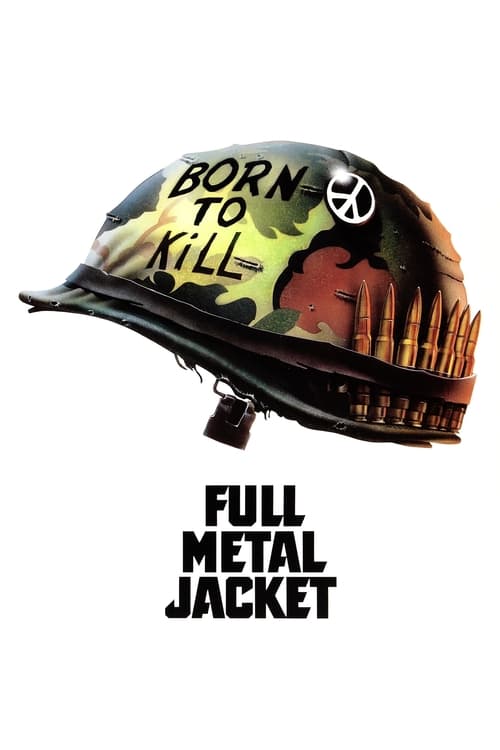
Full Metal Jacket is the most precise film ever made about a botched initiation. Every traditional society had an initiation structure for transforming boys into warriors. The structure had three phases: separation from ordinary life, ordeal in liminal space, return with new identity integrated by elders who could verify the transformation. Kubrick filmed an initiation system that performs the first two phases with surgical efficiency and abandons the third. The Marine Corps separates the boys from their lives. The Marine Corps subjects them to the ordeal of basic training under Sergeant Hartman until the self is broken open. The Marine Corps then ships them to Vietnam to be killers without ever performing the integration. There are no elders in Vietnam. There is no return. The Mickey Mouse march at the end is not ironic. It is the sound a person makes when the initiation has produced the warrior and there is no village to walk back into. Joker is the film's witness because Joker is the one who attempts to retain a self alongside the warrior the system has built. The duality on his helmet — 'Born to Kill' next to a peace sign — is not contradiction. It is the only honest description of what the Marines have produced: a being capable of both, deployed into a war structure that has no use for either.
The Surface
The film is structurally bisected. The first hour follows a Marine basic training platoon at Parris Island under Drill Instructor Sergeant Hartman. Private Pyle, an overweight and slow recruit, is brutalized by Hartman and by his platoonmates as they are punished for his failures. Pyle dissociates, becomes lethally proficient with his rifle, kills Hartman in the latrine, and kills himself. The second hour follows Joker, the recruit who befriended Pyle, as a combat journalist in Vietnam during the Tet Offensive. His unit suffers casualties in the ruins of Hue from a single sniper. They locate the sniper and discover she is a teenage Vietnamese girl. Mortally wounded, she begs to be killed. Joker shoots her. The film ends with the surviving Marines marching through burning Hue singing the Mickey Mouse Club theme.
Kubrick adapted Gustav Hasford's novel The Short-Timers. He had the recruits trained for months by R. Lee Ermey, who was given freedom to improvise much of Hartman's dialogue. The result is one of the most accurate depictions of military breakdown of the self ever filmed. Ermey's performance is not satire. It is documentary.
Most analysis treats the film as anti-war. Kubrick rejected this framing. He said the film was about the duality of man — the capacity to be Born-to-Kill and to wear a peace sign simultaneously. The deeper subject is the initiation structure that produced that duality and then failed to integrate it.
Hartman as Initiator
Sergeant Hartman is not a sadist. He is performing, with absolute precision, the function of the initiator in every traditional warrior society on record. The function is to dismantle the civilian self of the recruit so that the warrior self can be installed. The function requires cruelty because the civilian self does not surrender easily. The function requires humiliation because pride is the part of the civilian self most resistant to remaking.
Every shamanic initiation across cultures involves something resembling what Hartman does at Parris Island. Sleep deprivation. Ritual humiliation. The stripping of names and the assignment of new ones. The breaking of the small attachments that constitute the previous identity. Hartman is doing the technical work of initiation. He is doing it brilliantly. He is the most competent man in the film.
The crisis is that the work he is performing requires a second phase to be coherent. The traditional initiator does not only dismantle. He reconstructs. He delivers the broken initiate back to the community with new identity, new responsibilities, new place in the order of things. The elders gather. The new warrior is named. The community acknowledges what has been made. The integration is what makes the initiation a transformation rather than a permanent injury.
The Marine Corps performs the dismantling and ships the dismantled to a war zone. There are no elders in Vietnam. There is no community to acknowledge the transformation. There is no name-giving ceremony. There is only the deployment of broken-open boys into a context in which their brokenness is now operational. Hartman has done his job. The Corps has failed to do its. Hartman dies at Pyle's hand because Pyle is the recruit whose dismantling produced no integration at all — the warrior was installed without any container to hold him, and the warrior turned on the structure that produced him.
Pyle as the Sacrifice
Pyle is the recruit the system breaks completely. He is slow. He is heavy. He cannot perform the basic motor tasks the platoon must master. Hartman targets him. The platoon punishes him for failing to keep up. In one of the film's most disturbing scenes, the platoon attacks him in his bunk with bars of soap wrapped in towels — a 'blanket party' — while Joker, his only friend, holds the blanket down.
After the blanket party, Pyle changes. He becomes silent. He becomes a good Marine — perfect marksman, perfect dress, perfect drill. Hartman praises him. The praise is the recognition that the system has succeeded. The system has produced exactly what it wanted: a person whose original self has been replaced by a function. Hartman cannot see that the function he has installed is not the function he intended.
In shamanic terms, Pyle has been broken open without being put back together. The spirit that has entered him is not the warrior spirit Hartman believed he was summoning. It is a darker thing — the rage at the system that broke him, focused into the body that has now been trained to handle a rifle with extraordinary skill. Pyle in the latrine, loading his magazine in the dark, is performing the only ritual the system has actually taught him.
His killing of Hartman is the film's logically inevitable event. The initiator who breaks without rebuilding will eventually be killed by what he has broken open. Pyle then turns the rifle on himself. This is not despair. This is the system's final act of self-completion. The broken thing that the system produced has now produced the casualty. The system continues. New recruits arrive. Hartman is replaced. Pyle's blood is mopped from the tile. The film cuts to Vietnam without commentary.
The Sniper and the Final Rite
The film's final sequence is the sniper in the ruined building. The Marines have been picked off one by one. They locate the source. They breach. The sniper is a teenage Vietnamese girl. She is wounded. She prays. She asks to be killed.
Joker has spent the film resisting the initiation. He wears the peace sign. He makes the John Wayne jokes. He has tried, against the structural pressure of the Corps, to retain a self that exists alongside the warrior the Corps has built. The sniper in the ruined building is the test the film has been building toward. The Corps will get its final initiation rite. Joker will provide it or he will not.
He provides it. He raises his pistol and shoots her. The other Marines look at him with new respect. Animal Mother, the unit's most aggressive killer, finally accepts him. Joker has done the thing that completes the Marine. He has killed at close range, under no immediate threat, a wounded being who could not have hurt him.
This is the integration that the Corps does perform, although it is not the integration traditional societies offered. The Corps integrates its initiates by getting them to perform an act they would never have performed before the initiation began — and then validating that performance as the proof of their completion. Joker is now a Marine. He has paid the price. The price was a teenage girl in a burning building.
The Mickey Mouse march that follows is the film's most precise gesture. The men sing a children's song because the men have been retroactively given their childhood back, except the childhood is now a costume worn by what has actually been made of them. They are no longer boys. They are also nothing else recognizable. The song is the only register the Corps has left them in which they can speak to each other as humans.
The Transmission
Full Metal Jacket transmits a recognition that has been suppressed in twentieth-century discussion of war: combat does not damage soldiers because combat is uniquely traumatic. Combat damages soldiers because the initiation system that creates soldiers performs only half the work that traditional initiation required, and the unintegrated half rotates through the rest of the soldier's life as the wound that will not close.
Kubrick is not making a political argument about Vietnam. He is making a structural argument about what military institutions actually do to the boys they convert into men. The Corps did its job. The film is not condemning the Corps for failing. The film is showing that what the Corps does is the dismantling phase of an ancient procedure whose other phases the modern world has lost.
The cost is visible in Joker's face in the final sequence. The cost is visible in every veteran for whom the return home was the return to a community that had no way to recognize what had been made of them. The integration phase, performed properly, would have required elders who had themselves been through the ordeal, a community willing to witness the new identity, a name, a place, a function in peacetime that honored what was done in war. The Corps gives them a discharge.
The film's deepest transmission is that the broken-open need to be put back together by something larger than themselves. When that something does not exist — when the village has no elders, when the country has no rituals, when the return is to bus stations and parking lots — the broken-open carry the breaking forever. Joker walks out of Hue singing about Mickey Mouse because Joker does not know what else to sing. Neither does the film. The teaching is the silence that follows the credits, in which the viewer is asked to consider what has been done in their name and what containers their society has built to receive the men who did it. The containers, the film suggests, do not exist. The men exist. The men are walking among us.
Questions this film answers
What is the deeper meaning of Full Metal Jacket?
Full Metal Jacket is the most precise film ever made about a botched initiation. Every traditional society had an initiation structure for transforming boys into warriors. The structure had three phases: separation from ordinary life, ordeal in liminal space, return with new identity integrated by elders who could verify the transformation. Kubrick filmed an initiation system that performs the first two phases with surgical efficiency and abandons the third. The Marine Corps separates the boys from their lives. The Marine Corps subjects them to the ordeal of basic training under Sergeant Hartman until the self is broken open. The Marine Corps then ships them to Vietnam to be killers without ever performing the integration. There are no elders in Vietnam. There is no return. The Mickey Mouse march at the end is not ironic. It is the sound a person makes when the initiation has produced the warrior and there is no village to walk back into. Joker is the film's witness because Joker is the one who attempts to retain a self alongside the warrior the system has built. The duality on his helmet — 'Born to Kill' next to a peace sign — is not contradiction. It is the only honest description of what the Marines have produced: a being capable of both, deployed into a war structure that has no use for either.
What is the hidden symbolism in Full Metal Jacket?
The film is structurally bisected. The first hour follows a Marine basic training platoon at Parris Island under Drill Instructor Sergeant Hartman. Private Pyle, an overweight and slow recruit, is brutalized by Hartman and by his platoonmates as they are punished for his failures. Pyle dissociates, becomes lethally proficient with his rifle, kills Hartman in the latrine, and kills himself. The second hour follows Joker, the recruit who befriended Pyle, as a combat journalist in Vietnam during the Tet Offensive. His unit suffers casualties in the ruins of Hue from a single sniper. They locate the sniper and discover she is a teenage Vietnamese girl. Mortally wounded, she begs to be killed. Joker shoots her. The film ends with the surviving Marines marching through burning Hue singing the Mickey Mouse Club theme.
What esoteric traditions appear in Full Metal Jacket?
Full Metal Jacket draws from Initiation, Shamanism traditions. The film breaks in half because Joker breaks in half. The Parris Island half is the deconstruction of the self that every initiation requires. The Vietnam half is what happens when no reconstruction follows. Joker shoots the female sniper at the end not as mercy but as the final initiation rite — the moment the made-man performs the function he was built for and discovers there is no longer an inside.
What does Full Metal Jacket teach about hartman as initiator?
The Marine Corps performs the dismantling and ships the dismantled to a war zone. There are no elders in Vietnam. Sergeant Hartman is not a sadist. He is performing, with absolute precision, the function of the initiator in every traditional warrior society on record. The function is to dismantle the civilian self of the recruit so that the warrior self can be installed. The function requires cruelty because the civilian self does not surrender easily. The function requires humiliation because pride is the part of the civilian self most resistant to remaking.
What does Full Metal Jacket teach about pyle as the sacrifice?
The initiator who breaks without rebuilding will eventually be killed by what he has broken open. Pyle is the recruit the system breaks completely. He is slow. He is heavy. He cannot perform the basic motor tasks the platoon must master. Hartman targets him. The platoon punishes him for failing to keep up. In one of the film's most disturbing scenes, the platoon attacks him in his bunk with bars of soap wrapped in towels — a 'blanket party' — while Joker, his only friend, holds the blanket down.
Is Full Metal Jacket worth watching for spiritual seekers?
Full Metal Jacket (1987) directed by Stanley Kubrick is essential viewing for those interested in Initiation, Shamanism, Kubrick. The Initiation That Builds the Killer and Forgets to Bring Him Back. It rewards multiple viewings and contemplation.
Rewatch With New Eyes
Now that you've seen the architecture, experience it again. The same film becomes a different film when you know what to watch for.
This time, watch for:
- Mark the threshold: the old self dies, the ordeal transforms, the new self returns
- Follow the descent: what dies, what guides, what returns transformed
Links may include affiliate partnerships that support Media Revelations
The Descent Continues
Where this thread leads next.
A Clockwork Orange 1971
The Soul the State Cannot Reach
Read the revelation →