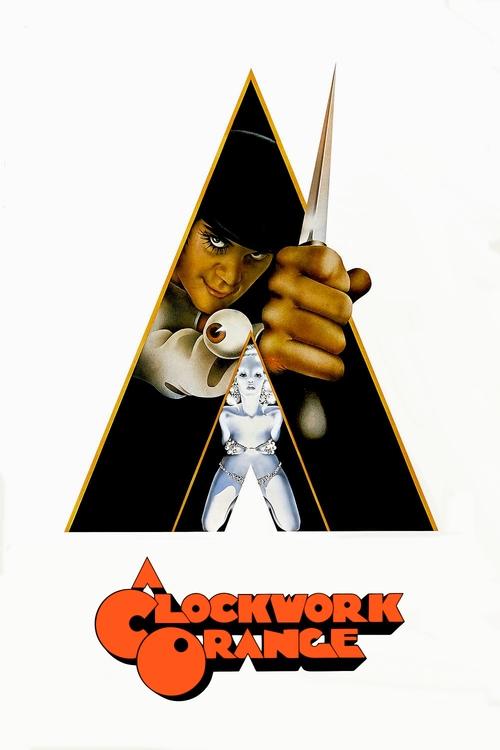
A Clockwork Orange
The Soul the State Cannot Reach
Directed by Stanley Kubrick
Kubrick made a film about whether a being deprived of the capacity to choose evil is still a being. The Ludovico Technique is not a punishment. It is a sacrament administered by a society that wants Alex's surface compliance and is willing to surgically extract his soul to get it. The final scene's restoration is not redemption. It is the system's confession that it needs the evil it can locate.
A Clockwork Orange is the most precise film ever made about the metaphysics of free will. Kubrick is not asking whether Alex should be punished. He is asking whether a being who has been surgically deprived of the capacity to choose evil is still a being at all. The Ludovico Technique is the secular West's answer to the soul: there is no soul, only a behavior set, and the behavior set can be edited. The film's structural cruelty is that everyone — the state, the prison chaplain, the writer who was Alex's victim, the parents who replaced him with a lodger — is operating on this assumption. Only the chaplain understands what has actually happened, and the chaplain is powerless. The famous final line, 'I was cured all right,' is not a punchline. It is the system restoring the evil it needs in order to claim it can manage evil. Alex was useful as monster and useful as broken man. Either way he was raw material.
The Surface
Alex DeLarge leads a gang of droogs through a series of night assaults — beatings, rape, home invasion — in a stylized near-future Britain. He is betrayed by his gang, arrested, sentenced. In prison he volunteers for the Ludovico Technique, an experimental aversion therapy that makes him physically ill at the thought of violence. He is released. Every victim of his past returns to torture him. He attempts suicide. The state, embarrassed, reverses the conditioning. He is restored to his original violent self in time for the credits.
The film was banned in Britain by Kubrick himself for nearly thirty years after copycat attacks. Most cultural memory of it is the imagery: the white jumpsuits, the milk bar, the Singin' in the Rain assault, the eyelid clamps. The stylized violence has done the work of distracting most viewers from what Kubrick was actually filming.
The actual subject is theological. The film is a sustained argument about whether moral agency is a soul-property or a behavioral pattern, and what kind of society treats the answer to that question as a technical problem to be solved with conditioning rather than as the question that defines whether the society is itself a moral entity.
The Ludovico Technique as Anti-Sacrament
In Gnostic cosmology, the Demiurge cannot make souls. He can only make bodies and then arrange the bodies to behave in ways that resemble what souls would do. The Demiurge's deepest deception is convincing the body that the arrangement is the same as the soul.
The Ludovico Technique is this deception made surgical. The state cannot make Alex good. It can make Alex incapable of acting on his violent impulses without becoming physically ill. From outside, this looks like virtue. From inside, it is a body in a cage. Alex has not become moral. He has become a creature whose moral agency has been removed from the question.
The prison chaplain — the film's only fully awake character — names this with surgical precision: 'Goodness comes from within. Goodness is chosen. When a man cannot choose, he ceases to be a man.' The state has no answer because the state does not believe in the distinction. The state needs behavior, not souls. The Minister of the Interior is a Demiurge in good tailoring. He does not understand what he has destroyed because he was never aware it existed.
Kubrick's framing during the Ludovico screenings — Alex strapped to the chair, eyes pinned open, mouth twisted in screaming — is iconography of crucifixion inverted. The Roman soldier nailed Christ but did not enter him. The state enters Alex. There is no surface that remains his own. The eyes that watch must watch. The body that recoils must recoil. The soul, if it ever existed, has been administratively dissolved.
Beethoven and the Twoness
Alex loves Beethoven's Ninth. He loves it the way some people love God. The same consciousness that orchestrates rape and murder weeps at the choral movement. Most viewers experience this as Kubrick's joke — a satire of the cultured monster. It is not the joke. It is the diagnosis.
Jung was clear that the Shadow is not separable from the conscious personality. The same vessel that holds the violence holds the music. The capacity for the highest aesthetic response and the capacity for the most degraded act are housed in the same animal. Kubrick refuses the consolation that the violent and the cultured are different kinds of people. Alex is one person, indivisible. His love of Beethoven and his love of the ultraviolent are organs of the same body.
The Ludovico Technique's deepest crime is what it does to Beethoven. The state, in conditioning Alex against violence, accidentally pairs the conditioning with the Ninth Symphony as background music. The aversion attaches itself to the music. Alex emerges unable to hear Beethoven without nausea. The state has removed not only his capacity for evil but his capacity for the beauty that lived in the same body.
This is the film's most theologically loaded image. The pneumatic spark — the thing in Alex that loved the Ninth — has been collateral damage in a project aimed at his behavior. The state does not know what it has destroyed because the state cannot perceive the order of being it has just amputated.
The Society That Needed Him
Every adult institution in the film is corrupt. The police are former droogs. The writer Mr. Alexander uses Alex's suffering as political theater. The Minister of the Interior cycles between using Alex as showpiece of the new technique and using Alex as victim of the technique's failure depending on which serves the current election cycle. The parents replace their son with a paying lodger within weeks of his imprisonment.
Alex is the only character with continuity of self. His violence is monstrous and his violence is also the only honest action in the film. He does what he wants. He does not pretend. Every adult around him is performing a role for the audience of other adults. Alex is at least, in his early scenes, a fully-occupied human animal.
The Gnostic frame: Alex is the unconditioned soul in an entirely conditioned world. The Archons that rule this world have not yet captured him because his violence puts him outside their control schema. They capture him. They process him. They release him. And then, when the conditioning fails them politically, they restore him — because they need monsters they can point to in order to justify their existence.
The final scene is the deal. The Minister feeds Alex spaghetti. Alex imagines violence again. The Minister smiles. The system has its symptom back. The papers will write that the experiment failed and the old methods will return. Alex will be useful as the embodiment of the danger the state exists to protect against. He was useful broken. He is useful restored. He was never going to be allowed to simply be.
The Transmission
A Clockwork Orange transmits a recognition most viewers spend the film resisting: the violent young man at the start and the broken young man at the end are not opposites. They are two configurations of the same body, both legible to the state, neither of them the soul the chaplain was defending.
The film does not ask the viewer to sympathize with Alex. It asks the viewer to notice that the question of whether to sympathize is the wrong question. The right question is what kind of society treats the soul as a behavior pattern that can be conditioned for political convenience. The answer is: every society in modernity. The Ludovico Technique is not a fiction. It is the model.
Kubrick's refusal to let any character escape clean is the rigor. The writer is as compromised as the minister. The parents are as compromised as the gang. Alex's restoration in the final shot is not the film's failure of nerve. It is the film's most precise gesture. The world that produced Alex is the world that needs Alex, and the only thing that will be done to that world is the periodic adjustment of the symptom the world has chosen to focus on.
The teaching, finally, is that the choice of evil is the structure of moral being. Remove the choice and you remove the being. What remains is meat and the institutional apparatus that processes meat. The chaplain knew. Nobody listens to the chaplain. The credits roll on a man cured of his cure, ready to be useful again.
Questions this film answers
What is the deeper meaning of A Clockwork Orange?
A Clockwork Orange is the most precise film ever made about the metaphysics of free will. Kubrick is not asking whether Alex should be punished. He is asking whether a being who has been surgically deprived of the capacity to choose evil is still a being at all. The Ludovico Technique is the secular West's answer to the soul: there is no soul, only a behavior set, and the behavior set can be edited. The film's structural cruelty is that everyone — the state, the prison chaplain, the writer who was Alex's victim, the parents who replaced him with a lodger — is operating on this assumption. Only the chaplain understands what has actually happened, and the chaplain is powerless. The famous final line, 'I was cured all right,' is not a punchline. It is the system restoring the evil it needs in order to claim it can manage evil. Alex was useful as monster and useful as broken man. Either way he was raw material.
What is the hidden symbolism in A Clockwork Orange?
Alex DeLarge leads a gang of droogs through a series of night assaults — beatings, rape, home invasion — in a stylized near-future Britain. He is betrayed by his gang, arrested, sentenced. In prison he volunteers for the Ludovico Technique, an experimental aversion therapy that makes him physically ill at the thought of violence. He is released. Every victim of his past returns to torture him. He attempts suicide. The state, embarrassed, reverses the conditioning. He is restored to his original violent self in time for the credits.
What esoteric traditions appear in A Clockwork Orange?
A Clockwork Orange draws from Gnosticism, Jungian traditions. Kubrick made a film about whether a being deprived of the capacity to choose evil is still a being. The Ludovico Technique is not a punishment. It is a sacrament administered by a society that wants Alex's surface compliance and is willing to surgically extract his soul to get it. The final scene's restoration is not redemption. It is the system's confession that it needs the evil it can locate.
What does A Clockwork Orange teach about the ludovico technique as anti-sacrament?
The state cannot make Alex good. It can make Alex a creature whose moral agency has been removed from the question. In Gnostic cosmology, the Demiurge cannot make souls. He can only make bodies and then arrange the bodies to behave in ways that resemble what souls would do. The Demiurge's deepest deception is convincing the body that the arrangement is the same as the soul.
What does A Clockwork Orange teach about beethoven and the twoness?
The capacity for the highest aesthetic response and the capacity for the most degraded act are housed in the same animal. Alex loves Beethoven's Ninth. He loves it the way some people love God. The same consciousness that orchestrates rape and murder weeps at the choral movement. Most viewers experience this as Kubrick's joke — a satire of the cultured monster. It is not the joke. It is the diagnosis.
Is A Clockwork Orange worth watching for spiritual seekers?
A Clockwork Orange (1971) directed by Stanley Kubrick is essential viewing for those interested in Gnosticism, Free Will, Kubrick. The Soul the State Cannot Reach. It rewards multiple viewings and contemplation.
Rewatch With New Eyes
Now that you've seen the architecture, experience it again. The same film becomes a different film when you know what to watch for.
This time, watch for:
- Watch for the false world vs. the real — who is asleep, who awakens
- Meet the shadow: what is rejected, projected, and finally integrated
Links may include affiliate partnerships that support Media Revelations
The Descent Continues
Where this thread leads next.
The Shining 1980
The Overlook as Living Memory Field
Read the revelation →