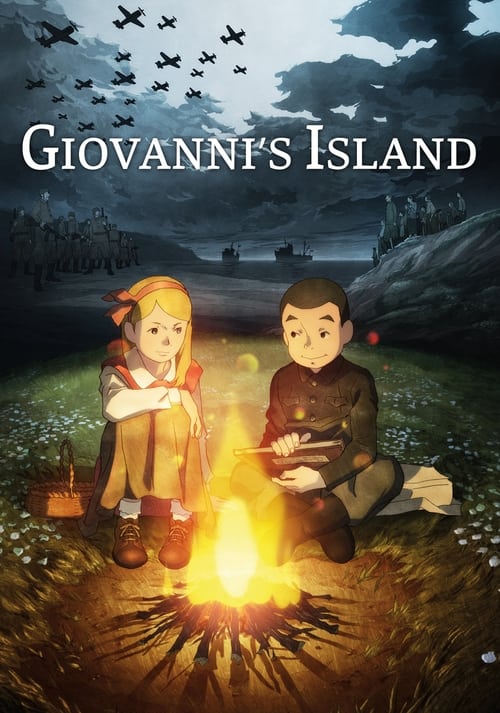
Giovanni's Island
Giovanni's Island Is a Boy Learning That the Train to Heaven Only Runs One Way
Directed by Mizuho Nishikubo
Two brothers on an occupied island read Kenji Miyazawa aloud and do not yet know the story is about them.
Junpei and Kanta are the sons of a man who names them after the Galactic Railroad. Their father took the names from Kenji Miyazawa's "Night on the Galactic Railroad," where a boy named Giovanni rides a celestial train and slowly realizes his friend Campanella has already died and will get off at a stop Giovanni cannot follow to. The film wraps the fall of Shikotan, the Soviet occupation, the starvation and the deportation, around that single borrowed story. On the surface this is a war memory, a childhood under a flag that changed overnight. Underneath, the film is doing something more exact. It hands a child the map to grief before the grief arrives, and then watches him walk into it. The Miyazawa book is the whole hidden architecture, buried and waiting, and the film's real subject is the gap between reading about loss and being asked to survive it.
Buddhist Reading: Impermanence Taught to a Child Who Has Not Yet Lost Anything
The Buddhist teaching on impermanence goes past the fact that things end. It says they are already ending while you hold them, and clinging to their permanence is the root of suffering. Giovanni's Island stages this as a slow removal of everything Junpei counts on. The island itself changes owners between one day and the next: the same schoolhouse, the same desks, now a Soviet classroom where Russian children sing on one side of a thin partition and Japanese children answer on the other. Junpei falls into a shy friendship with Tanya, the Soviet commander's daughter, across a language neither can cross. Then that too is taken. The deportation loads the whole village onto a ship, and the film refuses to let anyone keep even the small warm things.
The deepest instruction is delivered through the father. He is arrested, sent away, and Junpei carries the certainty that he will return, because children are built to assume return. The teaching is not that the father dies. It is that Junpei keeps the ticket long after the train has gone. When the truth finally lands, it lands the way the Miyazawa book warned it would: the person beside you on the journey gets off at a station with no return platform, and you continue alone, holding the seat that is now empty.
Initiatory Reading: The Descent That Strips the Names Away
Every initiation is a descent that takes from you what you thought you were. Junpei begins the film named, placed, sure of his family and his island. The war is his underworld, and it works exactly as an underworld works: it removes the props one by one until only the initiate is left. He loses the island, the language, the friend, the mother already gone, and finally the father. His younger brother Kanta, weaker, becomes the thing Junpei must carry, and the carrying is the trial. On the deportation march Junpei drags his brother through cold and hunger the way an initiate drags the last of himself toward the return.
The film frames the survivor as an old man revisiting Shikotan, which is the mark of a completed initiation: he came back, and he came back changed, carrying the dead as knowledge rather than as an open wound. The names his father gave him held all along. Junpei learned what the Galactic Railroad was always going to teach.
Questions this film answers
What is the deeper meaning of Giovanni's Island?
Junpei and Kanta are the sons of a man who names them after the Galactic Railroad. Their father took the names from Kenji Miyazawa's "Night on the Galactic Railroad," where a boy named Giovanni rides a celestial train and slowly realizes his friend Campanella has already died and will get off at a stop Giovanni cannot follow to. The film wraps the fall of Shikotan, the Soviet occupation, the starvation and the deportation, around that single borrowed story. On the surface this is a war memory, a childhood under a flag that changed overnight. Underneath, the film is doing something more exact. It hands a child the map to grief before the grief arrives, and then watches him walk into it. The Miyazawa book is the whole hidden architecture, buried and waiting, and the film's real subject is the gap between reading about loss and being asked to survive it.
What is the hidden symbolism in Giovanni's Island?
The Buddhist teaching on impermanence goes past the fact that things end. It says they are already ending while you hold them, and clinging to their permanence is the root of suffering. Giovanni's Island stages this as a slow removal of everything Junpei counts on. The island itself changes owners between one day and the next: the same schoolhouse, the same desks, now a Soviet classroom where Russian children sing on one side of a thin partition and Japanese children answer on the other. Junpei falls into a shy friendship with Tanya, the Soviet commander's daughter, across a language neither can cross. Then that too is taken. The deportation loads the whole village onto a ship, and the film refuses to let anyone keep even the small warm things.
What esoteric traditions appear in Giovanni's Island?
Giovanni's Island draws from Buddhism, Initiation traditions. Two brothers on an occupied island read Kenji Miyazawa aloud and do not yet know the story is about them.
Is Giovanni's Island worth watching for spiritual seekers?
Giovanni's Island (2014) directed by Mizuho Nishikubo is essential viewing for those interested in Buddhism, Initiation. Giovanni's Island Is a Boy Learning That the Train to Heaven Only Runs One Way. It rewards multiple viewings and contemplation.
Rewatch With New Eyes
Now that you've seen the architecture, experience it again. The same film becomes a different film when you know what to watch for.
This time, watch for:
- See impermanence: what clings, what releases, what remains
- Mark the threshold: the old self dies, the ordeal transforms, the new self returns
Links may include affiliate partnerships that support Media Revelations
The Descent Continues
Where this thread leads next.
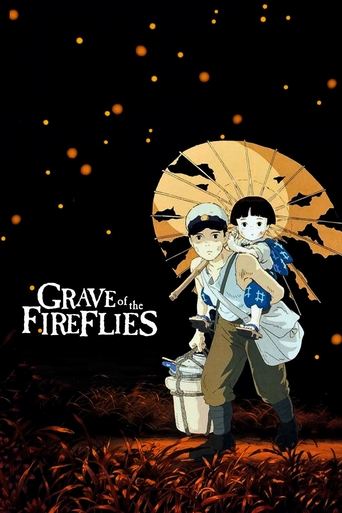
Grave of the Fireflies 1988
The Pride That Killed His Sister
Read the revelation →