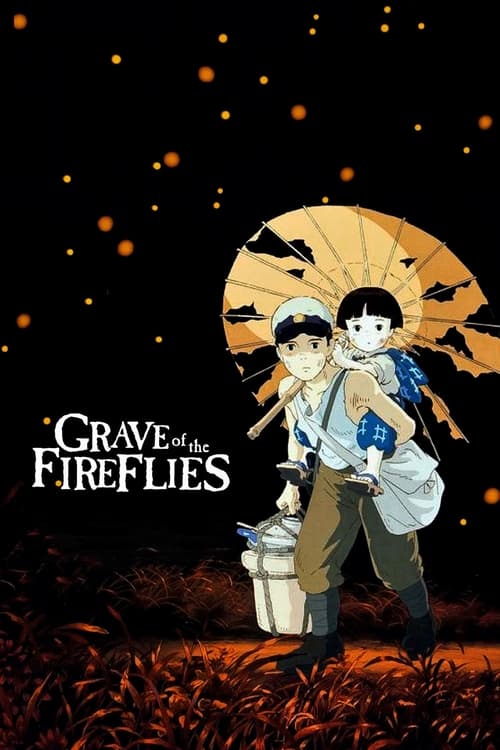
Grave of the Fireflies
The Pride That Killed His Sister
Directed by Isao Takahata
Takahata made the most precise Buddhist film about attachment ever animated. Setsuko does not die from the war. She dies from Seita's pride — his inability to bend, to ask, to accept the humiliation of dependency. The film is not a tragedy of bombs. It is a tragedy of the small architectures of identity that kill the people we love most. The fireflies last one night because Seita refuses every life that would have lasted longer.
Grave of the Fireflies is not an anti-war film. Takahata said so explicitly and audiences refused to hear him. The film is a Buddhist parable about attachment, pride, and the way a small kink in a young man's identity can kill the person he loves most. Seita does not lose Setsuko to the firebombing of Kobe or to American imperialism. He loses her to his own inability to bow — to accept charity, to apologize to the aunt, to swallow the humiliation of being a fourteen-year-old who needs adults. The bombs only set the conditions. The murder is performed by Seita's pride. The film opens with Seita already dead, narrating from the bardo, watching his own corpse get cleaned up by a janitor in a train station. He is reviewing the chain of small refusals that led to his sister's death because that is the work the bardo requires. Takahata is not asking the viewer to grieve. He is asking the viewer to study the structure of how a soul kills what it loves.
The Surface
September 21, 1945. Fourteen-year-old Seita dies in Sannomiya Station of starvation. A janitor finds a fruit-drop tin in his pocket and tosses it into a field. Setsuko's spirit emerges from the tin. Seita's spirit joins her. The two siblings, reunited in death, ride a train through their own past, watching the months since their mother's death in the firebombing — their move to their aunt's house, the aunt's growing resentment, Seita's decision to leave for an abandoned bomb shelter, Setsuko's slow starvation while Seita refused to swallow his pride and return.
Takahata adapted Akiyuki Nosaka's autobiographical story. Nosaka wrote it as a confession — he had been Seita. His sister had died of malnutrition under his care. He spent the rest of his life unable to forgive himself. Takahata understood the assignment exactly.
Most Western viewers experience the film as the most devastating anti-war film ever made. Takahata, asked directly, denied this. He said the film was about a young man who could not adjust to society and the price his sister paid for his inability. The war is the weather. The murder is interior.
The Bardo Frame
The film opens with Seita already dead. This is the structural choice that determines everything that follows. We are not watching events unfold. We are watching a soul in the bardo reviewing the events that brought it here. The red-tinted figures of Seita and Setsuko sit in a train carriage and watch their own past as cinema.
In Tibetan Buddhist tradition, the bardo of becoming is the period in which the recently deceased consciousness confronts what it did and what was done to it. The confrontation is not punishment. It is education. The soul is given the opportunity to see clearly what was previously obscured by the urgency of being alive. The bardo Seita has entered is the bardo where his pride is no longer protecting him from seeing what his pride did.
Every scene in the film is therefore double-coded. We see Seita as a fourteen-year-old making a fourteen-year-old's decisions. We also see Seita-after-death watching those decisions from a position where the consequences are now unhideable. The grief in the film does not belong only to Setsuko. It belongs to the dead Seita who is being made, slowly, to understand what he did.
Takahata's framing of the bardo is not Tibetan in the technical sense. It is closer to Pure Land Buddhism — the tradition Japanese audiences would have absorbed culturally. But the structural logic is the same. The dead see. The seeing is what death is for.
The Pride That Could Not Bow
The pivotal scene of the film is not the firebombing or Setsuko's death. It is the dinner at the aunt's house when Seita decides he cannot stay. The aunt has been resentful, then cruel, then openly hostile. She has called Seita useless. She has accused him of eating without contributing. Seita's mother's silk kimonos have been sold for rice and the rice has not been shared equally with the children.
Seita has every reason to be angry. His anger is also exactly what kills Setsuko. He decides that he will not be humiliated by this woman. He takes his sister and leaves for an abandoned air-raid shelter where they can be free of her contempt. The shelter has no food, no medical care, no adults. Seita knows this. He chooses dignity over dependency. The Buddhist diagnosis is precise: tanha — craving — including the craving to be a certain kind of self, the craving not to be diminished, the craving to be the protector rather than the supplicant.
Setsuko gets weaker. Seita steals from gardens. He gets beaten. He still does not return to the aunt. He still does not seek out other adults. He still does not bow. He withdraws their last savings from the bank and discovers Japan has surrendered and his father, a naval officer, is almost certainly dead. He buys food. He brings it back. Setsuko is already dying. She does not recognize the food. She is holding marbles she has mistaken for fruit drops.
Takahata stages this without sentimentality. The film does not weep for Setsuko. It watches her die because Seita could not perform one small act of social humiliation. The truth the film is delivering — and this is why Japanese audiences received it differently than Western ones — is that the pride of the young man was the actual cause of his sister's death. The war removed the safety net. Seita's identity refused the substitutes that were available.
The Fireflies
The fireflies appear in two scenes that anchor the film's title. In the first, Seita and Setsuko catch a swarm and release them inside the mosquito net of their shelter to use as a lantern. The light is unbearably beautiful. The next morning, all the fireflies are dead. Setsuko, weeping, buries them in a small grave. She asks why fireflies have to die so soon. Seita has no answer.
This scene is the film's whole teaching compressed into three minutes. The fireflies are caught for a single night of beauty and then are gone. Setsuko will be caught for a single childhood and then be gone. Seita will live a little longer and then be gone. The grave that Setsuko digs for the fireflies is the same grave the film is preparing for her. The light is not the point. The light's brevity is the point.
In Japanese folk tradition, fireflies are associated with the spirits of the dead — particularly soldiers killed in war whose souls return as small fires. Takahata layers this in. The fireflies in the mosquito net are not only insects. They are the dead of Japan, briefly visible, soon to be invisible again. Setsuko, who will soon join them, mourns them as kin without knowing why she recognizes them.
The final image of the film — Seita and Setsuko sitting together on a bench, illuminated by a swarm of fireflies, looking out at the lit skyline of postwar Kobe — is the bardo's resolution. The dead are with the dead. The city they could not save themselves into has rebuilt without them. The fireflies are everyone the war took. They have all been here together this whole time.
The Transmission
Grave of the Fireflies transmits a specific recognition that most viewers cannot bear to hold: the people we love are often killed by the smallest features of our identity. Not by malice. Not by indifference. By the tiny architecture of who we believe we are and what we believe we cannot tolerate.
Seita is not a bad person. He is a fourteen-year-old protecting a four-year-old in the aftermath of national catastrophe. He is also, structurally, the reason his sister dies. Both are true. The film does not let us escape into either side of the contradiction. Most Western readings emphasize his victimhood. Most Japanese readings emphasize his responsibility. The film holds both because both were Nosaka's experience and both are the human experience.
What the film actually asks the viewer to do is to look at their own pride. What humiliation are you refusing? Who is going to pay the bill for your refusal? Are you currently letting someone you love deteriorate because the alternative would require you to bow to a person you have decided is beneath you, or has wronged you, or has earned your contempt? Is the contempt worth what it is costing?
Takahata is not delivering sentiment. He is delivering instruction. The bardo is reviewing Seita's small refusals because in the bardo only the small refusals are visible — the bombs and the bureaucracies are gone, only the choices remain. The film is showing the viewer what their own bardo will be made of. The recommendation is to bow now, while there is still time, while the person you love is still in the room and still capable of accepting food.
Questions this film answers
What is the deeper meaning of Grave of the Fireflies?
Grave of the Fireflies is not an anti-war film. Takahata said so explicitly and audiences refused to hear him. The film is a Buddhist parable about attachment, pride, and the way a small kink in a young man's identity can kill the person he loves most. Seita does not lose Setsuko to the firebombing of Kobe or to American imperialism. He loses her to his own inability to bow — to accept charity, to apologize to the aunt, to swallow the humiliation of being a fourteen-year-old who needs adults. The bombs only set the conditions. The murder is performed by Seita's pride. The film opens with Seita already dead, narrating from the bardo, watching his own corpse get cleaned up by a janitor in a train station. He is reviewing the chain of small refusals that led to his sister's death because that is the work the bardo requires. Takahata is not asking the viewer to grieve. He is asking the viewer to study the structure of how a soul kills what it loves.
What is the hidden symbolism in Grave of the Fireflies?
September 21, 1945. Fourteen-year-old Seita dies in Sannomiya Station of starvation. A janitor finds a fruit-drop tin in his pocket and tosses it into a field. Setsuko's spirit emerges from the tin. Seita's spirit joins her. The two siblings, reunited in death, ride a train through their own past, watching the months since their mother's death in the firebombing — their move to their aunt's house, the aunt's growing resentment, Seita's decision to leave for an abandoned bomb shelter, Setsuko's slow starvation while Seita refused to swallow his pride and return.
What esoteric traditions appear in Grave of the Fireflies?
Grave of the Fireflies draws from Buddhism, Shamanism traditions. Takahata made the most precise Buddhist film about attachment ever animated. Setsuko does not die from the war. She dies from Seita's pride — his inability to bend, to ask, to accept the humiliation of dependency. The film is not a tragedy of bombs. It is a tragedy of the small architectures of identity that kill the people we love most. The fireflies last one night because Seita refuses every life that would have lasted longer.
What does Grave of the Fireflies teach about the bardo frame?
The bardo Seita has entered is the bardo where his pride is no longer protecting him from seeing what his pride did. The film opens with Seita already dead. This is the structural choice that determines everything that follows. We are not watching events unfold. We are watching a soul in the bardo reviewing the events that brought it here. The red-tinted figures of Seita and Setsuko sit in a train carriage and watch their own past as cinema.
Is Grave of the Fireflies worth watching for spiritual seekers?
Grave of the Fireflies (1988) directed by Isao Takahata is essential viewing for those interested in Buddhism, War, Animation. The Pride That Killed His Sister. It rewards multiple viewings and contemplation.
Rewatch With New Eyes
Now that you've seen the architecture, experience it again. The same film becomes a different film when you know what to watch for.
This time, watch for:
- See impermanence: what clings, what releases, what remains
- Follow the descent: what dies, what guides, what returns transformed
Links may include affiliate partnerships that support Media Revelations
The Descent Continues
Where this thread leads next.
My Neighbor Totoro 1988
What the World Sends When the Adults Cannot Help
Read the revelation →