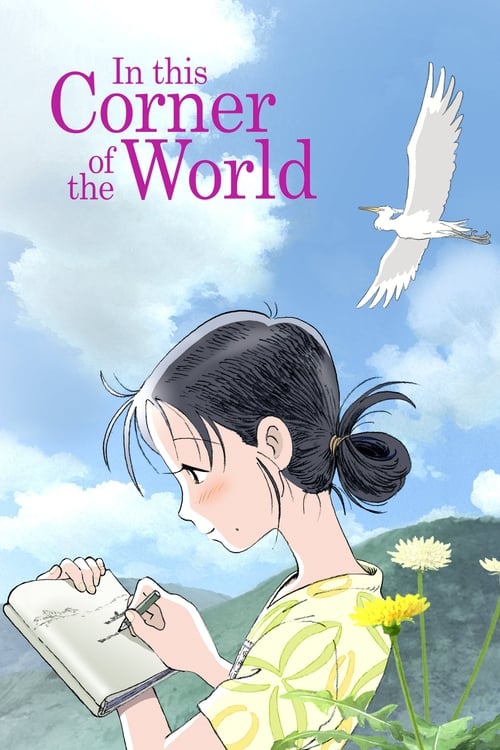
In This Corner of the World
In This Corner of the World Survives the Bomb by Refusing to Look Away From the Ordinary
Directed by Sunao Katabuchi
Sunao Katabuchi tells the story of Hiroshima by keeping the camera on a young wife peeling vegetables in a neighboring town. The war arrives sideways, through rationing and drawings and a missing hand. That is the whole method, and it is a spiritual one.
Suzu is a dreamy girl from a seaweed-farming family near Hiroshima who marries into a household in Kure, the naval port, in 1944. She draws constantly. She stretches thin rations into meals through invention and patience. The film gives most of its running time to laundry, cooking, courtship, and small domestic disasters, and only lets the war press in gradually: air-raid drills, then real raids, then a delayed-fuse bomb that kills her young niece and takes Suzu's drawing hand. The famous devastation happens off to the side, a flash and a cloud seen from a hillside in the next town over. The film's radical choice is to insist that the meaning of the war lives here, in the ordinary life it interrupts, and not in the spectacle everyone already knows.
Buddhist Reading: Mindfulness Practiced Under Falling Bombs
Suzu is a portrait of attention itself. She meets each moment fully, whether that moment is finding wild herbs, sketching warships in the harbor, or grieving. This is mindfulness rendered as personality rather than doctrine, and the film treats it as the actual technology of survival. When she loses her right hand, she loses her drawing, which was her way of holding the world in loving attention. The grief is that a specific faculty of presence has been amputated.
The film's deepest Buddhist stroke is its refusal of grand meaning. When the Emperor's surrender broadcast plays, Suzu erupts in rage, not relief, screaming that she still had her right mind and could have kept enduring, that she does not understand what all the suffering was for. The teaching does not arrive as consolation. It arrives as her decision, afterward, to keep living in this corner, to adopt an orphaned child, to continue meeting each ordinary moment. Impermanence took the hand, the niece, the city. Attention remains, and attention is where a life is actually lived.
Alchemical Reading: The Nigredo of a Country, Refined in One Kitchen
Alchemy begins with nigredo, the blackening, the dissolution of the old form into rot before anything new can form. Wartime Japan is a nation-scale nigredo, and the film locates the entire process inside Suzu's kitchen. Scarcity is the operation. She takes the base matter of near-nothing, wild greens, a few grains, and by patience and ingenuity transforms it into nourishment. This is the alchemist's literal work: taking what everyone considers waste and refining it into something that sustains life.
The severed hand is the film's calcinatio, the burning that destroys the artist's old mode. Yet the drawings persist. Late in the film we learn that Suzu's watercolors survived, small acts of seeing preserved against the fire that took everything else. The opus does not restore what was lost. The niece stays dead, the hand stays gone, the city stays erased. What the process yields is a self that can hold all of it and still choose to nourish an orphan under the same roof. The gold is not a return to before. It is the capacity to continue.
Questions this film answers
What is the deeper meaning of In This Corner of the World?
Suzu is a dreamy girl from a seaweed-farming family near Hiroshima who marries into a household in Kure, the naval port, in 1944. She draws constantly. She stretches thin rations into meals through invention and patience. The film gives most of its running time to laundry, cooking, courtship, and small domestic disasters, and only lets the war press in gradually: air-raid drills, then real raids, then a delayed-fuse bomb that kills her young niece and takes Suzu's drawing hand. The famous devastation happens off to the side, a flash and a cloud seen from a hillside in the next town over. The film's radical choice is to insist that the meaning of the war lives here, in the ordinary life it interrupts, and not in the spectacle everyone already knows.
What is the hidden symbolism in In This Corner of the World?
Suzu is a portrait of attention itself. She meets each moment fully, whether that moment is finding wild herbs, sketching warships in the harbor, or grieving. This is mindfulness rendered as personality rather than doctrine, and the film treats it as the actual technology of survival. When she loses her right hand, she loses her drawing, which was her way of holding the world in loving attention. The grief is that a specific faculty of presence has been amputated.
What esoteric traditions appear in In This Corner of the World?
In This Corner of the World draws from Buddhism, Alchemy traditions. Sunao Katabuchi tells the story of Hiroshima by keeping the camera on a young wife peeling vegetables in a neighboring town. The war arrives sideways, through rationing and drawings and a missing hand. That is the whole method, and it is a spiritual one.
Is In This Corner of the World worth watching for spiritual seekers?
In This Corner of the World (2016) directed by Sunao Katabuchi is essential viewing for those interested in Buddhism, Alchemy. In This Corner of the World Survives the Bomb by Refusing to Look Away From the Ordinary. It rewards multiple viewings and contemplation.
Rewatch With New Eyes
Now that you've seen the architecture, experience it again. The same film becomes a different film when you know what to watch for.
This time, watch for:
- See impermanence: what clings, what releases, what remains
- Track the stages: blackening, whitening, reddening — death before rebirth
Links may include affiliate partnerships that support Media Revelations
The Descent Continues
Where this thread leads next.

Grave of the Fireflies 1988
The Pride That Killed His Sister
Read the revelation →