The Tale of The Princess Kaguya
Even Paradise Is Worse Than This Dying World
Directed by Isao Takahata
Takahata animated his own death. A being from a luminous realm incarnates briefly into matter, falls in love with the wind and cherry blossoms and her own animal life, and is dragged back to the pure land against her will. Kaguya's grief at being taken home is the deepest argument for incarnation ever animated — even paradise is worse than this dying world if you have learned to love a single human face.
The Tale of the Princess Kaguya is Takahata's final film and the most precise inversion of Buddhist soteriology ever animated. The 10th-century folktale was used for centuries as a teaching about non-attachment — the Princess returns to her true home on the moon, the lunar realm of pure light, and the earthly attachments are revealed as illusion. Takahata animates the folktale and discovers that the standard reading was wrong. The Princess does not want to go home. She fought to be born here. She loved the dirt, the wind, the boy she could not marry, the small animal happiness of her childhood in the foothills. The moon-people who arrive to retrieve her are not liberators. They are extractors. And the Buddha at their head is not the compassionate one. He is the technician who removes attachment by removing memory. Takahata, dying as he made this film, refused to console himself. He insisted that incarnation matters. The pure land was paradise and the earth was suffering and Kaguya still chose, against the structure of the universe, to mourn what she was being taken from.
The Surface
An old bamboo cutter discovers a tiny glowing princess inside a stalk of bamboo. He and his wife raise her. She grows at an unnatural rate. The bamboo cutter, believing his daughter to be of noble origin, finds gold and silk in subsequent bamboo and uses the windfall to move the family to the capital, where Kaguya is groomed for court life and renamed appropriately. She rejects every suitor. The Emperor himself attempts to claim her. She prays in despair to the moon. The moon answers. The lunar court descends in a celestial procession to retrieve her. She begs to stay. She is given a robe that erases her memory. She is taken. The bamboo cutter and his wife are left with nothing.
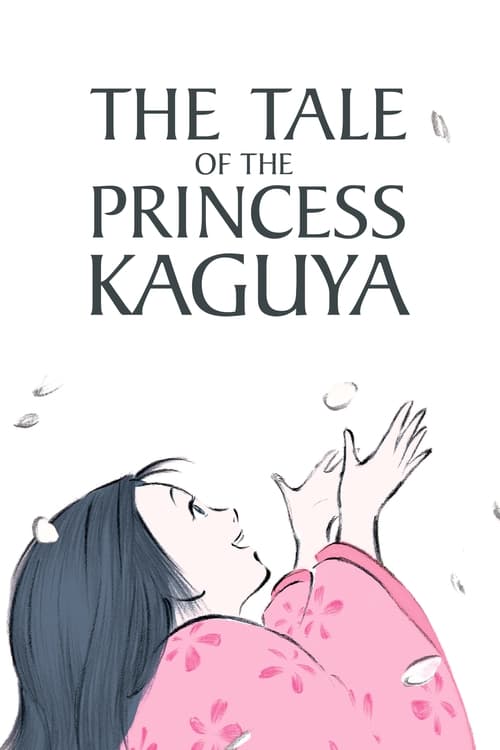
The film took Takahata eight years to complete. It is animated in a watercolor and charcoal style unprecedented in feature animation — lines that break, colors that bleed, frames that look hand-drawn moment by moment rather than mechanically produced. The aesthetic is doing theological work. The earth is rendered as fragile, beautiful, perishable. The moon, in the final sequence, is rendered as flat and untouchable.
Takahata was eighty-one when he finished it. He died five years later. The film is his statement, made knowing what was coming, about whether the life that ends was worth being alive for. The answer is unambiguous and is the most unfashionable answer in twentieth-century Buddhist art.
The Inversion of the Pure Land
In Pure Land Buddhism — the dominant Buddhist tradition in Japan for most of the last thousand years — the spiritual goal is rebirth in the Pure Land of Amitabha Buddha, a realm of pristine light and continuous teaching from which final liberation becomes possible. The Pure Land is paradise. The earthly realm is samsara, characterized by suffering, impermanence, and attachment. The standard story of the Princess Kaguya was read for centuries as a parable in this register. She belonged to the higher realm. She was sent down to learn. She returned. Earth was illusion. The moon was home.
Takahata read the folktale and saw something else entirely. He saw that Kaguya did not want to go home. He saw that her tears at the end were real tears. He saw that the lunar procession was not a rescue. It was extraction. The Pure Land in the film is not depicted as desirable. It is depicted as the place where memory ends and attachment is forcibly removed. The robe of forgetting is the most violent image in the film. To return to paradise, you must agree to forget that you ever loved anyone here.
This is doctrinally daring. Takahata is not arguing against Buddhism. He is arguing within it, and his argument is that the standard reading of the Pure Land as straightforward salvation may be a misunderstanding of what gets lost. He is filming the position of the bodhisattva who voluntarily refuses final liberation in order to remain in samsara with suffering beings. Kaguya is that bodhisattva, except that her vow is overridden by the lunar bureaucracy. She is taken against her will.
The Buddha figure at the head of the procession smiles serenely throughout. He is not malicious. He simply has no framework within which Kaguya's grief makes sense. From his perspective, she is being rescued from delusion. From hers, she is being torn from everything that ever made existence valuable. The film holds both positions and refuses to choose. The viewer is asked to consider which one the film's eight years of labor was defending.
The Crime Is the Wanting
Late in the film, Kaguya remembers why she was sent to earth in the first place. She had seen earth from the moon. She had heard a song carried on the wind. She had longed for it. The longing was the crime. The lunar court does not permit longing. To want a thing is to have a center of gravity outside the Pure Land, and the Pure Land is supposed to be the only center of gravity that should exist. Her sentence was banishment to the place she had longed for, so she could discover that longing produces suffering.
The lunar court's pedagogy is precise and is exactly the standard Buddhist diagnosis: wanting causes suffering, therefore extinguish wanting. Kaguya was supposed to come to earth, suffer, understand that suffering, and return enlightened — relieved that the moon never permitted the wanting in the first place.
She does not do this. She comes to earth and she wants more, not less. She wants the wind. She wants to run through the grass. She wants the boy from her village. She wants the bird that she watched her father release. She wants the cherry blossoms that bloom and fall in the same week. Her sojourn on earth, instead of curing her of attachment, gives her a thousand new attachments. By the time the moon comes to collect her, she has become a being who would rather suffer infinitely on earth than be at peace on the moon.
Takahata is challenging the foundational Buddhist diagnosis at its most sensitive point. He is asking: what if the wanting is not the problem? What if the wanting is what makes a creature a creature? What if the Pure Land's serenity is not enlightenment but anesthesia? He is asking these questions in his final film, dying as he asked them. He is not answering them. He is asserting, by structural decision, that Kaguya's longing was sacred and that the universe that punished it was the smaller intelligence.
The Bamboo Cutter's Misreading
The bamboo cutter is the film's quiet villain and the film's deepest tragedy. He loves Kaguya. He wants the best for her. He misreads what the best is, catastrophically, and his misreading is the proximate cause of her suffering.
He believes that a being from the heavens must be a princess. He believes a princess must live in the capital. He believes she must be groomed in courtly arts, presented to suitors of rank, married to the highest noble he can attract. He spends the gold the bamboo gave him on a mansion. He spends the silks on training. He spends his daughter's childhood on preparation for a court life she does not want.
This is the well-meaning parental projection at its most destructive. He does not see her. He sees the destiny he has assigned her. He cannot perceive that her happiness lay in the foothills, in the dirt, in the freedom to climb trees and chase frogs with the village boy. He has decided what greatness means and is forcing her into the shape of that greatness while she withers.
When she finally rebels — running through the snow in a torn kimono, back to the village to find her childhood gone — the film's heartbreak is total. The Pure Land was forcing one extraction. Her father was forcing another. Both extractions were performed by beings who loved her. Both were violent. The film is honest enough to refuse to make either one the villain. The bamboo cutter is the universe of well-meaning fathers everywhere. He is also the reason his daughter cannot be where she would have been most herself.
The Transmission
The Tale of the Princess Kaguya transmits a recognition that is more controversial in Buddhist culture than Western viewers can easily perceive. Takahata is challenging, with the authority of his final film, the position that liberation from attachment is unambiguously the goal. He is saying: the wanting is the holy thing. The attachment is what made the being a being. The Pure Land's serenity may be a smaller order of consciousness than the messy, dying, beautiful, attached consciousness of someone running through earthly grass.
He is not arguing against transcendence. He is arguing that the standard depiction of transcendence as departure-from-attachment may be a category error. The bodhisattva who refuses Nirvana to remain with suffering beings has always been Buddhism's most spiritually advanced figure. Kaguya is that bodhisattva. The film makes her so by refusing to dramatize her departure as a happy ending.
The viewer who has lost someone they loved — to death, to time, to circumstance — is the viewer the film is for. Takahata is saying: your grief is correct. The thing you lost was real. The various traditions that will try to tell you to stop wanting what is gone are offering you a smaller consciousness than the one your grief is currently occupying. Stay in the grief. The grief is the proof that you were alive.
He is also saying, dying as he said it, that he himself was not ready to forget. The film is not a deathbed reconciliation. It is a deathbed refusal. The Princess does not want to go home. Neither did Takahata. The film is what he left because he could not stay. The robe of forgetting was put on him too. The film resists the robe. The film is the part of him that did not consent to the extraction.
Questions this film answers
What is the deeper meaning of The Tale of The Princess Kaguya?
The Tale of the Princess Kaguya is Takahata's final film and the most precise inversion of Buddhist soteriology ever animated. The 10th-century folktale was used for centuries as a teaching about non-attachment — the Princess returns to her true home on the moon, the lunar realm of pure light, and the earthly attachments are revealed as illusion. Takahata animates the folktale and discovers that the standard reading was wrong. The Princess does not want to go home. She fought to be born here. She loved the dirt, the wind, the boy she could not marry, the small animal happiness of her childhood in the foothills. The moon-people who arrive to retrieve her are not liberators. They are extractors. And the Buddha at their head is not the compassionate one. He is the technician who removes attachment by removing memory. Takahata, dying as he made this film, refused to console himself. He insisted that incarnation matters. The pure land was paradise and the earth was suffering and Kaguya still chose, against the structure of the universe, to mourn what she was being taken from.
What is the hidden symbolism in The Tale of The Princess Kaguya?
An old bamboo cutter discovers a tiny glowing princess inside a stalk of bamboo. He and his wife raise her. She grows at an unnatural rate. The bamboo cutter, believing his daughter to be of noble origin, finds gold and silk in subsequent bamboo and uses the windfall to move the family to the capital, where Kaguya is groomed for court life and renamed appropriately. She rejects every suitor. The Emperor himself attempts to claim her. She prays in despair to the moon. The moon answers. The lunar court descends in a celestial procession to retrieve her. She begs to stay. She is given a robe that erases her memory. She is taken. The bamboo cutter and his wife are left with nothing.
What esoteric traditions appear in The Tale of The Princess Kaguya?
The Tale of The Princess Kaguya draws from Buddhism, Jungian traditions. Takahata animated his own death. A being from a luminous realm incarnates briefly into matter, falls in love with the wind and cherry blossoms and her own animal life, and is dragged back to the pure land against her will. Kaguya's grief at being taken home is the deepest argument for incarnation ever animated — even paradise is worse than this dying world if you have learned to love a single human face.
What does The Tale of The Princess Kaguya teach about the crime is the wanting?
What if the wanting is not the problem? What if the Pure Land's serenity is not enlightenment but anesthesia? Late in the film, Kaguya remembers why she was sent to earth in the first place. She had seen earth from the moon. She had heard a song carried on the wind. She had longed for it. The longing was the crime. The lunar court does not permit longing. To want a thing is to have a center of gravity outside the Pure Land, and the Pure Land is supposed to be the only center of gravity that should exist. Her sentence was banishment to the place she had longed for, so she could discover that longing produces suffering.
Is The Tale of The Princess Kaguya worth watching for spiritual seekers?
The Tale of The Princess Kaguya (2013) directed by Isao Takahata is essential viewing for those interested in Buddhism, Incarnation, Takahata. Even Paradise Is Worse Than This Dying World. It rewards multiple viewings and contemplation.
Rewatch With New Eyes
Now that you've seen the architecture, experience it again. The same film becomes a different film when you know what to watch for.
This time, watch for:
- See impermanence: what clings, what releases, what remains
- Meet the shadow: what is rejected, projected, and finally integrated
Links may include affiliate partnerships that support Media Revelations
The Descent Continues
Where this thread leads next.

Grave of the Fireflies 1988
The Pride That Killed His Sister
Read the revelation →