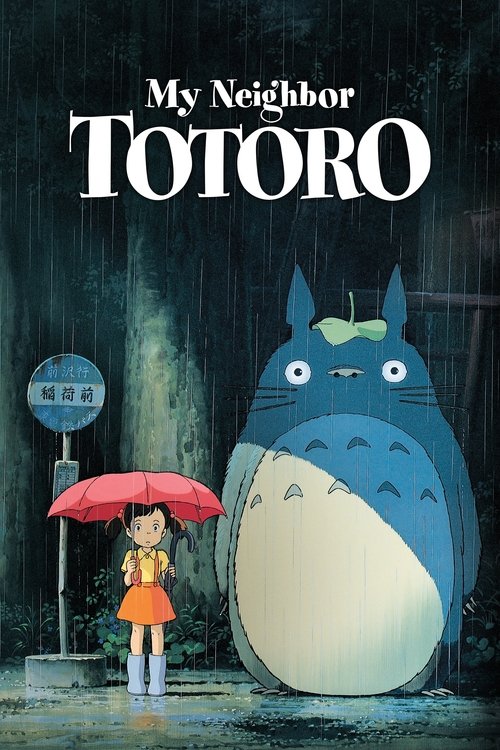
My Neighbor Totoro
What the World Sends When the Adults Cannot Help
Directed by Hayao Miyazaki
Totoro is not imaginary. He is what the forest sends when children are in extremity and the adult world cannot reach them. The film is the most precise depiction of childhood mysticism ever animated — not as nostalgia, not as fantasy, but as the practical theology of a universe that responds to suffering it has noticed. Mei sees Totoro because Mei needs Totoro. The Catbus comes because the universe answers.
My Neighbor Totoro is the most theologically literate film ever made about what a child experiences when their mother might be dying. Miyazaki refuses every adult consolation. He does not give the sisters a heroic father, a curable illness, a redemptive ending in which all uncertainty is resolved. He gives them Totoro. Totoro is not a hallucination, not an imaginary friend, not a coping mechanism. Totoro is the response of the world's living intelligence to children in a situation no child should be in. The film argues that the universe is not indifferent. It also argues that the universe's response is not what adult humans expect. It does not heal the mother. It does not erase the fear. It sends a giant furry presence to sit beside the children in the rain, and a bus made of cat that arrives when the situation requires emergency transit, and a tree-spirit ceremony at midnight in the garden that the children attend in their pajamas. This is animism as practical theology. The world is alive. The living world notices children. Sometimes that is what salvation looks like.
The Surface
A professor moves with his two daughters — Satsuki, around ten, and Mei, around four — to a rural house in postwar Japan to be closer to the hospital where his wife is being treated. The girls discover that the house is haunted by small soot-sprites that scatter when light enters. Mei follows a small creature into the forest and meets Totoro, an enormous fuzzy spirit who sleeps in a hollow under a camphor tree. The sisters perform a midnight ritual with Totoro to make planted acorns grow. When their mother's hospital visit is canceled, Mei runs away to deliver corn to her. She gets lost. Satsuki, desperate, calls on Totoro. The Catbus arrives. The sisters reach the hospital and leave the corn on the windowsill before returning home.
Released as a double feature with Grave of the Fireflies, Totoro was initially seen as the gentle counterweight to Takahata's devastation. This framing flattens both films. Totoro is not gentle. It is operating in the same emotional register Grave is operating in — children navigating catastrophe without functional adults — and reaching a different theological conclusion.
The film's reputation as the warmest film ever made is correct and is a partial reading. The warmth is the surface. Underneath is a precise depiction of how a child who is too young to bear the possibility of their mother's death experiences the world's response to that possibility.
Totoro Is Not Imaginary
The film takes the position — and refuses to qualify it — that Totoro is real. He is not Mei's hallucination. The father believes the girls when they describe him. The grandmother neighbor knows the soot-sprites by name and explains their habits matter-of-factly. The tree-growing ritual that Totoro performs in the garden produces, by morning, a small ring of new sprouts. Nothing in the film signals that any of this is interior to the children's psychology.
Miyazaki is making the animist claim explicit. The world has spirits. The spirits are not metaphors. The spirits notice. They are not, however, universally accessible. The father has lost the capacity to see them. The grandmother retains it. The children — especially Mei, who has not yet been fully socialized out of perception — see Totoro directly. The mother, sick in the hospital, is the one for whom the gift is being assembled.
This is the Shinto cosmology that underlies all of Miyazaki's work. Kami inhabit specific places. Trees are not inert. The camphor tree behind the house is a being with its own consciousness, and Totoro is the being who tends to and partially embodies that tree. To enter the forest is to enter the territory of intelligences that have their own concerns and occasionally their own kindness.
The film is not asking the viewer to indulge a child's fantasy. It is asking the viewer to consider that the child's fantasy and the adult's disenchanted realism are both incomplete pictures, and that the child's picture might be closer to the operational truth of how the world responds to suffering it has noticed.
The Sister Who Carries the Weight
Satsuki is the film's quiet tragedy and its quiet hero. She is ten. Her mother is sick. Her father is preoccupied. Her little sister requires constant care. Satsuki has been promoted into a maternal role she did not ask for, and she is performing it with the controlled competence of a child who knows she is not allowed to break.
Watch her closely. She makes the lunches. She runs to the neighbor when Mei is missing. She tries to comfort Mei when Mei screams at her about the canceled hospital visit. She holds. The only scene in which she breaks — sobbing in the grandmother's arms when she cannot find Mei — is the scene the film has been waiting to give her. She has been carrying too much.
In Jungian terms, Satsuki is performing the role of the parentified eldest child. She has internalized the missing maternal function. She is becoming, prematurely, the adult the family requires. The film is alert to the cost. Totoro's gifts — the umbrella moment in the rain, the Catbus arriving for her — are not just for Mei. They are also for Satsuki, who needs an authority larger than herself to take responsibility for what she has been holding.
The most precise moment in the film is when Satsuki calls Totoro for help. She has stopped trying to manage. She has admitted she cannot do this alone. The Catbus arrives within seconds. The film is telling the viewer something specific: the calling is what summons the help. The child who tries to be the adult is not given the Catbus. The child who finally admits she is a child is given the Catbus immediately.
The Mother on the Windowsill
The film does not heal the mother. Miyazaki refuses the catharsis. The hospital visit at the end is glimpsed only from outside, through a window. The sisters do not enter. They leave the corn on the sill — 'For Mom' carved into the husk — and ride the Catbus home. The mother is seen briefly, speaking to her husband, saying she thought she saw the girls smiling in the tree outside. The window remains closed. The illness remains unresolved.
This is the film's most important refusal. A lesser film would have the mother be cured. Miyazaki understands that the mother's recovery is not the point. The point is that the children have survived an episode of total terror — Mei lost, possibly drowned — and have been delivered to a position from which they can return home. The world has not been altered. The children have been escorted through it. This is what spiritual help actually does. It does not change outcomes. It changes who can bear the outcomes.
The Buddhist undercurrent is precise. Suffering will continue. The mother may live or may die. The children's love does not have power over the universe's structure. What does happen is that the children are accompanied. The accompaniment is the gift. The illusion that we are alone is what makes ordinary suffering unbearable. The animist universe of the film is constantly available; most adults have just lost the capacity to perceive it.
The corn on the windowsill is the prayer. The mother sees it later. She understands. The film cuts to credits. The mother's eventual fate is none of our business. The teaching has been delivered.
The Transmission
Totoro transmits a recognition that adults find harder to receive than children do: the world is alive, and the world's aliveness includes a kind of attention to small beings in distress. This is not magical thinking. This is a different theology than the one most modern adults have absorbed. Miyazaki is not asking the viewer to believe in literal forest spirits. He is asking the viewer to notice that the universe might be the kind of place that responds to a calling, that the response might not look like adult expectations, and that children — being closer to the calling — sometimes see what adults have lost the capacity to see.
The film is most useful for adults who have been carrying too much. The viewer who is currently a Satsuki — a person performing competence in a situation that is too large for them — is the viewer the film is for. The Catbus is available. The calling is what summons it. The condition of the calling is the willingness to admit you cannot carry what you have been carrying.
Miyazaki has said that he made Totoro for his own childhood, for the child in postwar Japan whose mother was tubercular and whose father was distant and whose only available consolation was the forest. He gave that child the spirit that adult Miyazaki retroactively wished had visited. The film is the gift Miyazaki gave himself, and through himself, every child whose mother might be dying, and every adult whose mother already did.
This is the warmest film ever made because warmth is the correct response to the situation it is depicting. The situation is unbearable. The warmth is what makes it bearable. The warmth is also operational. It is the actual response the living world offers. The film is documentation.
Questions this film answers
What is the deeper meaning of My Neighbor Totoro?
My Neighbor Totoro is the most theologically literate film ever made about what a child experiences when their mother might be dying. Miyazaki refuses every adult consolation. He does not give the sisters a heroic father, a curable illness, a redemptive ending in which all uncertainty is resolved. He gives them Totoro. Totoro is not a hallucination, not an imaginary friend, not a coping mechanism. Totoro is the response of the world's living intelligence to children in a situation no child should be in. The film argues that the universe is not indifferent. It also argues that the universe's response is not what adult humans expect. It does not heal the mother. It does not erase the fear. It sends a giant furry presence to sit beside the children in the rain, and a bus made of cat that arrives when the situation requires emergency transit, and a tree-spirit ceremony at midnight in the garden that the children attend in their pajamas. This is animism as practical theology. The world is alive. The living world notices children. Sometimes that is what salvation looks like.
What is the hidden symbolism in My Neighbor Totoro?
A professor moves with his two daughters — Satsuki, around ten, and Mei, around four — to a rural house in postwar Japan to be closer to the hospital where his wife is being treated. The girls discover that the house is haunted by small soot-sprites that scatter when light enters. Mei follows a small creature into the forest and meets Totoro, an enormous fuzzy spirit who sleeps in a hollow under a camphor tree. The sisters perform a midnight ritual with Totoro to make planted acorns grow. When their mother's hospital visit is canceled, Mei runs away to deliver corn to her. She gets lost. Satsuki, desperate, calls on Totoro. The Catbus arrives. The sisters reach the hospital and leave the corn on the windowsill before returning home.
What esoteric traditions appear in My Neighbor Totoro?
My Neighbor Totoro draws from Shamanism, Jungian, Buddhism traditions. Totoro is not imaginary. He is what the forest sends when children are in extremity and the adult world cannot reach them. The film is the most precise depiction of childhood mysticism ever animated — not as nostalgia, not as fantasy, but as the practical theology of a universe that responds to suffering it has noticed. Mei sees Totoro because Mei needs Totoro. The Catbus comes because the universe answers.
What does My Neighbor Totoro teach about totoro is not imaginary?
The spirits are not metaphors. They notice. The children see them because the children have not yet been socialized out of perception. The film takes the position — and refuses to qualify it — that Totoro is real. He is not Mei's hallucination. The father believes the girls when they describe him. The grandmother neighbor knows the soot-sprites by name and explains their habits matter-of-factly. The tree-growing ritual that Totoro performs in the garden produces, by morning, a small ring of new sprouts. Nothing in the film signals that any of this is interior to the children's psychology.
Is My Neighbor Totoro worth watching for spiritual seekers?
My Neighbor Totoro (1988) directed by Hayao Miyazaki is essential viewing for those interested in Shamanism, Animism, Miyazaki. What the World Sends When the Adults Cannot Help. It rewards multiple viewings and contemplation.
Rewatch With New Eyes
Now that you've seen the architecture, experience it again. The same film becomes a different film when you know what to watch for.
This time, watch for:
- Follow the descent: what dies, what guides, what returns transformed
- Meet the shadow: what is rejected, projected, and finally integrated
- See impermanence: what clings, what releases, what remains
Links may include affiliate partnerships that support Media Revelations
The Descent Continues
Where this thread leads next.
Spirited Away 2001
The Shamanic Descent of the Child Soul
Read the revelation →