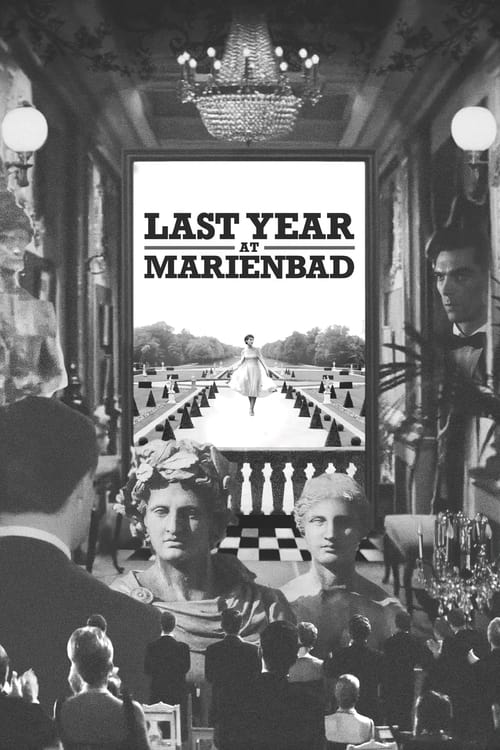
Last Year at Marienbad
Last Year at Marienbad Is a Man Constructing a Past Until the Woman Agrees to Have Lived It
Directed by Alain Resnais
Resnais made a film with no reliable memory, no fixed time, and no confirmable event. It is not a puzzle to solve. It is a demonstration of how a self gets built by being told what it was.
A man tells a woman they met here last year and agreed to run away together. She does not remember. He describes the corridors, the statue, the room, the encounter, and with each retelling the film shows us his version, then contradicts it, then reshapes it. There is no ground truth to recover. The affair may have happened, may be a seduction, may be a fantasy either of them is having. Resnais is not withholding the answer. He built a film where the answer does not exist, because the film is about a process that runs beneath every human relationship: one consciousness insisting on a version of reality until another consciousness accepts it as its own. By the end she leaves with him, not because she remembers, but because he has out-narrated her.
Jungian Reading: The Animus as Narrator, the Persona as Palace
Jung called the animus the inner masculine that, when unconscious, speaks in a woman's mind with the voice of absolute conviction, pronouncing what is true and what she must do. In Marienbad the man is not a character so much as that voice externalized: calm, relentless, certain of a past she cannot feel. He narrates and the world rearranges to match. This is precisely how the possessing animus operates, as an inner narrator that manufactures certainty and demands the psyche conform.
The baroque hotel is the persona rendered as architecture. Its endless mirrored galleries, its frozen guests posed like mannequins, its garden where the people cast shadows but the hedges do not, is a portrait of a self that has become all surface, all social masonry, with nothing living inside. The woman drifts through it because she has no interior of her own to return to; she is available to be authored. The rival figure, the second man who keeps winning the matchstick game and may be her husband, is the counter-voice, the resistance that loses. The film is the anatomy of a psyche being colonized in real time.
Initiatory Reading: The Threshold You Cross Without Consent
Initiation transforms identity, but Marienbad shows its dark mirror: transformation imposed rather than earned. The man's project is to move the woman across a threshold, from the woman who was never here to the woman who was, from the wife who stays to the lover who leaves. He does it through repetition, the way any indoctrination works, saying the same scene until it stops feeling foreign.
The statue in the garden is the film's still center, a man and a woman frozen mid-gesture, and the two of them argue over what it depicts, each assigning it a story. That is the whole film in one image: an ambiguous form that becomes whatever narrative is imposed on it. When she finally walks out into the night with him, it is not liberation and it is not clearly captivity. It is a self that has been overwritten, crossing into a past that was authored for it, unable to prove it did not consent. Resnais leaves the question open because in most lives it stays open: we rarely know which of our certainties we lived and which we were told.
Questions this film answers
What is the deeper meaning of Last Year at Marienbad?
A man tells a woman they met here last year and agreed to run away together. She does not remember. He describes the corridors, the statue, the room, the encounter, and with each retelling the film shows us his version, then contradicts it, then reshapes it. There is no ground truth to recover. The affair may have happened, may be a seduction, may be a fantasy either of them is having. Resnais is not withholding the answer. He built a film where the answer does not exist, because the film is about a process that runs beneath every human relationship: one consciousness insisting on a version of reality until another consciousness accepts it as its own. By the end she leaves with him, not because she remembers, but because he has out-narrated her.
What is the hidden symbolism in Last Year at Marienbad?
Jung called the animus the inner masculine that, when unconscious, speaks in a woman's mind with the voice of absolute conviction, pronouncing what is true and what she must do. In Marienbad the man is not a character so much as that voice externalized: calm, relentless, certain of a past she cannot feel. He narrates and the world rearranges to match. This is precisely how the possessing animus operates, as an inner narrator that manufactures certainty and demands the psyche conform.
What esoteric traditions appear in Last Year at Marienbad?
Last Year at Marienbad draws from Jungian, Initiation traditions. Resnais made a film with no reliable memory, no fixed time, and no confirmable event. It is not a puzzle to solve. It is a demonstration of how a self gets built by being told what it was.
Is Last Year at Marienbad worth watching for spiritual seekers?
Last Year at Marienbad (1961) directed by Alain Resnais is essential viewing for those interested in Jungian, Initiation. Last Year at Marienbad Is a Man Constructing a Past Until the Woman Agrees to Have Lived It. It rewards multiple viewings and contemplation.
Rewatch With New Eyes
Now that you've seen the architecture, experience it again. The same film becomes a different film when you know what to watch for.
This time, watch for:
- Meet the shadow: what is rejected, projected, and finally integrated
- Mark the threshold: the old self dies, the ordeal transforms, the new self returns
Links may include affiliate partnerships that support Media Revelations
The Descent Continues
Where this thread leads next.
Hiroshima Mon Amour 1959
Hiroshima Mon Amour Says Memory and Forgetting Are the Same Act
Read the revelation →