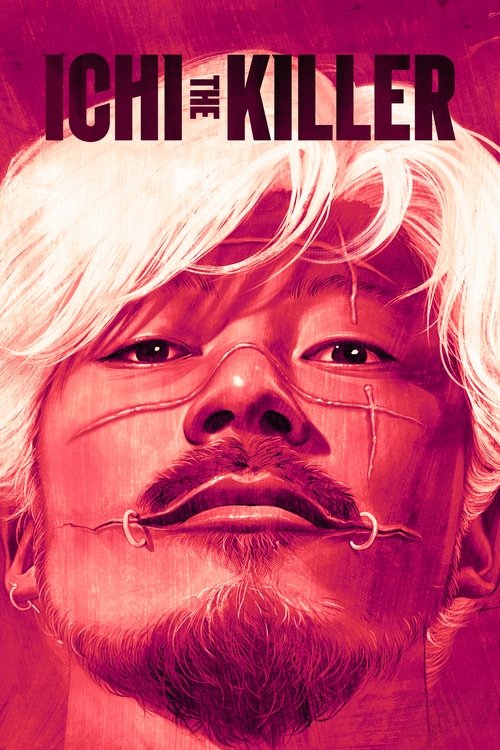
Ichi the Killer
Ichi the Killer Is a Sadist Searching the Whole City for the Pain That Would Finally Reach Him
Directed by Takashi Miike
Miike made the most extreme film he could to hide a genuinely tender question underneath the blood: what does a man do when he can no longer feel his own suffering?
Kakihara is a masochist, a yakuza enforcer with a slit-open mouth held together by piercings, who cannot find anyone strong enough to hurt him the way he needs. Ichi is a weeping, broken young man programmed to kill, who slices men apart while sobbing and ejaculating in the same act. The film is received as pure provocation, a gore competition, a dare aimed at the audience's stomach. That reading is not wrong so much as incomplete. Underneath the mutilation, Miike is staging a very old drama about two men who are each other's missing half, circling a whole city trying to find the sensation that would make them feel real. Kakihara spends the entire film hunting for the one who can deliver ultimate pain, and the film's cruelest joke is that when he finds Ichi, the delivery does not come. What follows is what the violence is actually about.
Jungian Reading: Two Men Who Are One Split Psyche Hunting for Its Other Half
Jung held that a disowned part of the self does not vanish. It splits off, personifies, and reappears in the outer world wearing another face, and the psyche is compelled to seek it, because wholeness demands the reunion of what was severed.
Kakihara and Ichi are one wound cut in two. Kakihara receives pain and calls it pleasure; Ichi inflicts pain and drowns it in guilt and tears. One is the sadism turned inward, one the sadism turned outward, and neither can feel the completing half without the other. This is why Kakihara's search is genuinely a quest and not just a manhunt. He has heard of a killer who can hurt like no one else, and he pursues that rumor with something close to devotion, because on some level he knows he is looking for his own severed capacity, the ability to cause pain he traded away for the ability to receive it. When the two finally near each other on the rooftop, the anticipated fusion, the great meeting of inflicted and received agony, dissolves into something small and pathetic. Ichi collapses, sobbing, unable to be the savior-executioner Kakihara needed. The split does not heal. The psyche does not reintegrate. Miike stages the longed-for reunion and then denies it, which is the most honest thing in the film.
Alchemical Reading: The Coniunctio That Fails Because Neither Substance Is Cooked
The alchemical wedding, the coniunctio, joins the two contraries, the fixed and the volatile, the red king and the white queen, into a single perfected substance. But the wedding only works if both substances have first been purified through the fire. Join two raw materials and you get not gold but rot.
Ichi the Killer is a coniunctio that fails at exactly this point. Kakihara and Ichi are the two contraries, active and passive, cruelty given and cruelty taken, and the entire film drives them toward union. Yet neither has undergone the purifying death the work requires. Kakihara has only ever fled into sensation. Ichi has only ever been programmed and manipulated, never made conscious of himself. Watch the ambiguous ending, the boy in the tree, Jijii hanging above, the suggestion that the whole cycle simply loops and repeats with a new vessel. Nothing has transmuted. The heat was applied, the two were brought together, and the result is not the philosopher's stone but a smear, because you cannot marry two substances that were never cooked. The opus collapses back into prima materia.
Questions this film answers
What is the deeper meaning of Ichi the Killer?
Kakihara is a masochist, a yakuza enforcer with a slit-open mouth held together by piercings, who cannot find anyone strong enough to hurt him the way he needs. Ichi is a weeping, broken young man programmed to kill, who slices men apart while sobbing and ejaculating in the same act. The film is received as pure provocation, a gore competition, a dare aimed at the audience's stomach. That reading is not wrong so much as incomplete. Underneath the mutilation, Miike is staging a very old drama about two men who are each other's missing half, circling a whole city trying to find the sensation that would make them feel real. Kakihara spends the entire film hunting for the one who can deliver ultimate pain, and the film's cruelest joke is that when he finds Ichi, the delivery does not come. What follows is what the violence is actually about.
What is the hidden symbolism in Ichi the Killer?
Jung held that a disowned part of the self does not vanish. It splits off, personifies, and reappears in the outer world wearing another face, and the psyche is compelled to seek it, because wholeness demands the reunion of what was severed.
What esoteric traditions appear in Ichi the Killer?
Ichi the Killer draws from Jungian, Alchemy traditions. Miike made the most extreme film he could to hide a genuinely tender question underneath the blood: what does a man do when he can no longer feel his own suffering?
Is Ichi the Killer worth watching for spiritual seekers?
Ichi the Killer (2001) directed by Takashi Miike is essential viewing for those interested in Jungian, Alchemy. Ichi the Killer Is a Sadist Searching the Whole City for the Pain That Would Finally Reach Him. It rewards multiple viewings and contemplation.
Rewatch With New Eyes
Now that you've seen the architecture, experience it again. The same film becomes a different film when you know what to watch for.
This time, watch for:
- Meet the shadow: what is rejected, projected, and finally integrated
- Track the stages: blackening, whitening, reddening — death before rebirth
Links may include affiliate partnerships that support Media Revelations