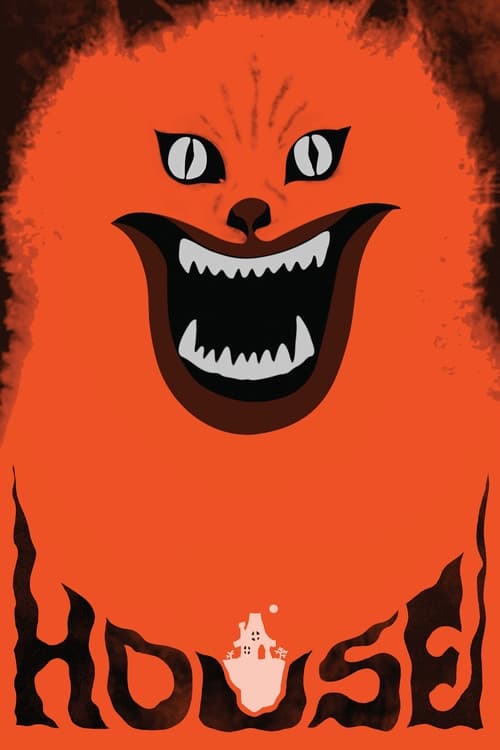
House
House Is a Widow's Devouring Grief Disguised as a Haunted Mansion
Directed by Nobuhiko Obayashi
Obayashi paints his nightmare in candy colors and cut-out collage so the horror slips past your defenses: this is a woman who was never allowed to stop waiting, and the house is her hunger made architecture.
Gorgeous and six friends, each named for a single trait, travel to her aunt's country mansion, where the house begins to eat them: a piano devours a girl, a severed head bites, futons and lampshades and reflections all turn predatory. The surface reading is a gleefully insane haunted-house film, all optical trickery and sugar-rush editing. What Obayashi is actually building underneath the delirium is grief itself. The aunt is a woman whose fiancé went off to war and never came back, and she died, or refused to die, still waiting for him. The house is what a life becomes when it is frozen at the moment of loss and forbidden to move forward. The girls are not killed by a monster. They are consumed by an unmarried woman's hunger that has waited so long it will now feed on any young life that enters, because the youth she lost was never returned to her.
Demonological Reading: The Hungry Ghost Bound to the Place of Its Waiting
In the folk demonology of much of East Asia, a person who dies with an unfulfilled longing does not pass on. They become a hungry ghost, an entity defined by an appetite that can never be satisfied, tethered to the site of their grief and feeding on the living to fill a void that has no bottom. The aunt is a textbook hungry ghost. Her longing, a bride waiting for a groom who died at war, curdled across decades into pure devouring need.
Watch the logic of who the house wants. It wants unmarried young women, girls still full of the future the aunt was denied. The white cat, Blanche, is the ghost's familiar and lure, its green eyes flashing the color of the possessing hunger. When Gorgeous puts on her late aunt's wedding-era finery and merges with her at a vanity mirror, the film states the mechanism outright: the ghost perpetuates itself by absorbing the young, wearing their faces, staging the marriage that never came. The demon here is not evil in the moral sense. It is grief that was never allowed to complete, and a grief that cannot complete will eat.
Jungian Reading: The Devouring Mother and the Girls Who Cannot Individuate
Jung named the archetype of the Terrible Mother, the maternal principle in its consuming aspect, the womb that will not release its children into their own lives but pulls them back to be reabsorbed. The aunt's house is this womb turned lethal. It offers shelter, food, family warmth, and then swallows the ones who accept it, refusing to let them leave as separate selves.
The seven girls are barely individuated to begin with. Named Gorgeous, Kung Fu, Prof, Melody, Mac, Sweet, Fantasy, each is a single function, not yet a whole person, exactly the psychic material the Devouring Mother can most easily reclaim. Their trip to the countryside should be a passage toward adulthood and separation. Instead the archetypal mother, in her possessive rage at her own arrested life, drags them back into undifferentiated matter: bodies dissolving into blood, into flowers, into the fabric of the house. Individuation is refused. The self that tries to leave the mother is devoured before it can be born.
Questions this film answers
What is the deeper meaning of House?
Gorgeous and six friends, each named for a single trait, travel to her aunt's country mansion, where the house begins to eat them: a piano devours a girl, a severed head bites, futons and lampshades and reflections all turn predatory. The surface reading is a gleefully insane haunted-house film, all optical trickery and sugar-rush editing. What Obayashi is actually building underneath the delirium is grief itself. The aunt is a woman whose fiancé went off to war and never came back, and she died, or refused to die, still waiting for him. The house is what a life becomes when it is frozen at the moment of loss and forbidden to move forward. The girls are not killed by a monster. They are consumed by an unmarried woman's hunger that has waited so long it will now feed on any young life that enters, because the youth she lost was never returned to her.
What is the hidden symbolism in House?
In the folk demonology of much of East Asia, a person who dies with an unfulfilled longing does not pass on. They become a hungry ghost, an entity defined by an appetite that can never be satisfied, tethered to the site of their grief and feeding on the living to fill a void that has no bottom. The aunt is a textbook hungry ghost. Her longing, a bride waiting for a groom who died at war, curdled across decades into pure devouring need.
What esoteric traditions appear in House?
House draws from Demonology, Jungian traditions. Obayashi paints his nightmare in candy colors and cut-out collage so the horror slips past your defenses: this is a woman who was never allowed to stop waiting, and the house is her hunger made architecture.
Is House worth watching for spiritual seekers?
House (1977) directed by Nobuhiko Obayashi is essential viewing for those interested in Demonology, Jungian. House Is a Widow's Devouring Grief Disguised as a Haunted Mansion. It rewards multiple viewings and contemplation.
Rewatch With New Eyes
Now that you've seen the architecture, experience it again. The same film becomes a different film when you know what to watch for.
This time, watch for:
- Identify the hierarchy: which demon, which rank, which grimoire it comes from
- Meet the shadow: what is rejected, projected, and finally integrated
Links may include affiliate partnerships that support Media Revelations