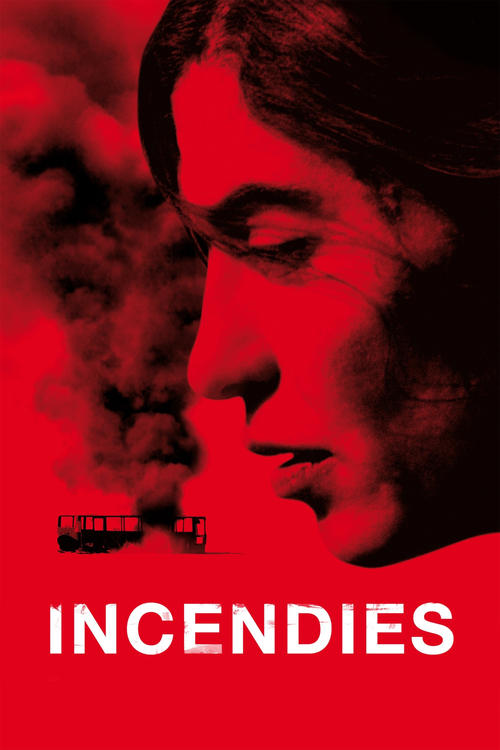
Incendies
The Knot That Stops Counting When It Is Untied
Directed by Denis Villeneuve
Villeneuve adapted Wajdi Mouawad's play into the most unbearable family-structure revelation in twenty-first-century cinema. The mother's last instruction sends the twins into a Lebanese civil war the family never spoke of. They find the brother. They find the father. They discover the two are the same man. The film is not about war. The film is about the moment a Sufi knot is untied and the resulting silence is louder than any of the violence that produced it.
Incendies is the film Villeneuve made before the rest of the world realized what he was. Adapted from Wajdi Mouawad's play, the film tracks twins Jeanne and Simon as they fulfill their mother's posthumous instruction to find their father (whom they thought was dead) and a brother (whom they did not know existed). The investigation leads through Nawal Marwan's life — her village in Lebanon, her conversion to political resistance, her years as a political prisoner, the rape that produced the twins, the boy she gave up at the orphanage years before. The film's catastrophic revelation is that the father and the brother are the same man — Nihad, the boy who was kidnapped from the orphanage, trained as a sniper, then as a torturer in the prison where Nawal herself was held, where he was the man who repeatedly raped her without either of them knowing. The film does not present this as a thriller twist. It presents it as the unbearable arithmetic at the center of certain wars. Mouawad and Villeneuve are working in the tradition of Greek tragedy, but the underlying spiritual lineage is Sufi: the heart's task, at the bottom of the most knotted suffering, is to recognize, to acknowledge, to address. The mother's two letters — one to her son, one to her son-and-father — perform the recognition the entire war was constructed to prevent. The silence at the cemetery, after both letters have been delivered, is what peace actually sounds like.
The Surface
After the death of their mother Nawal, twins Jeanne and Simon Marwan are given a strange instruction by her notary: to find their father and brother, neither of whom they knew existed, and deliver letters to each before placing a headstone on her grave. Jeanne travels to Lebanon to investigate. Simon eventually joins her. The investigation reconstructs Nawal's life — her family's honor killing of her Christian first love, the son she bore him and was forced to give up, her years of political activism, her assassination of a Christian militia leader, her imprisonment in Kfar Ryat where she was systematically raped by 'Abu Tarek' — the prison's torturer — and gave birth to the twins. The twins discover that the boy from the orphanage, Nihad, was trained as a sniper, became Abu Tarek the torturer, and is now their father and their brother in one person. He is alive, in Canada, working as a janitor. The letters are delivered. The headstone is placed.
The film won the Academy Award for Best Foreign Language Film nomination and launched Villeneuve's international career. Critics praised the screenplay's structural complexity and the performance of Lubna Azabal as Nawal across multiple time periods.
Underneath the procedural surface, the film is conducting one of the most precise inquiries in modern cinema into the structure of inherited trauma — what is passed down without being told, what the body of the next generation carries because the prior generation could not metabolize it, and what kind of operation is required to make the inheritance speakable so it can stop being lived blindly. The investigation the twins undertake is the operation. The siblings are the lineage's first attempt to know what the lineage actually contains.
The Knot of the Lineage
Sufi teaching describes certain patterns in a soul, a family, or a community as knots — places where the flow of awareness has been twisted around an unfaced truth so tightly that the truth is held in place by the very mechanism that conceals it. The knot cannot be cut. The knot must be untied. Untying requires patience, attention, and the willingness to follow the strand into the center of the twist without flinching.
Nawal Marwan spent her last years untying the knot. The film opens with her in a public pool, seeing something that triggers the recognition that her son and her rapist are the same person. The next shot is her at her desk preparing letters. She has spent decades in silence. She finally has the information she needs to perform the recognition. The work she does in the period the film does not show — between recognition and death — is the work of preparing the apparatus by which her children can complete what she began.
The will, the notary, the instructions, the letters: this is the apparatus. Nawal is not asking her children to do something cruel. She is asking them to do something that will be unbearable in the moment and that will finally release the lineage. She has calculated that they are old enough, that the documents will lead them where they need to go, and that they will be able to deliver the letters with the precise gesture the situation requires.
Jeanne and Simon are the inheritors who become the untiers. The film is the documentation of the untying. The knot does not become a different shape. The knot ceases to exist. What was held in place by it is released. The release is not happiness. The release is silence.
1 + 1 = 1
Jeanne is a mathematics doctoral student. The film opens with her professor lecturing on a particular topic in pure mathematics. Throughout the film, mathematical motifs recur — the structures of graph theory, the patterns of unsolvable problems, the way certain equations describe what cannot be otherwise stated.
The mother's revelation, when it lands, is announced by the film as the mathematical impossibility that turns out to be true. The father is the brother. One plus one is one. The graph that should be acyclic has a cycle. The relation that should be irreflexive maps a node to itself. Villeneuve uses Jeanne's mathematical framework to make the family arithmetic visible. The viewer who has been paying attention recognizes that the film has been showing the same kind of impossible structure throughout.
Kabbalistic teaching has always taken seriously that the deepest truths about reality have a mathematical character. The structure of the sefirot, the relationships between divine names, the patterns of letters in the Torah: these are pursued because the structure is the message. Mouawad's screenplay — and Villeneuve's adaptation — uses contemporary mathematics in the same spirit. The impossible identity at the center of the family is presented as a kind of theological mathematics. The system cannot resolve. The system has to be solved at a different level than the one where the contradiction lives.
Nawal's two letters are the solution. They acknowledge both relations — son and father — without collapsing them. The contradiction is not resolved. It is held. The holding is what the letters perform. After the letters, the equation does not need to be solved because the equation has been acknowledged in its actual form. The torturer who is also the son has been addressed as both. He weeps in his car. He has been seen, by his mother, as the entire truth of what he is. Most people do not receive this gift. Most do not survive receiving it.
The Bus and the Sniper
The film's most disturbing midsection sequence is the bus attack — Christian militia stop a refugee bus, separate passengers, set the vehicle on fire with the women and children still inside. Nawal survives by claiming Christian identity. The film does not flinch from showing the violence. The little girl Nawal tries to claim as her own is shot. The bus burns. Nawal walks away through the smoke. The viewer learns precisely what conditions made Nawal into the woman who would later assassinate the militia leader.
This sequence is not present for shock. It is present because the film is making a structural argument about how cycles of violence reproduce themselves. The militia who burned the bus produced the sniper Nihad who, years later, sided with whichever faction would let him kill. The sniper produced the torturer. The torturer produced the children. The children, raised in Canada with no information, are the cycle's first opportunity to become aware of itself.
Mouawad and Villeneuve are working with material that comes from the Lebanese Civil War without insisting that the war's specific identifications matter to the cycle's pattern. The film keeps the religious and political identifiers slightly fictional. The militia is identified by signs but not by an exact historical name. This is not evasion. This is rendering the structure visible without letting the structure get filed as a local issue.
The structure is: violence done to a community produces a generation whose participation in further violence appears to them as both inevitable and just. The lineage Nawal carries is the cycle's micro-instance. The cycle is the macro-instance the film is also showing. Either is enough to break a viewer. The film offers both.
The Transmission
Incendies transmits a particular and devastating clarity about what is required to break inherited patterns of violence. The pattern is not broken by retaliation. The pattern is not broken by political settlement. The pattern is broken by the act Nawal performs in the last years of her life: the dogged, painful work of finding out what actually happened, then preparing the apparatus by which what happened can be acknowledged across generations.
The mother's last gesture is not vengeance. It is recognition. She does not ask her children to punish Nihad. She asks them to deliver letters. The letters acknowledge him in both relations. He is, simultaneously, her son and the man who raped her. Both are true. Neither is allowed to silence the other. This is the form of address that breaks the structure that produced the silence.
The film leaves the viewer in the cemetery, the headstone placed, the twins standing in front of the grave. The work of the lineage has been completed. Nawal can finally be buried face-up, with a name. The pact she made with her own silence has been settled by the children who unknowingly carried what she could not say. This is what intergenerational repair looks like when it actually occurs. It is not pretty. It is not redemptive. It is the silence that follows the untying of the knot. The film earns that silence. Few films of any era have earned anything similar.
Questions this film answers
What is the deeper meaning of Incendies?
Incendies is the film Villeneuve made before the rest of the world realized what he was. Adapted from Wajdi Mouawad's play, the film tracks twins Jeanne and Simon as they fulfill their mother's posthumous instruction to find their father (whom they thought was dead) and a brother (whom they did not know existed). The investigation leads through Nawal Marwan's life — her village in Lebanon, her conversion to political resistance, her years as a political prisoner, the rape that produced the twins, the boy she gave up at the orphanage years before. The film's catastrophic revelation is that the father and the brother are the same man — Nihad, the boy who was kidnapped from the orphanage, trained as a sniper, then as a torturer in the prison where Nawal herself was held, where he was the man who repeatedly raped her without either of them knowing. The film does not present this as a thriller twist. It presents it as the unbearable arithmetic at the center of certain wars. Mouawad and Villeneuve are working in the tradition of Greek tragedy, but the underlying spiritual lineage is Sufi: the heart's task, at the bottom of the most knotted suffering, is to recognize, to acknowledge, to address. The mother's two letters — one to her son, one to her son-and-father — perform the recognition the entire war was constructed to prevent. The silence at the cemetery, after both letters have been delivered, is what peace actually sounds like.
What is the hidden symbolism in Incendies?
After the death of their mother Nawal, twins Jeanne and Simon Marwan are given a strange instruction by her notary: to find their father and brother, neither of whom they knew existed, and deliver letters to each before placing a headstone on her grave. Jeanne travels to Lebanon to investigate. Simon eventually joins her. The investigation reconstructs Nawal's life — her family's honor killing of her Christian first love, the son she bore him and was forced to give up, her years of political activism, her assassination of a Christian militia leader, her imprisonment in Kfar Ryat where she was systematically raped by 'Abu Tarek' — the prison's torturer — and gave birth to the twins. The twins discover that the boy from the orphanage, Nihad, was trained as a sniper, became Abu Tarek the torturer, and is now their father and their brother in one person. He is alive, in Canada, working as a janitor. The letters are delivered. The headstone is placed.
What esoteric traditions appear in Incendies?
Incendies draws from Sufism, Kabbalah, Initiation traditions. Villeneuve adapted Wajdi Mouawad's play into the most unbearable family-structure revelation in twenty-first-century cinema. The mother's last instruction sends the twins into a Lebanese civil war the family never spoke of. They find the brother. They find the father. They discover the two are the same man. The film is not about war. The film is about the moment a Sufi knot is untied and the resulting silence is louder than any of the violence that produced it.
What does Incendies teach about the knot of the lineage?
The knot cannot be cut. The knot must be untied. Untying requires the willingness to follow the strand into the center of the twist without flinching. Sufi teaching describes certain patterns in a soul, a family, or a community as knots — places where the flow of awareness has been twisted around an unfaced truth so tightly that the truth is held in place by the very mechanism that conceals it. The knot cannot be cut. The knot must be untied. Untying requires patience, attention, and the willingness to follow the strand into the center of the twist without flinching.
What does Incendies teach about 1 + 1 = 1?
The system cannot resolve. The system has to be solved at a different level than the one where the contradiction lives. Jeanne is a mathematics doctoral student. The film opens with her professor lecturing on a particular topic in pure mathematics. Throughout the film, mathematical motifs recur — the structures of graph theory, the patterns of unsolvable problems, the way certain equations describe what cannot be otherwise stated.
Is Incendies worth watching for spiritual seekers?
Incendies (2010) directed by Denis Villeneuve is essential viewing for those interested in Sufism, Initiation, Villeneuve. The Knot That Stops Counting When It Is Untied. It rewards multiple viewings and contemplation.
Rewatch With New Eyes
Now that you've seen the architecture, experience it again. The same film becomes a different film when you know what to watch for.
This time, watch for:
- Feel the love that transforms: what the heart sees that the mind cannot
- Notice the vessels: what contains, what shatters, what repairs
- Mark the threshold: the old self dies, the ordeal transforms, the new self returns
Links may include affiliate partnerships that support Media Revelations
The Descent Continues
Where this thread leads next.
Sicario 2015
The Border as the Visible Edge of an Older Cosmos
Read the revelation →