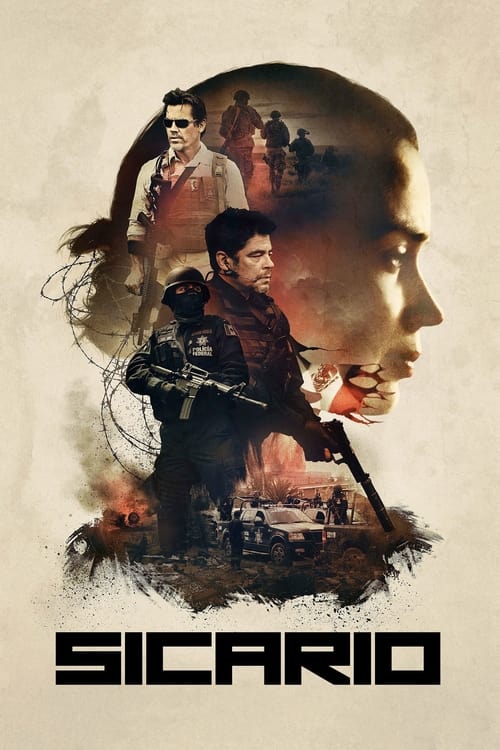
Sicario
The Border as the Visible Edge of an Older Cosmos
Directed by Denis Villeneuve
Villeneuve filmed the U.S.-Mexico border not as policy problem but as cosmological boundary — the place where the rule-bound world ends and the realm of older, unsoftened powers begins. Kate Macer is the idealist who keeps demanding to know the operation's legal authority. Alejandro is the wolf in clean clothes. The film's terrible peace is the moment Kate finally signs the form acknowledging that the rules she came to enforce never applied to the territory she was brought into.
Sicario is widely admired as one of the great American thrillers of the last decade, and almost nobody talks about what it is structurally. Villeneuve made a katabasis film — a descent into the underworld — using a contemporary cartel-war setting as cover. Kate Macer is the protagonist of the conventional story. She is not the protagonist of the film. The protagonist of the film is Alejandro, the wolf of the underworld, whose work the film exists to document. Kate is the witness. Kate is the audience-surrogate brought along so that the viewer has someone to be horrified through. The film's most disturbing structural choice is that Kate is treated by the operation as nothing more than a legal fig leaf — they need an FBI agent on the operation so that subsequent actions can be classified as joint task force work. She is invited not because she matters but because her presence is paperwork. By the end she has signed the document affirming the operation's legitimacy under conditions of duress that the document does not reflect. The film documents how the rule of law is converted, by careful procedure, into the rule of older powers that simply use the rule of law as their alibi.
The Surface
An FBI agent specialized in hostage rescue, Kate Macer, is recruited onto a federal task force operating along the U.S.-Mexico border. The team is led by Matt Graver, a relaxed CIA officer who tells her almost nothing. A silent figure named Alejandro accompanies them. The team conducts increasingly extra-legal operations — a brutal extraction across the Juarez border, a brutal nighttime tunnel raid, a final mission in which Alejandro infiltrates a cartel boss's home and kills the boss and his family at a dinner table. The film reveals that Alejandro is a former Mexican prosecutor whose wife was beheaded and daughter killed by the same cartel boss years ago, that the CIA has weaponized his vengeance to consolidate the cartel power they prefer, and that Kate's only function in the operation has been to provide jurisdictional cover. The film ends with Alejandro forcing Kate to sign the documents legitimizing what was done.
On release, the film was praised for Roger Deakins's cinematography, Jóhann Jóhannsson's score, and the bravura set pieces — the convoy through Juarez, the night-vision tunnel raid. Most discussion has stayed at the level of craft.
Villeneuve and screenwriter Taylor Sheridan have built something more disturbing underneath the craft. The film is a sustained essay on how power actually operates at the boundary where institutional rules formally end. The border is the literal location, but the film's actual subject is the threshold between rule-bound society and the cosmos that rule-bound society depends on but never acknowledges. The threshold is patrolled by figures like Alejandro. The figures are not law enforcement. The figures are something older that law enforcement, in extremis, employs.
Alejandro as Underworld Guide
Alejandro is one of the most precise contemporary depictions of the psychopomp — the figure in mythology whose office is to guide souls across the threshold between the living world and the underworld. Hermes in Greek myth. Anubis in Egyptian. The Sufi khidr in unmarked instance. They are not heroes. They are not villains. They are functionaries of the boundary.
Benicio del Toro plays him with an unsettling stillness. He sleeps on planes when others cannot. He speaks rarely. When he does speak it is to deliver an instruction Kate cannot use. He kills with neither pleasure nor reluctance — he kills because killing is the function. The grief that produced him has been processed into pure operational capacity. He is not the man whose family was murdered anymore. He is what that man became after the years required to become it.
The film treats him with the appropriate respect for the office. He is not glamorized. He is not condemned. He is shown. The dinner table scene — Alejandro killing the cartel boss and his children — is among the most disturbing things ever filmed by a major-studio production. It is filmed with no music, no editing tricks, no relief. The wife is shot. The children are shot. The boss is forced to watch. Then the boss is shot. Then Alejandro eats from the boss's plate. He is performing the symmetry. Eye for eye. Family for family. Underworld arithmetic.
Villeneuve refuses to give the audience a position from which to receive this scene comfortably. The cartel boss is not framed as victim. His children's deaths are framed as the consequence of his choices. The arithmetic is satisfied. The viewer is implicated by having watched. This is what the underworld looks like operating with the precision its own logic requires.
Kate as the Disposable Witness
Kate Macer is the film's nominal protagonist. She is also its instrument. The operation needs an FBI signature on paperwork. Kate is the signature. The operation does not care about her competence, her opinions, her ethical objections. The operation cares about the form she will eventually sign under threat. Matt Graver is candid about this halfway through, when Kate demands to know what she is doing on the team. Volunteer. The operation needed a volunteer. She volunteered. The volunteering is what the operation required.
This is the Gnostic position with surgical precision. Kate is the conscious soul who keeps asking what the rules are, what the authority is, who can be appealed to, where the line is. The system around her is composed of Archons who have answers but the answers are wrong, and Archons who have answers but will not give them, and the Demiurge himself — Matt — who has the answers and is bored by them because he has been operating at this level long enough that the questions Kate is asking strike him as childish.
The teaching of every Gnostic text is that the system will use the awakening soul for the system's purposes if the soul is naive enough to participate. Kate is naive. She believes that her presence will keep the operation accountable. The film documents how exactly that belief is what the operation needed her to have. Her objections, her demands for legal authority, her constant attempts to slow the operation down — these are the texture the operation requires to be later defensible. Without her objections, the operation could be retroactively framed as rogue. With her objections and her eventual capitulation, the operation has a witness who has been forced to acknowledge that the rules were observed.
She is broken at the end not because she fails. She is broken because she succeeds at exactly the function she was recruited to perform. The succeeding is what reveals what the function was.
Matt Graver and the Casual Demiurge
Josh Brolin's Matt Graver is the film's most quietly damning portrait. He wears sandals to operational briefings. He eats fast food in armored vehicles. He never raises his voice. He never looks worried. He runs an operation involving multiple international jurisdictions, dozens of armed men, and a sanctioned series of assassinations, and he runs it with the affect of a man on a particularly enjoyable golf weekend.
This is what the Demiurge looks like when the position has become normal to him. There is no malice. There is no theatricality. There is only the routine administration of an extraction operation that he has done many times before. He explains things to Kate when explaining things is convenient. He withholds when withholding is convenient. He does not torture; he simply does not provide.
Villeneuve's most cutting beat is the moment Matt's casual cruelty is exposed. Kate asks why they are crossing into Juarez when crossing is illegal. Matt explains that the crossing is to draw out a response. Kate asks what response. Matt says, smiling, 'You're asking me how a watch works. For now, just keep your eye on the time.' This is the Demiurge's catechism in three sentences. The administrator does not explain the machine to the user. The user is expected to trust the time the machine displays. Curiosity about the mechanism is impertinence.
Matt is not the villain of the film. He has read the cosmos accurately. The cartels are a fixture. They will exist. The only available policy is to manage which cartel dominates so that the violence is at least bounded. He has chosen the boundary. He is administering it. He is the manager of the underworld interface. The film does not endorse him. The film also refuses to give us the satisfaction of dismissing his analysis.
The Transmission
Sicario transmits a particular and disturbing recognition: that the rule-bound world most viewers inhabit is bounded by a much larger world in which the rules do not operate, and that the rule-bound world maintains its tidiness only because certain figures — sanctioned, employed, equipped — perform the work that the rule-bound world cannot acknowledge. The border is the visible edge of this arrangement. The arrangement extends much further than the border.
What the film leaves the viewer with is the structural understanding that idealism is not a viable strategy in conditions where the institutions themselves are merely the polite surface of older operations. Kate's idealism is not naive in the silly sense. It is naive in the more serious sense — it does not yet take seriously what kind of cosmos it is operating in. The film does not punish her for the naivete. The film simply shows what happens to the naivete when it makes contact with the actual structure.
The final scene — children playing soccer on a field as gunshots are heard in the distance, the children pausing briefly and then continuing the game — is Villeneuve's closing image of what the world is, beneath the news cycle and the policy paper. The violence is the background. The children adapt. The game continues. Villeneuve does not editorialize. The image is the diagnosis. Most policy debates do not reach this level of seriousness. The film does.
Questions this film answers
What is the deeper meaning of Sicario?
Sicario is widely admired as one of the great American thrillers of the last decade, and almost nobody talks about what it is structurally. Villeneuve made a katabasis film — a descent into the underworld — using a contemporary cartel-war setting as cover. Kate Macer is the protagonist of the conventional story. She is not the protagonist of the film. The protagonist of the film is Alejandro, the wolf of the underworld, whose work the film exists to document. Kate is the witness. Kate is the audience-surrogate brought along so that the viewer has someone to be horrified through. The film's most disturbing structural choice is that Kate is treated by the operation as nothing more than a legal fig leaf — they need an FBI agent on the operation so that subsequent actions can be classified as joint task force work. She is invited not because she matters but because her presence is paperwork. By the end she has signed the document affirming the operation's legitimacy under conditions of duress that the document does not reflect. The film documents how the rule of law is converted, by careful procedure, into the rule of older powers that simply use the rule of law as their alibi.
What is the hidden symbolism in Sicario?
An FBI agent specialized in hostage rescue, Kate Macer, is recruited onto a federal task force operating along the U.S.-Mexico border. The team is led by Matt Graver, a relaxed CIA officer who tells her almost nothing. A silent figure named Alejandro accompanies them. The team conducts increasingly extra-legal operations — a brutal extraction across the Juarez border, a brutal nighttime tunnel raid, a final mission in which Alejandro infiltrates a cartel boss's home and kills the boss and his family at a dinner table. The film reveals that Alejandro is a former Mexican prosecutor whose wife was beheaded and daughter killed by the same cartel boss years ago, that the CIA has weaponized his vengeance to consolidate the cartel power they prefer, and that Kate's only function in the operation has been to provide jurisdictional cover. The film ends with Alejandro forcing Kate to sign the documents legitimizing what was done.
What esoteric traditions appear in Sicario?
Sicario draws from Gnosticism, Initiation traditions. Villeneuve filmed the U.S.-Mexico border not as policy problem but as cosmological boundary — the place where the rule-bound world ends and the realm of older, unsoftened powers begins. Kate Macer is the idealist who keeps demanding to know the operation's legal authority. Alejandro is the wolf in clean clothes. The film's terrible peace is the moment Kate finally signs the form acknowledging that the rules she came to enforce never applied to the territory she was brought into.
What does Sicario teach about alejandro as underworld guide?
He is performing the symmetry. Eye for eye. Family for family. Underworld arithmetic. Alejandro is one of the most precise contemporary depictions of the psychopomp — the figure in mythology whose office is to guide souls across the threshold between the living world and the underworld. Hermes in Greek myth. Anubis in Egyptian. The Sufi khidr in unmarked instance. They are not heroes. They are not villains. They are functionaries of the boundary.
What does Sicario teach about kate as the disposable witness?
The operation cares about the form she will eventually sign under threat. The volunteering is what the operation required. Kate Macer is the film's nominal protagonist. She is also its instrument. The operation needs an FBI signature on paperwork. Kate is the signature. The operation does not care about her competence, her opinions, her ethical objections. The operation cares about the form she will eventually sign under threat. Matt Graver is candid about this halfway through, when Kate demands to know what she is doing on the team. Volunteer. The operation needed a volunteer. She volunteered. The volunteering is what the operation required.
Is Sicario worth watching for spiritual seekers?
Sicario (2015) directed by Denis Villeneuve is essential viewing for those interested in Gnosticism, Shadow, Villeneuve. The Border as the Visible Edge of an Older Cosmos. It rewards multiple viewings and contemplation.
Rewatch With New Eyes
Now that you've seen the architecture, experience it again. The same film becomes a different film when you know what to watch for.
This time, watch for:
- Watch for the false world vs. the real — who is asleep, who awakens
- Mark the threshold: the old self dies, the ordeal transforms, the new self returns
Links may include affiliate partnerships that support Media Revelations
The Descent Continues
Where this thread leads next.
Prisoners 2013
The Father Who Becomes What He Was Praying Against
Read the revelation →