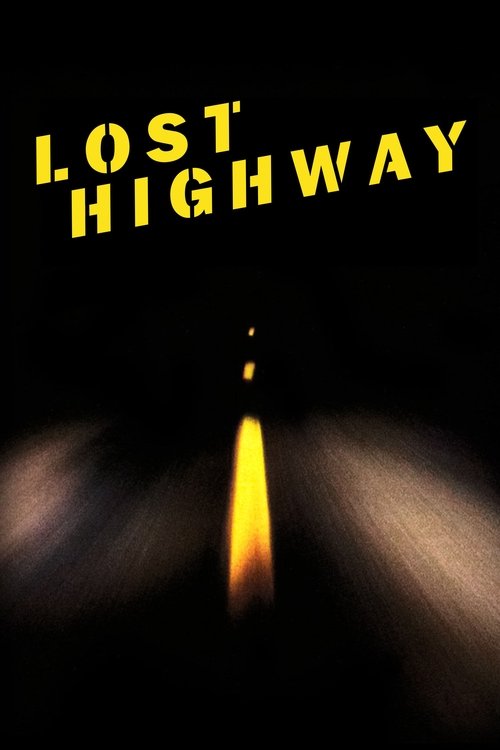
Fred Madison murdered his wife. He cannot bear what he has done. He dissociates into Pete Dayton — a younger version of himself who gets to have her alive again — and lives out the parallel life until the dissociation collapses. The Mystery Man is Fred's witness consciousness, the part of him that knows. The video tapes are the unconscious filming itself. Lynch made the most accurate film about psychogenic fugue ever attempted.
Lost Highway is the most precise film ever made about psychogenic fugue — the dissociative state in which a person who has done something they cannot integrate becomes, internally, a different person who did not do it. Lynch interviewed psychiatrists during pre-production and structured the film around the actual phenomenology of fugue. Fred Madison murders his wife Renee in a moment of jealous rage. The act is so incompatible with his self-image that he cannot retain authorship of it. The psyche performs the only remaining trick: it splits. Pete Dayton wakes up in Fred's prison cell as a younger man with a different name, a different girlfriend, a different life. Pete is what Fred would have wanted to be — virile, desired, free of the unbearable thing Fred did. The film follows Pete until Pete's life inevitably reproduces the same structure that destroyed Fred's, because the underlying psyche is the same psyche and the same wound will generate the same crime regardless of which identity is on the surface. The Mystery Man, with his white face and his video camera, is the witness consciousness that did not split — the part of Fred that knows, that filmed the murder, that delivers the verdict whenever the fugue's surface threatens to forget. Lynch is not making a puzzle to be solved. He is filming the actual structure of a mind that did something it cannot live with.
The Surface
Fred Madison, an avant-garde saxophonist in Los Angeles, lives in a modernist house with his wife Renee. He is sexually impotent. He suspects she is being unfaithful. Videotapes begin arriving on their doorstep — first showing the exterior of the house, then showing the bedroom while they sleep, finally showing Fred kneeling over Renee's mutilated body. Fred has no memory of the killing. He is arrested, convicted, and sentenced to death. In his cell, he experiences extreme distress, then transforms — physically, the actor changes — into Pete Dayton, a young auto mechanic with no apparent connection to Fred's case. The authorities release Pete, baffled. Pete returns to his life, begins an affair with a woman named Alice who is identical to Renee but blonde, becomes entangled with Alice's mobster boyfriend, attempts to rob a man with Alice, has sex with Alice in the desert, watches her walk into a cabin and leaves him with the line 'You'll never have me' — at which point Pete is replaced by Fred again. Fred drives to the Mystery Man, learns the address where Mr. Eddy is, kills Mr. Eddy, and at the end is being pursued by the police on the highway, screaming as the film cuts to a strobing white-out.
The film was Lynch's first feature after the cancellation of Twin Peaks. It was co-written with Barry Gifford. Lynch has refused, consistently, to explain it. He has said only that the film operates on dream logic and that the structure was psychogenic fugue.
Most viewers, attempting to assemble the film as a coherent timeline, fail. The film does not have a coherent timeline because the psyche it is depicting does not have a coherent timeline. Once the viewer accepts that the entire Pete Dayton section is the fugue of Fred Madison after the murder, the film snaps into terrifying clarity.
Pete as the Fugue's Solution
Pete Dayton is what the psyche generates when integration is impossible and the unbearable cannot be lived with. He is younger than Fred. He is sexually potent. He works with his hands. He is attractive to women in the direct, uncomplicated way that Fred was not. He has parents who are mildly concerned about him. He is, in every detail, the life Fred wishes he had been living instead of the life that ended in murder.
The fugue is not random. The fugue is wish-fulfillment performed by a mind in crisis. Pete is the second draft of Fred's biography, written by the part of Fred that survived the murder and that had to find somewhere to be. The prison cell is the laboratory. The actor change is Lynch's literalization of the structural change: there is no continuity of person, only continuity of psychic material that has rearranged itself into a different configuration.
The fugue cannot hold because the underlying wound has not been addressed. Pete meets Alice. Alice is Renee, again, in a slightly different costume. The same triangle reassembles itself — Alice belongs to another man, Alice is using Pete, Alice will eventually leave him. The same jealousy begins to build in Pete that built in Fred. The fugue is not solving the problem. The fugue is rerunning the conditions that produced the problem, because the conditions are interior and the interior has come with the fugue.
When Alice walks into the cabin and tells Pete 'You'll never have me,' the fugue collapses. The wish-fulfillment was that Pete, being the more virile version, would be the one who got to have her. The discovery that even Pete cannot have her is the discovery that the inability to have her was never about Fred's inadequacy. It was about Alice/Renee's autonomy. The wound is not curable by being a different person. The wound is the inability to accept what the wound is actually about. Fred re-emerges in the desert because there is no longer any psychic territory for Pete to occupy. The fugue has failed.
The Mystery Man as Witness
The Mystery Man — white-faced, formally dressed, with a handheld video camera — is one of the most genuinely uncanny figures Lynch ever put on screen. He approaches Fred at a party and tells Fred that he is, at this moment, in Fred's house. Fred calls the house. The Mystery Man answers. Fred is talking to the Mystery Man at the party while the Mystery Man is also at Fred's house. The Mystery Man laughs.
The Mystery Man is the witness consciousness — the part of the psyche that has not split, that knows what is happening across all the levels of the dissociation, that observes and records without itself being subject to the rules the surface identities have to obey. In shamanic terms, he is the part of the soul that was never fully incarnated into any of the social personas the person was building. He stays outside. He watches. He films.
His camera is the same camera that produced the videotapes that arrived on Fred's doorstep. He is the agent of those tapes. He is also, by structural implication, the agent of the film the audience is watching. The film itself is the Mystery Man's footage. The audience is being shown what the witness consciousness has been recording the entire time, edited into the form the witness considers necessary for the recording to deliver its meaning.
When Fred finds the Mystery Man at the end and asks how to find Mr. Eddy, the Mystery Man hands Fred a video camera — gives Fred, finally, the apparatus of witnessing his own actions. The murder of Mr. Eddy that follows is the only act Fred performs as a fully integrated agent. He is doing the killing knowing he is doing it. The fugue's purpose has finally been completed: not avoidance, but eventual reintegration of the original act through the agency of the witness consciousness that the fugue had previously kept separate.
The final shot is Fred on the highway, screaming, dissolving into white light. The reintegration is also annihilation. There is no whole self that can survive having done what was done. The film stops because the structure has nowhere left to go.
The Transmission
Lost Highway transmits a recognition that the mainstream of cinema almost never approaches: the mind that has done something it cannot live with does not become a different mind, does not heal, does not find an alternative life that lets it escape what it did. The mind becomes a different mind only as a temporary structural response, and the temporary structure inevitably reproduces the conditions that necessitated it.
The film is not a metaphysical puzzle to be solved. It is the precise depiction of a psychiatric condition rendered as cinema. Lynch interviewed forensic psychiatrists. He read case studies. He structured the film to match the actual phenomenology that dissociation produces from inside. The Pete Dayton section feels real because to the patient experiencing fugue, the alternate identity feels real. The collapse back into Fred is sudden because in actual cases the collapse is sudden. The denial that anything happened during the fugue is total because in actual cases the denial is total.
What the film offers the viewer is the position of the Mystery Man — the witness consciousness from which the structure can be seen. The viewer is not Fred and not Pete. The viewer is the one watching both. From this position, the underlying continuity is visible. The same wound. The same jealousy. The same triangle. The same inability to allow the woman her autonomy. The fugue did not change any of these. The fugue only redistributed the inability across two surface personalities.
Lynch's broader transmission, sustained across his career, is that the apparatus of psychic dissociation is universal — that everyone is performing some version of Pete-shielding-Fred, and that the integration the witness consciousness can offer is the only available alternative to the eventual collapse of whatever fugue the surface has been using. The viewer is asked to consider what they have made themselves into in order to not have done what they did. The viewer is asked to consider what video camera might already be filming what they refuse to know. The viewer is asked, finally, to become the Mystery Man — the part of themselves that watches without splitting, and that, at the necessary moment, hands them the camera and asks them to do the killing as the person they actually are.
Questions this film answers
What is the deeper meaning of Lost Highway?
Lost Highway is the most precise film ever made about psychogenic fugue — the dissociative state in which a person who has done something they cannot integrate becomes, internally, a different person who did not do it. Lynch interviewed psychiatrists during pre-production and structured the film around the actual phenomenology of fugue. Fred Madison murders his wife Renee in a moment of jealous rage. The act is so incompatible with his self-image that he cannot retain authorship of it. The psyche performs the only remaining trick: it splits. Pete Dayton wakes up in Fred's prison cell as a younger man with a different name, a different girlfriend, a different life. Pete is what Fred would have wanted to be — virile, desired, free of the unbearable thing Fred did. The film follows Pete until Pete's life inevitably reproduces the same structure that destroyed Fred's, because the underlying psyche is the same psyche and the same wound will generate the same crime regardless of which identity is on the surface. The Mystery Man, with his white face and his video camera, is the witness consciousness that did not split — the part of Fred that knows, that filmed the murder, that delivers the verdict whenever the fugue's surface threatens to forget. Lynch is not making a puzzle to be solved. He is filming the actual structure of a mind that did something it cannot live with.
What is the hidden symbolism in Lost Highway?
Fred Madison, an avant-garde saxophonist in Los Angeles, lives in a modernist house with his wife Renee. He is sexually impotent. He suspects she is being unfaithful. Videotapes begin arriving on their doorstep — first showing the exterior of the house, then showing the bedroom while they sleep, finally showing Fred kneeling over Renee's mutilated body. Fred has no memory of the killing. He is arrested, convicted, and sentenced to death. In his cell, he experiences extreme distress, then transforms — physically, the actor changes — into Pete Dayton, a young auto mechanic with no apparent connection to Fred's case. The authorities release Pete, baffled. Pete returns to his life, begins an affair with a woman named Alice who is identical to Renee but blonde, becomes entangled with Alice's mobster boyfriend, attempts to rob a man with Alice, has sex with Alice in the desert, watches her walk into a cabin and leaves him with the line 'You'll never have me' — at which point Pete is replaced by Fred again. Fred drives to the Mystery Man, learns the address where Mr. Eddy is, kills Mr. Eddy, and at the end is being pursued by the police on the highway, screaming as the film cuts to a strobing white-out.
What esoteric traditions appear in Lost Highway?
Lost Highway draws from Jungian, Shamanism traditions. Fred Madison murdered his wife. He cannot bear what he has done. He dissociates into Pete Dayton — a younger version of himself who gets to have her alive again — and lives out the parallel life until the dissociation collapses. The Mystery Man is Fred's witness consciousness, the part of him that knows. The video tapes are the unconscious filming itself. Lynch made the most accurate film about psychogenic fugue ever attempted.
What does Lost Highway teach about fred as the authorless crime?
The videotapes are the unconscious filming itself. The unconscious admitted the act before the conscious mind was allowed to know it occurred. The film's first section is Fred's life leading to the murder. He is impotent. His wife is sexually alive in ways that exceed his capacity to provide for or to control. He is jealous, but he cannot perform the jealousy directly — he is, on the surface, civilized, articulate, professionally accomplished. The jealousy collects in the unconscious. The unconscious begins to film itself.
What does Lost Highway teach about pete as the fugue's solution?
Pete is the second draft of Fred's biography, written by the part of Fred that survived the murder and had to find somewhere to be. Pete Dayton is what the psyche generates when integration is impossible and the unbearable cannot be lived with. He is younger than Fred. He is sexually potent. He works with his hands. He is attractive to women in the direct, uncomplicated way that Fred was not. He has parents who are mildly concerned about him. He is, in every detail, the life Fred wishes he had been living instead of the life that ended in murder.
Is Lost Highway worth watching for spiritual seekers?
Lost Highway (1997) directed by David Lynch is essential viewing for those interested in Jungian, Shadow, Lynch. The Fugue State Filmed From Inside. It rewards multiple viewings and contemplation.
Rewatch With New Eyes
Now that you've seen the architecture, experience it again. The same film becomes a different film when you know what to watch for.
This time, watch for:
- Meet the shadow: what is rejected, projected, and finally integrated
- Follow the descent: what dies, what guides, what returns transformed
Links may include affiliate partnerships that support Media Revelations