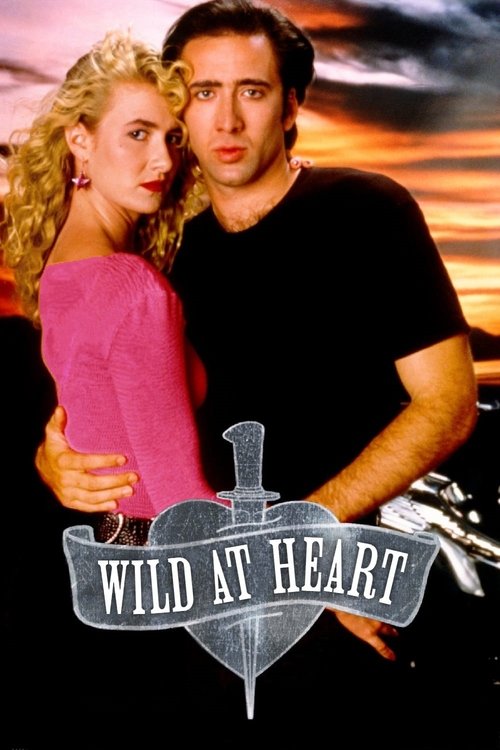
Wild at Heart
Every Road in Wild at Heart Leads Through a Demon Before It Leads Home
Directed by David Lynch
Lynch did not make a road movie. He made a fairy-tale initiation with the Wizard of Oz written directly into the bones.
David Lynch buried the architecture in plain sight. He cites The Wizard of Oz in the film's own dialogue. Glinda the Good Witch appears at the end, floating in her bubble, speaking to Sailor in the parking lot. The film contains a wicked witch, flying monkeys, a tornado, and a young woman longing to find home again. But Lynch runs the fairy tale through the initiatory tradition and the result is not camp or pastiche. What it transmits is the complete structure of descent, ordeal, and renewal, compressed into Sailor and Lula's careening flight across a burning American landscape.
Jungian: Marietta Is the Devouring Mother, and She Cannot Let the Anima Go
In Jungian terms, Lula is the anima made flesh. She is vitality, erotic truth, the feminine principle that calls the hero toward full life. Sailor is the ego-hero whose individuation depends on his capacity to hold and protect that principle against everything that would reclaim or destroy it.
The force trying to reclaim her is Marietta Fortune, Lula's mother, and she is the negative mother complex rendered as a living character. Marietta ordered Sailor framed and imprisoned. She hires Marcello Santos to have him killed. She calls in debts to drag Lula back into her orbit. This is not a jealous or controlling parent in the ordinary sense. Marietta cannot tolerate the anima escaping because she has built her entire psychological world around its possession. The scene where Marietta smears red lipstick across her face, weeping and furious after the two lovers leave, is not melodrama. It is the devouring mother unmasked: something that cannot love without consuming.
Sailor's refusal to let Lula be pulled back is the hero's essential act. His love is not possession. It is protection of what Marietta would devour.
Initiatory: Bobby Peru Is the Threshold Demon the Lovers Cannot Bypass
Every genuine initiation requires the ordeal. The hero cannot arrive at renewal by going around the darkness. The darkness must be entered and survived.
Bobby Peru is the ordeal. Willem Dafoe's performance encodes something Lynch understood: Bobby is not a realistic criminal. He moves through the film like a figure from a lower realm, appearing without warning, smelling wrong, breathing wrong, making Lula's skin crawl in a scene where he invades her personal space with methodical, demonic patience. The film gives him no origin and no explanation. He simply arrives, and his arrival is the test.
The scene where Bobby coerces Lula into saying she wants him is the moment the initiation goes wrong. Sailor has left her alone at the threshold. She is unprotected, and the demon extracts a false confession from her. The consequence is near-destruction. Sailor's subsequent collapse and imprisonment feels like the direct result of that breach. He failed to protect the anima at the critical moment, and everything unravels.
What restores them is not cleverness or violence. Sailor is beaten down, released, and finds Lula and his son waiting. The fairy godmother appears. He climbs a car roof and sings "Love Me Tender" to Lula in the dark. The lovers are renewed through the only thing that survives the ordeal: the vow they made at the beginning.
Wild at Heart runs in the same mythic territory as Blue Velvet on the descent beneath the American surface and what lives there, Lost Highway on the dream logic Lynch uses when identity fractures under guilt and desire, and Twin Peaks: The Return on evil as a genuine atmospheric presence that requires more than goodwill to survive.
Questions this film answers
What is the deeper meaning of Wild at Heart?
David Lynch buried the architecture in plain sight. He cites The Wizard of Oz in the film's own dialogue. Glinda the Good Witch appears at the end, floating in her bubble, speaking to Sailor in the parking lot. The film contains a wicked witch, flying monkeys, a tornado, and a young woman longing to find home again. But Lynch runs the fairy tale through the initiatory tradition and the result is not camp or pastiche. What it transmits is the complete structure of descent, ordeal, and renewal, compressed into Sailor and Lula's careening flight across a burning American landscape.
What is the hidden symbolism in Wild at Heart?
In Jungian terms, Lula is the anima made flesh. She is vitality, erotic truth, the feminine principle that calls the hero toward full life. Sailor is the ego-hero whose individuation depends on his capacity to hold and protect that principle against everything that would reclaim or destroy it.
What esoteric traditions appear in Wild at Heart?
Wild at Heart draws from Jungian, Initiation traditions. Lynch did not make a road movie. He made a fairy-tale initiation with the Wizard of Oz written directly into the bones.
Is Wild at Heart worth watching for spiritual seekers?
Wild at Heart (1990) directed by David Lynch is essential viewing for those interested in Jungian, Initiation. Every Road in Wild at Heart Leads Through a Demon Before It Leads Home. It rewards multiple viewings and contemplation.
Rewatch With New Eyes
Now that you've seen the architecture, experience it again. The same film becomes a different film when you know what to watch for.
This time, watch for:
- Meet the shadow: what is rejected, projected, and finally integrated
- Mark the threshold: the old self dies, the ordeal transforms, the new self returns
Links may include affiliate partnerships that support Media Revelations