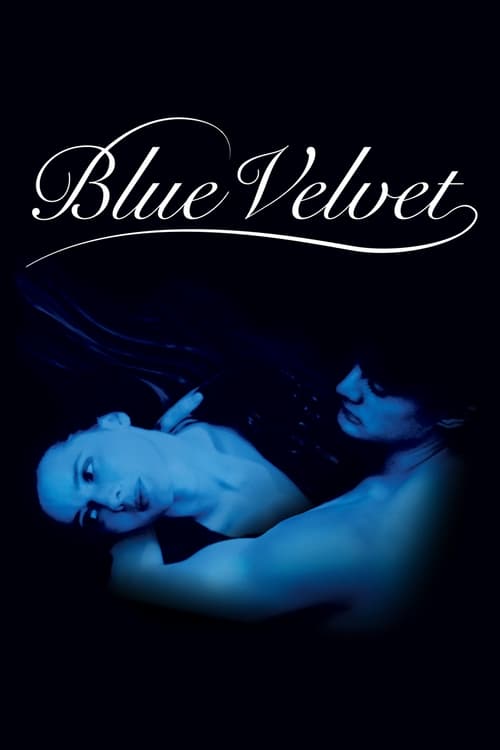
Lynch dragged the camera under the lawn. The film is a phenomenology of the American Shadow — the rotting ear in the grass is not metaphor, it is the door that should not have been opened. Jeffrey Beaumont is not investigating a crime. He is investigating his own appetite. Frank Booth is what suburban Lumberton produces and then refuses to recognize as its own son.
Blue Velvet is the most precise Jungian film ever made about the American suburb. The opening sequence is the film's whole argument compressed into three minutes: white picket fence, red roses, blue sky, friendly fireman, school children crossing — and then a man watering his lawn collapses from a stroke, the camera descends into the grass, and we find ourselves in a writhing mass of black beetles consuming each other beneath the perfect surface. The rest of the film is the elaboration of that descent. Jeffrey Beaumont finds the severed ear in the field. He follows the ear into the apartment of Dorothy Vallens. He hides in her closet and watches Frank Booth — the suburb's complete Shadow — perform a ritual of sadism so total that it cannot be denied. And the film's most disturbing recognition is not that Frank exists. It is that Jeffrey, watching from the closet, is aroused. The closet scene is the film's whole transmission. The viewer who has been watching the film from the safety of their own seat has been doing what Jeffrey is doing — looking at the Shadow material the surface conceals and discovering that the looking itself is part of the appetite. Lynch is not showing the viewer a monster. Lynch is showing the viewer their own face in the closet.
The Surface
Jeffrey Beaumont returns to his small American town of Lumberton when his father suffers a stroke. Walking through a vacant lot, he finds a severed human ear. He brings it to the police. A detective's daughter, Sandy, tells him about a singer named Dorothy Vallens who is somehow connected to the case. Jeffrey breaks into Dorothy's apartment and hides in her closet to spy on her. Frank Booth, the kidnapper of Dorothy's husband and child, arrives. Jeffrey witnesses Frank's ritualistic sexual abuse of Dorothy. He becomes entangled with Dorothy, with Sandy, and eventually in direct confrontation with Frank. He kills Frank. The film ends with the surface restored — the family reunited, the bird singing on the porch, the apparent return to normality — with the audience unable to forget what was beneath it.
Released in 1986 to deeply divided reviews, Blue Velvet was Lynch's commercial breakthrough after the failure of Dune. Pauline Kael called it the work of a sick genius. Roger Ebert dismissed it as misogynistic exploitation. Both responses, characteristically for Lynch, were missing the structural level on which the film was operating.
The film is not a thriller. The film is not exploitation. The film is a sustained psychological exposure of what the postwar American suburb was actually built on top of, who pays for the surface to be maintained, and what kinds of looking are available to a young man who decides to look.
The Beetles Under the Lawn
Jung's Shadow is the disowned material of the psyche — the sexual, aggressive, primitive, unspeakable contents that the conscious ego refuses to integrate. Disowned material does not disappear. It collects underground. The denser the surface respectability, the more energy the Shadow accumulates beneath it. A civilization that builds white picket fences with manicured roses requires, structurally, that the disowned material be processed somewhere out of sight.
Lynch's opening sequence is the cleanest visual demonstration of this principle in cinema. The camera moves through the perfect images of the postwar American dream — the friendly suburban surface — and then descends, literally, into the soil. What is under the soil is not metaphor. It is the actual content. Black beetles, writhing, eating each other. The sound design is overwhelming. This is what the suburb is built on. This is what makes the surface possible.
The severed ear that Jeffrey finds in the field is not a clue. It is an entry point. The ear is the organ of hearing. The ear in the grass is the suburb's listening apparatus, severed and abandoned, found by the young man whose curiosity has not yet been disciplined into looking away. Jeffrey picks it up. He brings it home. He puts it on a plate. The camera zooms into the ear's dark canal and we are inside the auditory channel of the suburb's unconscious. From that point forward, the film is operating inside the Shadow's territory.
The detective, the local authority, knows that Frank Booth exists and knows that processing Frank is part of what the town requires. The detective will not investigate Frank directly. Jeffrey investigates Frank directly because Jeffrey has not yet learned the adult discipline of not-looking. The investigation is Jeffrey's initiation into what every adult in the town knows and does not say.
Frank Booth as Pure Shadow
Dennis Hopper's performance as Frank Booth is one of the most committed depictions of the unintegrated Shadow ever filmed. Frank is not a villain in the conventional sense. He is a fully energized human being whose entire personality is composed of the material the suburb has refused to acknowledge as its own. He is sexual without civilization. He is violent without rationalization. He is the suburb's id walking around in a leather jacket.
Frank uses an inhaler during his sexual encounters with Dorothy. The inhaler's contents are never specified — amyl nitrite, helium, gas of some kind. The point is the regression. Frank inhales and becomes infantile. He calls Dorothy 'Mommy.' He weeps. He rages. He occupies, simultaneously, the position of brutal aggressor and the position of needy child. This is the Shadow's actual structure. The disowned material is not only the violent. It is also the infantile. It is the pre-civilized, pre-verbal, pre-formed material that the adult ego has had to seal away in order to function in society.
Frank's relationship with Dorothy is the suburb's relationship with the maternal feminine, expressed without the usual concealments. He needs her. He hates her for being needed. He punishes her for the dependency he cannot acknowledge. He calls her Mommy because the call is honest. The viewer is supposed to be shocked. The shock is the recognition that the suburb's official sentimentalization of mothers — the apple pie, the apron, the kitchen — is the same psychic structure as Frank's, with the violence sealed off and the sentimentality made acceptable for daytime television.
Lynch is not arguing that Frank should be celebrated. Lynch is arguing that Frank is what the suburb produces by refusing to acknowledge its own contents. Frank exists because the surface requires him. The Detective knows. The town's adults know. Jeffrey — newly returned, newly curious — does not yet know. The film is Jeffrey's education in what his town actually contains.
The Closet and the Watcher
The closet scene is the film's central transmission and the scene most viewers most actively avoid thinking about afterward. Jeffrey is hiding in Dorothy's closet when Frank arrives. He watches, through the slats, as Frank performs his ritualistic sexual violence. The camera repeatedly cuts back to Jeffrey's face. The face is not horrified. The face is not turning away. The face is fascinated. The face is aroused.
This is the moment the film stops being about Jeffrey investigating Frank and becomes about Jeffrey investigating Jeffrey. Frank is the open expression of material that Jeffrey contains in latent form. The watching is not surveillance. The watching is rehearsal. Jeffrey is studying what he might be capable of if the constraints were ever removed.
Later, when Jeffrey is with Dorothy himself, he discovers that he is capable of striking her. She has asked him to. He does. He is appalled at what he has done. He runs. The appalled-running is the suburb's standard response to discovering its own contents. The act has already been performed. The discovery is only that the capacity was there.
The closet is the viewer's position. The audience in the theater is watching what Jeffrey is watching. The audience is also being shown a portion of itself. Lynch is not entertaining the audience with depravity. Lynch is exposing the structure of cinematic spectatorship — the safe darkness from which we watch what we would never permit in our own lives — and showing that the safe darkness has its own appetite. The film's deepest cruelty is to the viewer who came expecting a thriller and is instead shown their own face in the slats.
The Transmission
Blue Velvet transmits the recognition that the American suburb — and by extension every modern arrangement of acceptable surface — is structurally dependent on the maintenance of Shadow material that the surface cannot acknowledge. The maintenance is performed by Franks. The watching is performed by Jeffreys. The denial is performed by everyone else. The roses are real and the beetles are real and the same lawn produces both.
Lynch is not asking the viewer to choose between the surface and the depth. He is asking the viewer to notice that the surface and the depth are continuous, that the surface requires the depth, and that the official cultural project of insisting on the surface alone has the cost of producing the depth in concentrated and increasingly dangerous form. Frank exists because the town refuses to acknowledge what the town produces. If the town acknowledged it, Frank would not need to.
The film's ending — the surface restored, the robin on the porch, Sandy and Jeffrey together as the music swells — is famously read as ironic. The reading is partial. Lynch is not mocking the restoration. He is showing it. The restoration is real. The town does restore. The next Jeffrey, in the next generation, will find the next ear in the next field. The next Frank will be processed. The surface will be maintained. The cycle will continue.
What the viewer is left with is the question Jeffrey is left with: now that you have seen what is under the lawn, what do you do with your life? Lynch's answer, sustained across his entire career, is that the seeing is the beginning of integration. The Shadow that has been seen has at least been seen. The watcher in the closet is not absolved by the seeing, but is no longer protected by the not-knowing. The robin on the porch carries a beetle in its beak in the final shot. The transmission is the beetle. The robin is the surface that is now visibly metabolizing what the surface used to insist did not exist.
Questions this film answers
What is the deeper meaning of Blue Velvet?
Blue Velvet is the most precise Jungian film ever made about the American suburb. The opening sequence is the film's whole argument compressed into three minutes: white picket fence, red roses, blue sky, friendly fireman, school children crossing — and then a man watering his lawn collapses from a stroke, the camera descends into the grass, and we find ourselves in a writhing mass of black beetles consuming each other beneath the perfect surface. The rest of the film is the elaboration of that descent. Jeffrey Beaumont finds the severed ear in the field. He follows the ear into the apartment of Dorothy Vallens. He hides in her closet and watches Frank Booth — the suburb's complete Shadow — perform a ritual of sadism so total that it cannot be denied. And the film's most disturbing recognition is not that Frank exists. It is that Jeffrey, watching from the closet, is aroused. The closet scene is the film's whole transmission. The viewer who has been watching the film from the safety of their own seat has been doing what Jeffrey is doing — looking at the Shadow material the surface conceals and discovering that the looking itself is part of the appetite. Lynch is not showing the viewer a monster. Lynch is showing the viewer their own face in the closet.
What is the hidden symbolism in Blue Velvet?
Jeffrey Beaumont returns to his small American town of Lumberton when his father suffers a stroke. Walking through a vacant lot, he finds a severed human ear. He brings it to the police. A detective's daughter, Sandy, tells him about a singer named Dorothy Vallens who is somehow connected to the case. Jeffrey breaks into Dorothy's apartment and hides in her closet to spy on her. Frank Booth, the kidnapper of Dorothy's husband and child, arrives. Jeffrey witnesses Frank's ritualistic sexual abuse of Dorothy. He becomes entangled with Dorothy, with Sandy, and eventually in direct confrontation with Frank. He kills Frank. The film ends with the surface restored — the family reunited, the bird singing on the porch, the apparent return to normality — with the audience unable to forget what was beneath it.
What esoteric traditions appear in Blue Velvet?
Blue Velvet draws from Jungian, Initiation traditions. Lynch dragged the camera under the lawn. The film is a phenomenology of the American Shadow — the rotting ear in the grass is not metaphor, it is the door that should not have been opened. Jeffrey Beaumont is not investigating a crime. He is investigating his own appetite. Frank Booth is what suburban Lumberton produces and then refuses to recognize as its own son.
What does Blue Velvet teach about the beetles under the lawn?
What is under the soil is not metaphor. It is the actual content. The surface requires the Shadow to be processed somewhere out of sight. Jung's Shadow is the disowned material of the psyche — the sexual, aggressive, primitive, unspeakable contents that the conscious ego refuses to integrate. Disowned material does not disappear. It collects underground. The denser the surface respectability, the more energy the Shadow accumulates beneath it. A civilization that builds white picket fences with manicured roses requires, structurally, that the disowned material be processed somewhere out of sight.
What does Blue Velvet teach about frank booth as pure shadow?
Frank is not a villain. He is the suburb's id walking around in a leather jacket. The town produces him by refusing to acknowledge its own contents. Dennis Hopper's performance as Frank Booth is one of the most committed depictions of the unintegrated Shadow ever filmed. Frank is not a villain in the conventional sense. He is a fully energized human being whose entire personality is composed of the material the suburb has refused to acknowledge as its own. He is sexual without civilization. He is violent without rationalization. He is the suburb's id walking around in a leather jacket.
Is Blue Velvet worth watching for spiritual seekers?
Blue Velvet (1986) directed by David Lynch is essential viewing for those interested in Jungian, Shadow, Lynch. The Door Under the Suburban Lawn. It rewards multiple viewings and contemplation.
Rewatch With New Eyes
Now that you've seen the architecture, experience it again. The same film becomes a different film when you know what to watch for.
This time, watch for:
- Meet the shadow: what is rejected, projected, and finally integrated
- Mark the threshold: the old self dies, the ordeal transforms, the new self returns
Links may include affiliate partnerships that support Media Revelations
The Descent Continues
Where this thread leads next.
Mulholland Drive 2001
The Blue Key and the Dissolution of Identity
Read the revelation →