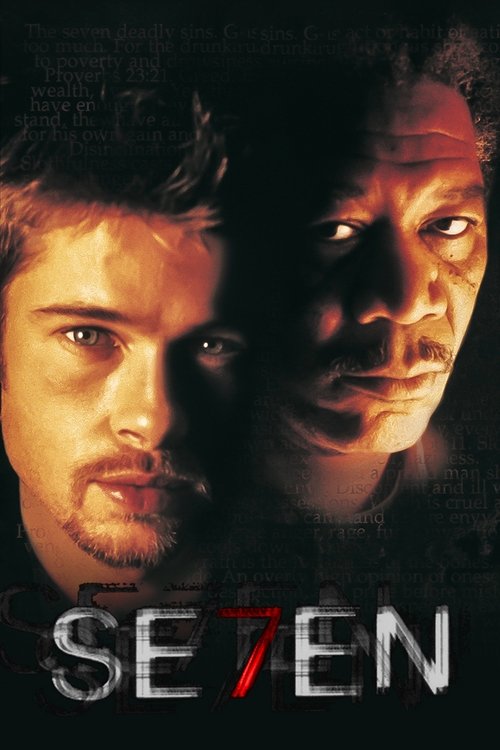
Fincher made a film whose villain is theologically literate, structurally successful, and morally indistinguishable from the medieval sermons that named the seven deadly sins in the first place. John Doe wins. The film does not soften it. The rain stops. The killer gets the response he engineered. The detective becomes the seventh sin enacted on cue. The horror is that the sermon was correct and the wrong man preached it.
Se7en is the most theologically serious mainstream American film of the 1990s, and almost nobody talks about it that way. Fincher and screenwriter Andrew Kevin Walker did not make a serial killer thriller decorated with Catholic iconography. They made a film in which a self-appointed preacher selects an unwilling congregation and delivers a sermon on the deadly sins by means of the bodies of those who exemplify them — and the sermon, terrifyingly, lands. John Doe is not a maniac. John Doe is a moralist with infrastructure. He has read Dante and Aquinas. He has chosen his examples with care. He has timed his crescendo. And he has engineered, with surgical precision, the participation of the very detectives sent to catch him, so that the final act of the sermon — wrath — must be performed by one of the men whose job was to stop the sermon from being delivered. The film's horror is not the gore. The film's horror is that the structure works. Doe has named seven actual conditions of contemporary moral life, has demonstrated each in flesh, and has produced — at the cost of his own life — a witness who will carry the recognition for the rest of his career. The film is a Gnostic indictment of the world disguised as a procedural, and the indictment is allowed to stand.
The Surface
Two detectives — Somerset, a week from retirement, and Mills, his hot-headed replacement — investigate a series of murders modeled on the seven deadly sins. The killer is methodical, well-read, and one step ahead. He turns himself in voluntarily after committing five murders. He demands the detectives drive him to a remote location, where the final two crimes will be revealed. The box arrives by truck. It contains Mills's wife's head. Doe is sloth, gluttony, greed, lust, and pride personified through his victims. Mills's wife is envy — Doe envied Mills's life. Mills, executing Doe, becomes wrath. The sermon is complete. The killer has won.
On release, the film was praised as a brilliant, bleak thriller with one of the most disturbing endings in mainstream cinema. Most discussion focuses on the box, the twist, the atmosphere — the constant rain, the unnamed city, the production design's commitment to a world already in decay.
What is rarely discussed is that the film treats the killer's framework as serious. The seven deadly sins are not a gimmick. The sins are the actual subject. Doe is a homiletic figure, badly served by the term 'serial killer.' He is something older — a wandering preacher with a body count, using murder as illustration the way medieval preachers used woodcuts and morality plays. Fincher does not endorse him. Fincher refuses to dismiss him.
Doe as Demiurge of the Sermon
John Doe — the name itself an erasure, the placeholder for the unidentified body — is not a person in the ordinary sense. He has shaved his fingerprints. He has emptied his apartment of identifying material. He has assembled, instead, a library of notebooks documenting his preparation. He has subordinated his identity to the work. The work is the sermon.
Gnostic teaching distinguishes between the wisdom that liberates and the wisdom that imprisons further. Doe possesses the second kind. He has seen through the consensus reality of the city — its gluttony, its envy, its pride — and he has correctly identified its decay. The diagnosis is accurate. He cannot stop there. He has to enact, to demonstrate, to compel the world to acknowledge what he has seen. This is the trap of the angry pneumatic: correct perception without the wisdom to know what to do with it.
The Demiurge in Gnostic teaching is a being who has confused administration for cosmos. Doe is a small Demiurge — he has built a sermon and made it a world. Inside the sermon, every event is necessary, every victim is required, every detective is a piece of his apparatus. He cannot fail because he has rigged the field. Even his death is a designed component. The Demiurge wins by ensuring no other framework can take hold once his framework has been established.
Fincher's most unsettling decision is to give Doe articulate dialogue in the car. The killer explains himself with theological precision. He is not raving. He is reasoning. The reasoning is internally consistent. The performance — Spacey, in his most disciplined work — refuses the comfort of obvious madness. We are required to take the sermon as a sermon, not a symptom.
Somerset and Mills as the Twin Responses
The detective partnership is the film's psychological structure made visible. Somerset is the disciplined Shadow — the man who has integrated his recognition of the world's evil to the point of leaving it. He is exiting the city because he can no longer pretend not to see what he sees. He reads. He thinks. He has the metronome by the bed because silence is unbearable; he needs the rhythm to hold his nervous system together.
Mills is the unintegrated ego. He is brash, eager, confident in his own decency. He has not yet been broken by his perception. He believes he can be a good cop, a good husband, a good man, and have all of these survive contact with the work. Doe sees the structure immediately. Mills is precisely the candidate Doe needs for the final illustration. A man who has not yet been compromised is the only man whose compromise can complete the sermon.
Jung wrote that the Shadow we have not integrated will be lived out, eventually, in conditions not of our choosing. Mills's wrath is not Doe's invention. Mills already had the rage. The marriage had not yet tested it. The job had not yet released it. Doe simply creates the conditions under which the rage must surface in its purest form. Doe is the Shadow practitioner who knows how to elicit Shadow material from anyone he selects. He selects Mills because Mills is selectable.
Somerset's final monologue — Hemingway: 'The world is a fine place and worth fighting for. I agree with the second part.' — is the integrated Shadow speaking. He cannot leave. The retirement is canceled. Somebody has to stay in this city, do this work, watch the rest of the sermon's aftermath. The film does not give him hope. The film gives him obligation. The two are not the same.
The City Without Sun
Fincher's city is unnamed and constantly raining. This is not a stylistic choice. This is theological commentary. The city is the world after the Gnostic recognition — the material plane stripped of the false consolations that allow most people to live in it. There is no sky. There is no weather other than rain. There is no relief. The light is always artificial. The architecture is decaying. The streets are crowded with people who do not look up because looking up reveals nothing.
Only the final sequence — the desert beyond the city, the cleared sky, the box arriving in sunlight — breaks the visual scheme. The break is calculated. The sermon's climax requires visibility. The film has to step out of its gloom for one act, so that the final crime can be seen with the clarity that demonstration requires.
This is the inversion of Christian iconography. Where Christianity moves toward light at the end — resurrection, ascension, the heavenly Jerusalem — Se7en moves into daylight only to deliver the most upsetting image of the film. The sun lights the box. The desert is the new altar. The detectives' helicopter is the witness. Doe has, with theological precision, choreographed an apotheosis in which he is the sacrificial figure and Mills is the unwilling celebrant.
The rain returning over the closing credits is the world resuming its proper weather. The brief desert sun was the exception that proved the rule. The world is back to what it was. The sermon has been delivered. The city continues.
The Transmission
Se7en transmits something most films do not dare attempt: the conviction that genuine evil can be intelligent, articulate, theologically literate, and successful. Most thrillers comfort the viewer at the end. The killer is defeated. The hero recovers. Order is restored. Se7en refuses every one of these consolations. The killer wins. The hero is destroyed. Order is exposed as the surface over the disorder that was always underneath.
What the film leaves the viewer with is the realization that the seven deadly sins were not invented by puritans to repress fun. They were named because they describe actual structures of soul-deformation that any tradition that pays attention to soul has to address. Doe is a monster, but the diagnosis he uses is older than him, more durable than him, and accurate. The film does not let the viewer pretend otherwise.
This is the gift, if it is a gift. Se7en installs a permanent suspicion of one's own complacency. The wraths, the envys, the slothful resignations that one had filed as personality become visible as moral conditions. The fact that they were named by John Doe does not make them less real. He used the names to kill. They are still the names. After this film, the seven words are no longer abstractions. They are operational categories with examples now in your head. You did not ask for them. They will not leave.
Questions this film answers
What is the deeper meaning of Se7en?
Se7en is the most theologically serious mainstream American film of the 1990s, and almost nobody talks about it that way. Fincher and screenwriter Andrew Kevin Walker did not make a serial killer thriller decorated with Catholic iconography. They made a film in which a self-appointed preacher selects an unwilling congregation and delivers a sermon on the deadly sins by means of the bodies of those who exemplify them — and the sermon, terrifyingly, lands. John Doe is not a maniac. John Doe is a moralist with infrastructure. He has read Dante and Aquinas. He has chosen his examples with care. He has timed his crescendo. And he has engineered, with surgical precision, the participation of the very detectives sent to catch him, so that the final act of the sermon — wrath — must be performed by one of the men whose job was to stop the sermon from being delivered. The film's horror is not the gore. The film's horror is that the structure works. Doe has named seven actual conditions of contemporary moral life, has demonstrated each in flesh, and has produced — at the cost of his own life — a witness who will carry the recognition for the rest of his career. The film is a Gnostic indictment of the world disguised as a procedural, and the indictment is allowed to stand.
What is the hidden symbolism in Se7en?
Two detectives — Somerset, a week from retirement, and Mills, his hot-headed replacement — investigate a series of murders modeled on the seven deadly sins. The killer is methodical, well-read, and one step ahead. He turns himself in voluntarily after committing five murders. He demands the detectives drive him to a remote location, where the final two crimes will be revealed. The box arrives by truck. It contains Mills's wife's head. Doe is sloth, gluttony, greed, lust, and pride personified through his victims. Mills's wife is envy — Doe envied Mills's life. Mills, executing Doe, becomes wrath. The sermon is complete. The killer has won.
What esoteric traditions appear in Se7en?
Se7en draws from Gnosticism, Jungian traditions. Fincher made a film whose villain is theologically literate, structurally successful, and morally indistinguishable from the medieval sermons that named the seven deadly sins in the first place. John Doe wins. The film does not soften it. The rain stops. The killer gets the response he engineered. The detective becomes the seventh sin enacted on cue. The horror is that the sermon was correct and the wrong man preached it.
Is Se7en worth watching for spiritual seekers?
Se7en (1995) directed by David Fincher is essential viewing for those interested in Gnosticism, Shadow, Fincher. The Sermon Delivered by the Wrong Preacher. It rewards multiple viewings and contemplation.
Rewatch With New Eyes
Now that you've seen the architecture, experience it again. The same film becomes a different film when you know what to watch for.
This time, watch for:
- Watch for the false world vs. the real — who is asleep, who awakens
- Meet the shadow: what is rejected, projected, and finally integrated
Links may include affiliate partnerships that support Media Revelations
The Descent Continues
Where this thread leads next.
Fight Club 1999
The Shadow Made Flesh and the Alchemy of Self-Destruction
Read the revelation →