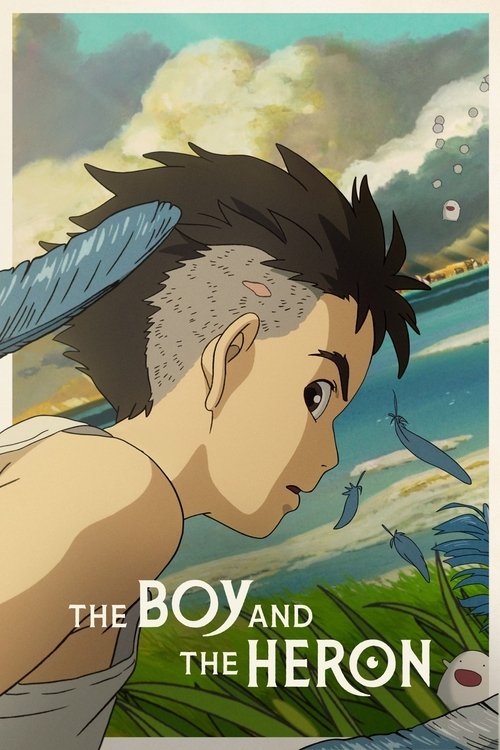
The Boy and the Heron
The Boy and the Heron Is Miyazaki Handing His World to a Boy Who Refuses to Rule It
Directed by Hayao Miyazaki
The final Miyazaki film is a great magus offering his creation to an heir, and the whole meaning turns on the boy saying no.
Mahito's mother burned to death in a wartime hospital fire. He is moved to the country, to a stepmother who is his mother's sister and already pregnant, into a house where grief has nowhere to go. A grey heron begins taunting him, then leads him through a sealed tower into an underworld built by his granduncle, a man who withdrew from the world to maintain a private cosmos balanced on floating stones. That underworld is the alchemical vessel, and the granduncle is unmistakably Miyazaki himself: a maker sustaining a fragile universe by stacking blocks in perfect equilibrium, exhausted, looking for someone to inherit the labor. The film is the master's last question to his successor and to us. Will you take this world, with all its malice and beauty, and try to keep it balanced? Mahito's answer is the point of everything.
Alchemical Reading: The Tower as Vessel, the Wound as Prima Materia
The tower is a sealed alembic, a whole world cooking inside a container cut off from ordinary time. Alchemy begins with the nigredo, the blackening, the confrontation with death and putrefaction, and Mahito arrives already in it: his mother's death is his prima materia, the base matter that the work must transform. The underworld is populated with the imagery of that first stage, the wawa souls waiting to be born, the pelicans starving because there is not enough life to go around, the parakeets who have become a devouring army. This is the raw psychic material heated in the vessel.
The granduncle offers Mahito thirteen untainted building blocks and asks him to stack them, to become the new keeper of a world without malice. And here the alchemy turns on a single confession. Mahito touches the scar on his own head, a wound he gave himself with a rock to manipulate the adults around him, and says he cannot build a pure world because he is not free of malice. That is the true philosopher's stone of the film. The completed work is not a spotless cosmos. It is the honest acknowledgment of one's own darkness. Mahito refuses the sterile perfection and chooses the flawed real world, and in alchemy that choice, integration rather than purification, is the gold.
Initiatory Reading: The Descent to Retrieve the Mother and Return Without Her
Every deep initiation is a katabasis, a descent into the land of the dead to recover something and a return transformed by the fact that you cannot bring it fully back. Mahito goes underground literally to find his mother. He meets her as Himi, a girl who commands fire, his mother young and alive before the fire that will one day kill her. The initiatory devastation is total and precise. Himi knows she will grow up to bear Mahito and to die in flames, and she chooses that future anyway, telling him that having him is worth the fire.
This is the secret initiation delivers and sentiment refuses: you descend to undo the loss and instead you receive the loss consciously, chosen, understood. Mahito returns to the surface having lost his mother a second time, but now as a completed grief rather than an open wound. He carries out one small stone from the tower, a fragment of the collapsed world, and re-enters ordinary life ready to live in it. The tower crumbles behind him because the initiate does not stay in the underworld. He brings the changed self back into the war-torn, imperfect world and agrees to live there.
Questions this film answers
What is the deeper meaning of The Boy and the Heron?
Mahito's mother burned to death in a wartime hospital fire. He is moved to the country, to a stepmother who is his mother's sister and already pregnant, into a house where grief has nowhere to go. A grey heron begins taunting him, then leads him through a sealed tower into an underworld built by his granduncle, a man who withdrew from the world to maintain a private cosmos balanced on floating stones. That underworld is the alchemical vessel, and the granduncle is unmistakably Miyazaki himself: a maker sustaining a fragile universe by stacking blocks in perfect equilibrium, exhausted, looking for someone to inherit the labor. The film is the master's last question to his successor and to us. Will you take this world, with all its malice and beauty, and try to keep it balanced? Mahito's answer is the point of everything.
What is the hidden symbolism in The Boy and the Heron?
The tower is a sealed alembic, a whole world cooking inside a container cut off from ordinary time. Alchemy begins with the nigredo, the blackening, the confrontation with death and putrefaction, and Mahito arrives already in it: his mother's death is his prima materia, the base matter that the work must transform. The underworld is populated with the imagery of that first stage, the wawa souls waiting to be born, the pelicans starving because there is not enough life to go around, the parakeets who have become a devouring army. This is the raw psychic material heated in the vessel.
What esoteric traditions appear in The Boy and the Heron?
The Boy and the Heron draws from Alchemy, Initiation traditions. The final Miyazaki film is a great magus offering his creation to an heir, and the whole meaning turns on the boy saying no.
Is The Boy and the Heron worth watching for spiritual seekers?
The Boy and the Heron (2023) directed by Hayao Miyazaki is essential viewing for those interested in Alchemy, Initiation. The Boy and the Heron Is Miyazaki Handing His World to a Boy Who Refuses to Rule It. It rewards multiple viewings and contemplation.
Rewatch With New Eyes
Now that you've seen the architecture, experience it again. The same film becomes a different film when you know what to watch for.
This time, watch for:
- Track the stages: blackening, whitening, reddening — death before rebirth
- Mark the threshold: the old self dies, the ordeal transforms, the new self returns
Links may include affiliate partnerships that support Media Revelations
The Descent Continues
Where this thread leads next.
Spirited Away 2001
The Shamanic Descent of the Child Soul
Read the revelation →