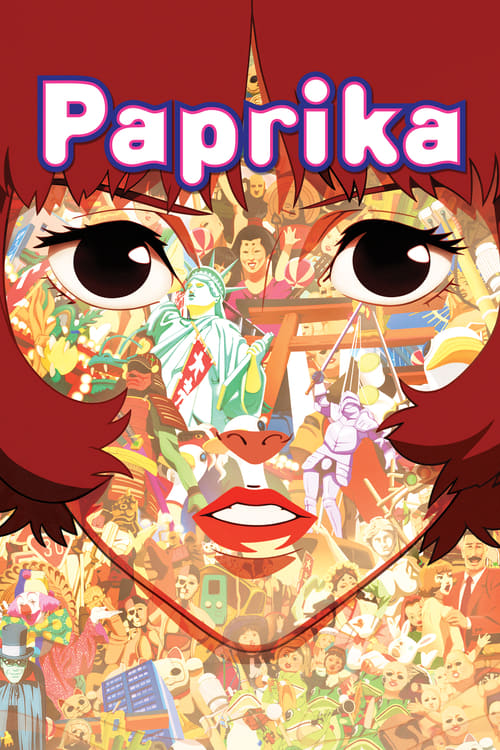
When the collective unconscious breaks containment, dreams flood waking life. Paprika is the shadow-therapist — free where Dr. Chiba is constrained. Kon understood: we're not individuals dreaming alone. We're one dream pretending to be many.
Paprika is Satoshi Kon's final completed film and his most direct cosmological claim: we are not separate dreamers having parallel private dreams. We are one dream pretending to be many. The DC Mini is a technological device for what humans have always done unconsciously — share dream content across the species. When dreams flood waking life, the boundary that ordinary consciousness defends is revealed to have been a polite agreement, not a wall. The parade is everyone's repressed material in unified procession. Kon was diagnosing the internet age before it had quite arrived.
The Surface
A new technology, the DC Mini, allows therapists to enter their patients' dreams. The devices are stolen. The boundary between dreams and waking life dissolves. A parade of inanimate objects, fairy tales, and cultural detritus marches through Tokyo. Dr. Atsuko Chiba and her alter ego Paprika must stop it before reality is lost.
Read as plot, Paprika is a busy thriller with elaborate set pieces. Read as Kon intended — and his interviews make this explicit — it is a treatise on dreams as shared rather than individual phenomena, told through animation precisely because animation can render what live-action cannot: the smooth dissolve of one image into another that bears no logical connection.
Every Satoshi Kon film is about the porousness of identity. Perfect Blue did it through media. Millennium Actress did it through memory. Paprika does it through dreams. This is the most ambitious of the three because dreams are the substrate of the other two.
Paprika as Liberated Shadow
Dr. Atsuko Chiba is composed, professional, emotionally restrained. Paprika is mischievous, playful, sexually free, and impossible to constrain. They are the same person and not the same person at all.
This is the relationship between persona and Shadow in its rarest configuration: a Shadow that is not destructive but liberatory. Chiba has built a successful life by suppressing everything that became Paprika. Paprika lives in dream-space because dream-space is the only place where Chiba's full self can move freely.
Most films treat the Shadow as the dark double who must be defeated or integrated through painful confrontation. Kon's claim is different and harder. The Shadow can be brilliant. The Shadow can be the part of you that knows how to act, how to flirt, how to take risks, how to delight in being. The person you are during the day may be a heavily edited subset of who you are in dreams.
When the dream world floods reality, Chiba does not have to defeat Paprika. She has to recognize that Paprika is not separate from her. The final sequence is them merging — not Chiba absorbing Paprika back into the unconscious but their boundary dissolving entirely.
The Collective Dream
Kon's claim about dreams is not that they belong to individuals. The DC Mini technology only externalizes what is already true: dreams interpenetrate. The parade that floods Tokyo is composed of dream content from many people simultaneously — kitchen appliances, schoolgirls, frogs in tuxedos, dolls with faces — and it is one parade. Many sources. One procession.
This is the Buddhist insight that the boundary between minds is a convention, not a metaphysical truth. The substrate of consciousness is shared. What appears as my private interior is one local instance of a continuous medium that runs through all sentient beings.
Kon makes the case visually. Characters share dreams without intending to. They appear in each other's reveries. The villain's plan is not theft of a private object — it is the hijacking of a shared field. He uses the DC Mini to amplify his own dream-content until it overwrites everyone else's. This is what tyrants have always tried to do. The DC Mini just makes the mechanism visible.
The film aired three years before Twitter existed. Watch the parade sequence now. It is the timeline.
Cinema as Dream Engineering
Kon shoots the film like a dream because animation lets him. A character closes a door in one scene and opens it into a different scene. An object becomes a different object mid-frame. Match cuts that would be impossible to construct in live-action are routine here.
He understood that cinema is dream technology. The film theater is a controlled dream chamber: dark room, large field of vision, surround sound, a contained image that holds attention. We have always known how to enter shared dream states. We just call it 'going to the movies.'
Paprika is making the technology of itself visible. The villain's plan is essentially to broadcast a dream into other people's heads. The film is a dream being broadcast into your head. The metaphor and the medium are the same gesture.
Kon is openly acknowledging what filmmakers usually hide. The character of Paprika even works inside a movie theater within the film — she enters genres, hops between cinematic worlds, treats film history as a single shared dreamscape. This is not whimsy. This is the cosmology of the medium stated plainly.
The Transmission
Watching Paprika is closer to dreaming than to watching most films. The pace is wrong for thrillers. The transitions are wrong for narrative. The emotional logic is wrong for character study. Everything is operating on dream-rules: associative, image-driven, refusing to settle.
What the film transmits is the suspicion that your dreams have been doing more than you thought. That the boundary between your dream-life and waking-life is permeable in directions you have not been taught to perceive. That the things you assume are your private interior may already be public, and the things you assume are public may be specific dreams that someone is actively broadcasting.
Kon died at 46, before he could complete his next film. The closing shot of Paprika is Paprika entering a movie theater to watch a film called 'Dreaming Kids.' She buys a ticket. She walks in. The credits roll. He was telling us where to find him.
Questions this film answers
What is the deeper meaning of Paprika?
Paprika is Satoshi Kon's final completed film and his most direct cosmological claim: we are not separate dreamers having parallel private dreams. We are one dream pretending to be many. The DC Mini is a technological device for what humans have always done unconsciously — share dream content across the species. When dreams flood waking life, the boundary that ordinary consciousness defends is revealed to have been a polite agreement, not a wall. The parade is everyone's repressed material in unified procession. Kon was diagnosing the internet age before it had quite arrived.
What is the hidden symbolism in Paprika?
A new technology, the DC Mini, allows therapists to enter their patients' dreams. The devices are stolen. The boundary between dreams and waking life dissolves. A parade of inanimate objects, fairy tales, and cultural detritus marches through Tokyo. Dr. Atsuko Chiba and her alter ego Paprika must stop it before reality is lost.
What esoteric traditions appear in Paprika?
Paprika draws from Jungian, Buddhism traditions. When the collective unconscious breaks containment, dreams flood waking life. Paprika is the shadow-therapist — free where Dr. Chiba is constrained. Kon understood: we're not individuals dreaming alone. We're one dream pretending to be many.
What does Paprika teach about paprika as liberated shadow?
The person you are during the day may be a heavily edited subset of who you are in dreams. Dr. Atsuko Chiba is composed, professional, emotionally restrained. Paprika is mischievous, playful, sexually free, and impossible to constrain. They are the same person and not the same person at all.
What does Paprika teach about the collective dream?
The substrate of consciousness is shared. What appears as my private interior is one local instance of a continuous medium. Kon's claim about dreams is not that they belong to individuals. The DC Mini technology only externalizes what is already true: dreams interpenetrate. The parade that floods Tokyo is composed of dream content from many people simultaneously — kitchen appliances, schoolgirls, frogs in tuxedos, dolls with faces — and it is one parade. Many sources. One procession.
Is Paprika worth watching for spiritual seekers?
Paprika (2006) directed by Satoshi Kon is essential viewing for those interested in Dreams, Collective Unconscious, Kon. The Dream That Escapes Its Dreamer. It rewards multiple viewings and contemplation.
Rewatch With New Eyes
Now that you've seen the architecture, experience it again. The same film becomes a different film when you know what to watch for.
This time, watch for:
- Meet the shadow: what is rejected, projected, and finally integrated
- See impermanence: what clings, what releases, what remains
Links may include affiliate partnerships that support Media Revelations
The Descent Continues
Where this thread leads next.

Perfect Blue 1997
The First Horror Film About What Social Media Does to Identity
Read the revelation →