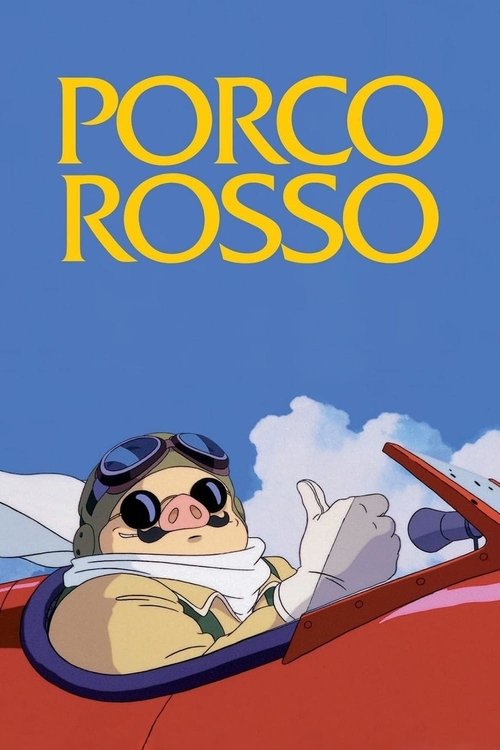
Porco Rosso
Porco Rosso Cursed Himself Into the Only Honest Body Left in Italy
Directed by Hayao Miyazaki
A man flies alone over the Adriatic in 1929, wearing the face of a pig. He put it there himself.
Marco Pagot survived the First World War, watched every man he flew with die, and came home to a country falling in love with fascism. The human face had become the uniform of a civilization racing toward catastrophe. He looked at what being a man meant in that world, the salutes, the chest-out pride, the hunger for empire, and he refused it. The curse of the pig's face is not punishment handed down. Marco chose it. The film's deepest revelation is that the ugliness is the integrity, and the transformation back into a man requires him to decide whether the world is worth rejoining.
The Shamanic Reading: The Animal Body as Voluntary Exile
In shamanic traditions across cultures, the practitioner crosses into the animal realm by choice, taking on an animal form to move between worlds that ordinary humans cannot travel. The animal body is not degradation, it is the costume of someone who has seen too much to pretend the social mask still fits.
Marco did not have a spell cast on him. He stepped out of his burning formation, watched his squadron ghost away into the clouds, and chose not to return to the world that had sent them there. The scene where he describes the battle to Fio, sky turned white, dead pilots rising in a long pale stream toward a luminous corridor overhead, is a vision. He saw the threshold, and he decided to live on its near side. The pig face is the mark of the threshold-crosser: present in the human world, operating in it, doing business and drinking wine, but no longer of it. Shamans who return from that kind of crossing are never entirely back. Marco is not hiding. He is accurately reporting where he stands.
The Jungian Reading: Shadow Worn as Face
Carl Jung identified the Shadow as the sum of everything the ego refuses to be. Most people spend their lives projecting it outward, seeing in others what they cannot acknowledge in themselves. The entire machinery of fascism in the 1930s was a Shadow projection on a civilizational scale, the ugly, the bestial, the weak, all assigned to an enemy while the projector stood upright and uniformed and proud.
Marco wears his Shadow as his face. He does not project the animal outward onto an inferior race or a scapegoated enemy. He takes the pig, the glutton, the wallowing beast, the thing civilization uses to mean low and degraded, and he puts it on himself, in public, and flies his red seaplane across the Adriatic doing exactly what he thinks is right. This is individuation taken to a structural extreme. By the film's end, when Gina glimpses his human face and the audience is denied that image, Miyazaki makes the point cleanly: the transformation was never about the face. A man who knows who he is does not need a mirror.
Also in the Miyazaki transformation arc: Howl's Moving Castle, Spirited Away, The Wind Rises.
Questions this film answers
What is the deeper meaning of Porco Rosso?
Marco Pagot survived the First World War, watched every man he flew with die, and came home to a country falling in love with fascism. The human face had become the uniform of a civilization racing toward catastrophe. He looked at what being a man meant in that world, the salutes, the chest-out pride, the hunger for empire, and he refused it. The curse of the pig's face is not punishment handed down. Marco chose it. The film's deepest revelation is that the ugliness is the integrity, and the transformation back into a man requires him to decide whether the world is worth rejoining.
What is the hidden symbolism in Porco Rosso?
In shamanic traditions across cultures, the practitioner crosses into the animal realm by choice, taking on an animal form to move between worlds that ordinary humans cannot travel. The animal body is not degradation, it is the costume of someone who has seen too much to pretend the social mask still fits.
What esoteric traditions appear in Porco Rosso?
Porco Rosso draws from Shamanism, Jungian traditions. A man flies alone over the Adriatic in 1929, wearing the face of a pig. He put it there himself.
Is Porco Rosso worth watching for spiritual seekers?
Porco Rosso (1992) directed by Hayao Miyazaki is essential viewing for those interested in Shamanism, Jungian. Porco Rosso Cursed Himself Into the Only Honest Body Left in Italy. It rewards multiple viewings and contemplation.
Rewatch With New Eyes
Now that you've seen the architecture, experience it again. The same film becomes a different film when you know what to watch for.
This time, watch for:
- Follow the descent: what dies, what guides, what returns transformed
- Meet the shadow: what is rejected, projected, and finally integrated
Links may include affiliate partnerships that support Media Revelations