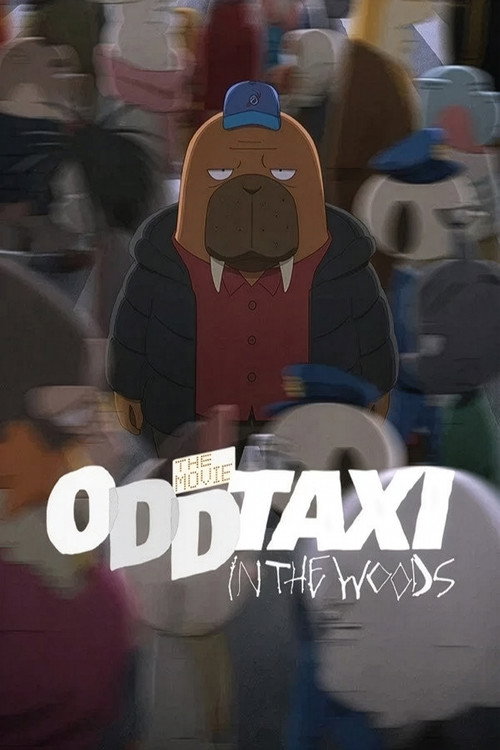
ODDTAXI in the Woods
Everyone Is an Animal Because He Cannot Bear Their Human Faces
Directed by Baku Kinoshita
You spend the whole story trusting the walrus. The reconstruction makes you sit again with the reason he is a walrus, and it is not whimsy.
Odokawa is a middle-aged taxi driver in a Tokyo where everyone is an animal. He is a walrus. His doctor is a monkey, the yakuza a lizard, the idol a cat. He is dry, decent, insomniac, and pulled into the disappearance of a schoolgirl through nothing but the fares who climb into his cab and talk. ODDTAXI in the Woods recompiles the series into a single seeing and adds a coda, which means it foregrounds the thing the show hid in plain sight until its final act: the animals were never a stylistic choice about the world, but a symptom in one man's head. Odokawa has a condition that renders every human face as an animal, including his own. The one moment we glimpse people as they physically are, the effect is a small earthquake, because it means the entire warm, funny, animal city we have been watching was a nervous system's mistranslation of faces it could not process. The mystery is not who took the girl. The mystery is what a man does when he cannot see anyone, himself included, as human.
Gnostic Reading: The Whole Perceived World Is a Veil Over the Real
Gnostic cosmology begins with a claim most people find unbearable: the world you perceive is not the world. A screen sits between the seer and the real, and almost no one knows the screen is there. Odokawa is that claim made flesh. He walks through a city that does not exist as he sees it. Every being he meets is dressed by his own faculty in a form that is not theirs. He is not deceived by a liar. He is deceived by the apparatus of perception itself, which is the more radical Gnostic point.
The film's coda withholds easy release from the veil. Even shown the human faces, Odokawa does not simply "wake up" into corrected sight; the walrus is how he must go on living. This is the Gnostic tragedy in its exact form. Knowing the world is a veil does not lift the veil. It only ends your innocence about wearing one. He becomes a man who knows he cannot see, which is a lonelier state than blindness that does not know its name.
Jungian Reading: The Animal Is the Face the Psyche Can Survive Looking At
Jung held that the psyche protects itself by symbolizing what it cannot yet meet directly. The unbearable is not deleted. It is costumed. Odokawa's animal-vision is a defense drawn with clinical accuracy: the human, with all its threat and intimacy and demand, arrives to him softened into creature, near enough to relate to, far enough not to wound.
Notice which animal he assigns himself. The walrus is heavy, solitary, armored in blubber, faintly comic and deeply sad, a thing built to sit alone in cold water. That is his self-image returned to him by his own symbolizing mind, a self-portrait he did not consciously paint. The story's warmth, its patience with lonely people who talk too much in the back of cabs, comes from this: the whole zoo is a wounded man's attempt to make the human race approachable enough to keep driving through. When the human faces finally surface, we understand the animals were never the problem. They were the mercy.
Questions this film answers
What is the deeper meaning of ODDTAXI in the Woods?
Odokawa is a middle-aged taxi driver in a Tokyo where everyone is an animal. He is a walrus. His doctor is a monkey, the yakuza a lizard, the idol a cat. He is dry, decent, insomniac, and pulled into the disappearance of a schoolgirl through nothing but the fares who climb into his cab and talk. ODDTAXI in the Woods recompiles the series into a single seeing and adds a coda, which means it foregrounds the thing the show hid in plain sight until its final act: the animals were never a stylistic choice about the world, but a symptom in one man's head. Odokawa has a condition that renders every human face as an animal, including his own. The one moment we glimpse people as they physically are, the effect is a small earthquake, because it means the entire warm, funny, animal city we have been watching was a nervous system's mistranslation of faces it could not process. The mystery is not who took the girl. The mystery is what a man does when he cannot see anyone, himself included, as human.
What is the hidden symbolism in ODDTAXI in the Woods?
Gnostic cosmology begins with a claim most people find unbearable: the world you perceive is not the world. A screen sits between the seer and the real, and almost no one knows the screen is there. Odokawa is that claim made flesh. He walks through a city that does not exist as he sees it. Every being he meets is dressed by his own faculty in a form that is not theirs. He is not deceived by a liar. He is deceived by the apparatus of perception itself, which is the more radical Gnostic point.
What esoteric traditions appear in ODDTAXI in the Woods?
ODDTAXI in the Woods draws from Gnosticism, Jungian traditions. You spend the whole story trusting the walrus. The reconstruction makes you sit again with the reason he is a walrus, and it is not whimsy.
Is ODDTAXI in the Woods worth watching for spiritual seekers?
ODDTAXI in the Woods (2022) directed by Baku Kinoshita is essential viewing for those interested in Gnosticism, Jungian. Everyone Is an Animal Because He Cannot Bear Their Human Faces. It rewards multiple viewings and contemplation.
Rewatch With New Eyes
Now that you've seen the architecture, experience it again. The same film becomes a different film when you know what to watch for.
This time, watch for:
- Watch for the false world vs. the real — who is asleep, who awakens
- Meet the shadow: what is rejected, projected, and finally integrated
Links may include affiliate partnerships that support Media Revelations
The Descent Continues
Where this thread leads next.
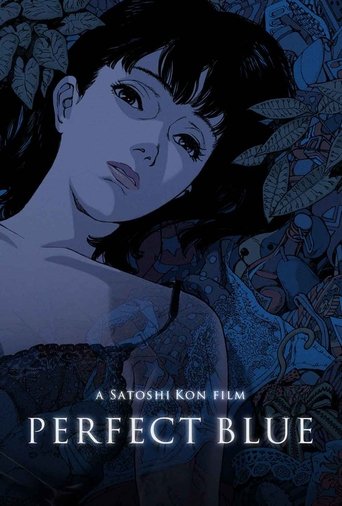
Perfect Blue 1997
The First Horror Film About What Social Media Does to Identity
Read the revelation →