Tokyo Godfathers
Tokyo Godfathers Is a Nativity Where the Three Wise Men Are the Ones Being Reborn
Directed by Satoshi Kon
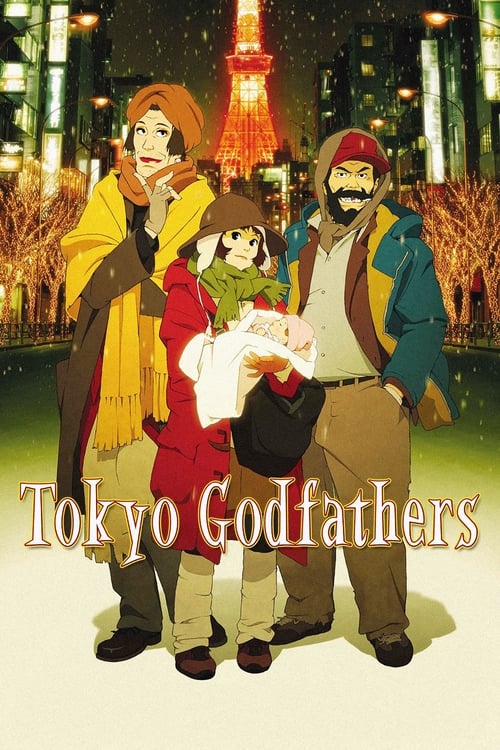
Satoshi Kon put a baby in the garbage and let three discarded people carry it. The child was never the one who needed saving.
On Christmas Eve, Gin the alcoholic, Hana the trans woman who dreamed of motherhood, and Miyuki the runaway teenager pull an abandoned infant from a mountain of Tokyo trash. The surface reading is a heartwarming holiday story about the homeless returning a lost baby to its parents. What Kon actually built is a machine of coincidences so relentless they stop being coincidences and become law. Every person the trio needs appears exactly when needed. A gust of wind delivers a critical document. A man they save turns out to hold the next thread. The film calls this luck. It is not luck. It is a search for the parents of a baby that becomes a search for the abandoned self inside each of the three carriers, and the infant, named Kiyoko, "pure child," is the pretext the universe uses to drag three people back toward the families they fled.
Initiatory Reading: Three Descents Into the Buried Wound
Every initiation requires the confrontation with what was abandoned. Kon gives each of his three godfathers a personal underworld and sends them down.
Gin has told his companions he was a champion cyclist who lost everything to debt. Late in the film, under a bridge, the lie collapses: he was a bicycle-shop owner who gambled his family into ruin and ran from a daughter he could not face. The baby forces the descent. To return Kiyoko, Gin must approach the exact wound he built his homelessness to avoid, the daughter Kiyoko has been standing in for the entire time. Hana's initiation is different in shape and identical in function. When she cradles the baby and insists she was meant to be a mother, she is not delusional. She is stating the thing her body and the world agreed she could not have, and the film makes her hold a real infant until the wanting becomes unbearable and then real. Miyuki ran from her father, a policeman, after stabbing him in a fight. Her descent is the walk back toward the door she slammed. The baby is the guardian of the threshold that each of them must pass to reach the family they buried. Kon disguises the oldest initiatory structure as a Christmas comedy, and it works because nobody expects the sacred to smell like the inside of a dumpster.
Kabbalistic Reading: The Shekhinah in the Trash Heap
In Kabbalah, the Shekhinah is the divine presence in exile, the feminine indwelling of God that fell into the lowest world and waits in the broken places to be raised. She is not found in temples. She is found in the sparks buried in the most degraded matter, and the work of the righteous is to lift those sparks home.
Kiyoko is a spark in exile, literally placed in the refuse of the wealthiest city on earth. The three who find her are themselves in exile, cast out of the social order, sleeping in its margins. The rescue runs in both directions at once. As they carry the divine child up out of the trash, the child carries them up out of their own exile. The climax, Hana leaping to catch the falling baby and being borne gently to the ground as though the air itself decided to hold them, is the moment the sparks are gathered. The lowest world reaches the highest. The exile ends for everyone in the frame.
Questions this film answers
What is the deeper meaning of Tokyo Godfathers?
On Christmas Eve, Gin the alcoholic, Hana the trans woman who dreamed of motherhood, and Miyuki the runaway teenager pull an abandoned infant from a mountain of Tokyo trash. The surface reading is a heartwarming holiday story about the homeless returning a lost baby to its parents. What Kon actually built is a machine of coincidences so relentless they stop being coincidences and become law. Every person the trio needs appears exactly when needed. A gust of wind delivers a critical document. A man they save turns out to hold the next thread. The film calls this luck. It is not luck. It is a search for the parents of a baby that becomes a search for the abandoned self inside each of the three carriers, and the infant, named Kiyoko, "pure child," is the pretext the universe uses to drag three people back toward the families they fled.
What is the hidden symbolism in Tokyo Godfathers?
Every initiation requires the confrontation with what was abandoned. Kon gives each of his three godfathers a personal underworld and sends them down.
What esoteric traditions appear in Tokyo Godfathers?
Tokyo Godfathers draws from Initiation, Kabbalah traditions. Satoshi Kon put a baby in the garbage and let three discarded people carry it. The child was never the one who needed saving.
Is Tokyo Godfathers worth watching for spiritual seekers?
Tokyo Godfathers (2003) directed by Satoshi Kon is essential viewing for those interested in Initiation, Kabbalah. Tokyo Godfathers Is a Nativity Where the Three Wise Men Are the Ones Being Reborn. It rewards multiple viewings and contemplation.
Rewatch With New Eyes
Now that you've seen the architecture, experience it again. The same film becomes a different film when you know what to watch for.
This time, watch for:
- Mark the threshold: the old self dies, the ordeal transforms, the new self returns
- Notice the vessels: what contains, what shatters, what repairs
Links may include affiliate partnerships that support Media Revelations
The Descent Continues
Where this thread leads next.

Perfect Blue 1997
The First Horror Film About What Social Media Does to Identity
Read the revelation →